
Online

If you are an architect who has a qualification from overseas and wish to become a registered architect or Skilled Migration in Australia, you may need to submit an Overseas Qualification Assessment (OQA) to the Architects Accreditation Council of Australia (AACA).
The AACA Overseas Qualification Assessment is a process of determining the comparability of an overseas architectural qualification to a current Australian accredited architecture qualification. The assessment also takes into account that the applicants have the ability to demonstrate the required competencies in accordance with the 2021 National Standard of Competency for Architects (NSCA).
CDRWriters offers professional support with preparing your documentation for your OQA, such as project summaries, preparing a portfolio, NSCA competency statements, and supporting documents.

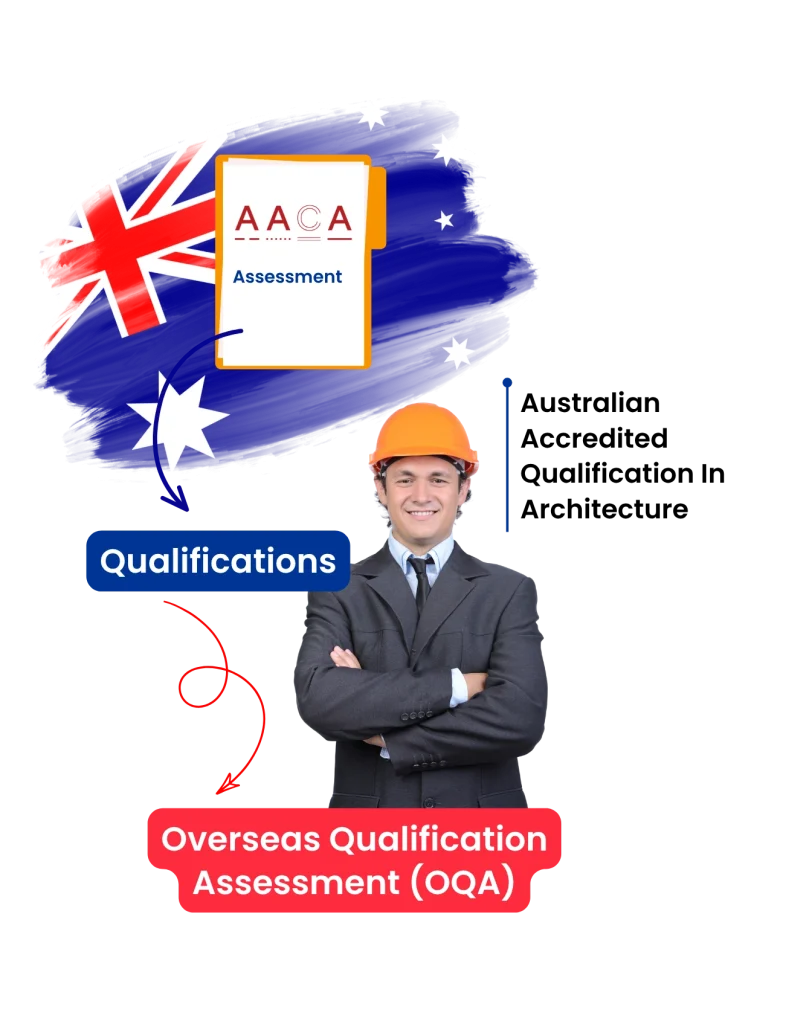
The Overseas Qualification Assessment (OQA) is an assessment process administered by the Architects Accreditation Council of Australia (AACA) to assess the qualifications of eligible applicants for architectural qualifications who have acquired them overseas.
The assessment’s aim is to decide if an overseas academic qualification is equivalent to an existing Australian accredited qualification in architecture.
AACA evaluates qualifications from overseas on a case-by-case basis. The assessment will take into account the education system in which the qualification is acquired, the status of the awarding institution, the length and organisation of the course, individual subjects and the grading system.
If successful, an OQA result may help someone advance towards architect registration in Australia for eligible applicants. This successful outcome could also be used for a Skilled Migration Assessment for the occupation of Architect, if requested and the relevant requirements are met.
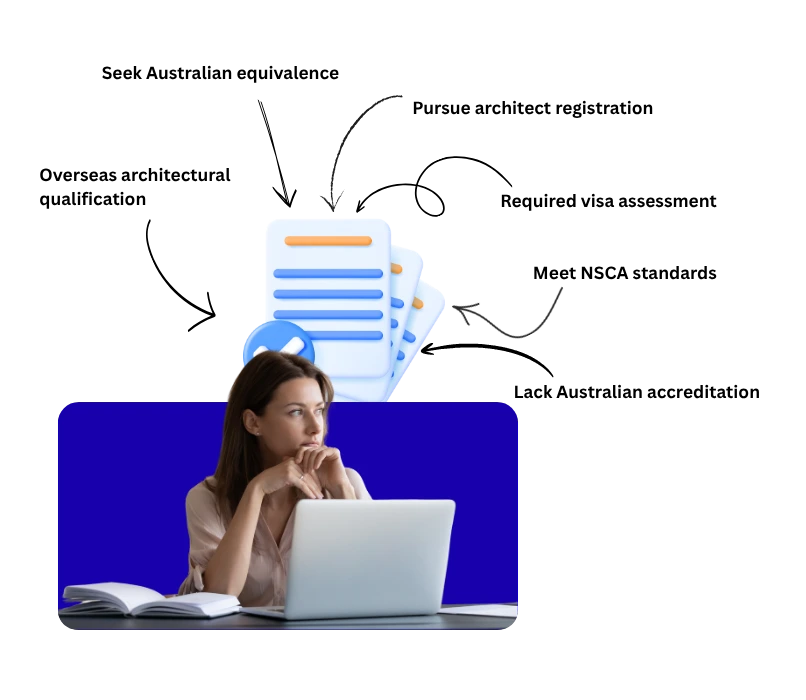
AACA does not confirm suitability of a qualification until a complete application and supporting evidence have been received.
Applicants who:
The applicant is expected to have completed a tertiary architectural course or courses where a graduate can progress towards registering as an architect in his or her country of origin, as stated by AACA. The typical requirement is a five-year qualification. All candidates are required to also possess the necessary experience and English proficiency.
Requirements may differ based on qualifications, professional experience and situation.
AACA compares overseas qualifications based upon a number of academic considerations.
These include:
The qualification is included as a component of the assessment system in the country in which it was gained.
AACA takes into account the status and recognition of the institution that provided the architecture qualification.
Comparability to Australian architectural training will be assessed on the basis of the length of the architecture qualification.
The academic program and program components are evaluated.
The content of the individual units of study is used to assess whether the areas of architectural education required are covered.
The grading system of the institution is also taken into account as part of the qualification assessment.
Take our free Eligibility Test — answer 5 quick questions about your engineering background, qualifications, and visa goals. We’ll identify your assessment body, ANZSCO code, and the exact documents required. Takes under 3 minutes.
Your qualification might not be deemed to be equivalent to an Australian accredited qualification if you have completed your Bachelor of Architecture, Master of Architecture or other professional architecture qualification in another country.
The OQA process provides a chance for “eligible” architects who are coming from overseas to demonstrate both their academic qualifications and their professional skills.
You must clearly and consistently articulate your education, architectural projects, and evidence of competence and experience in your application.
This is especially critical as the assessment is not just a document verification process. The applicant is required to possess the appropriate skills and abilities as outlined in the National Standard of Competency for Architects (NSCA).
Academic qualifications are just a part of the OQA process.
Applicants must also show the skills and competencies necessary to meet the 2021 National Standard of Competency for Architects.
The competency component consists of:
As of now, AACA requires a portfolio with a minimum of 3-4 architectural projects following the OQA requirements.
Your choice of project should enable you to show how you have developed the skills needed to demonstrate your competencies, not the most spectacular projects.
The portfolio is a significant component in the presentation of your architectural knowledge and professional skills.
The selected projects should demonstrate enough evidence of the competencies of the corresponding NSCA.
The information in a strong OQA portfolio should be presented in a logical and evaluative manner.
Depending on the project, it is important to supply the following information:
The goal is not just to depict architectural drawings. The submission must include a description of what you did, why you did it, and how your experience shows your understanding of the required competencies.
NSCA summary statements will be used to describe how your architectural education and experience reflect the requisite competencies.
Good statements must be:
Don’t make general statements without supporting evidence.
For example, instead of simply stating that you have experience in project management, your statement should explain the particular project situation, your responsibilities, the decisions you made, and the outcome.
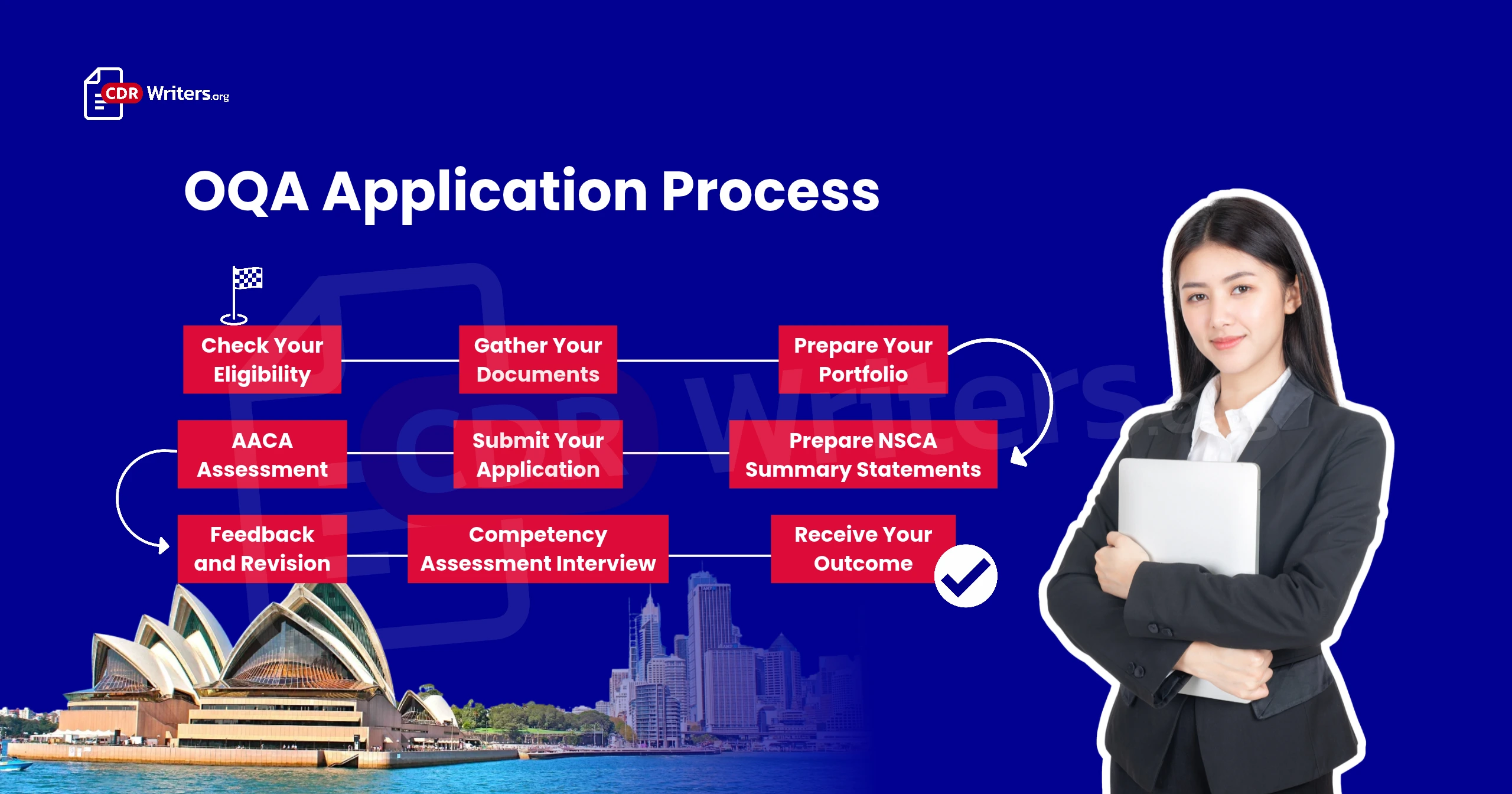
The following stages can be used to understand the general OQA process.
Please read the AACA eligibility and the OQA Applicant Guide prior to preparing your application.
The academic qualifications, types of professional experience, and English-language context should be taken into account when making the submission.
Complete academic and professional paperwork according to current requirements of the AACA.
Avoid keeping applications incomplete, as it may impact processing time. AACA advises that the application be legible and must be submitted with supporting documents in the proper format.
Identify 3-4 appropriate architectural projects and complete the portfolio based on the current OQA requirements.
The projects should show good evidence for the competencies of the appropriate NSCA in total.
Create written statements that validate competencies through experience and project evidence.
Follow the required AACA process and submit the completed application and supporting documents.
AACA validates the qualification and the evidence submitted.
New applicants will submit one application with the current OQA, which includes the competency assessment and the qualification assessment.
AACA claims that applicants get one feedback chance before they enter into the Competency Assessment Interview. All applicants may need to rework and resubmit papers during the specified time period.
The OQA competency assessment consists of the following steps: Eligible applicants move on to the Competency Assessment Interview.
It is expected that you will be able to discuss the projects and discuss your professional responsibilities, and the competency evidence provided in your submission.
AACA offers an assessment result at the end of the process.
An appropriate result will facilitate progression towards the Architectural Practice Examination and, if applicable, a Skilled Migration Assessment for migration purposes.
The applicable document requirements will always be verified with the current AACA OQA Applicant Guide.
Your submission could include:
The documents must adhere to the current AACA formatting and submission guidelines.
AACA’s documentation and requirements are continually being updated, so it is best for applicants to use OQA examples and guides that are current with the most recent official updates.
AACA currently indicates that applications for OQA are normally finalised within 7 weeks of lodgement, with the required documentation then complete.
Applications where documents are incomplete may usually take up to 12 weeks after lodgement. These are not scheduling times for the Competency Assessment Interview and are subject to change if there is a peak period or a shutdown through holidays.
Hence, it is suggested that applicants prepare well in advance before applying.
Published fees may change, and applicants should review the most up-to-date AACA fee schedule prior to submitting an application.
As of the writing of this article, AACA has separate fees for applicants from Australia and applicants from overseas. New applicants to OQA must pay a fee of AUD 4,973.01 for Australian Card applications and AUD 5,042.10 for Overseas Card applications.
The price is subject to change, so please check the latest price with AACA before you make your payment.
Achieving a successful OQA can be one of the key steps to be taken to become a registered architect in Australia.
Registration may include a suitable OQA outcome, provided the appropriate eligibility qualifications are met, as a basis for proceeding to the Architectural Practice Examination (APE).
Applicants taking APE Part 1 via the OQA route are required to fulfil the practical experience requirements as well. The APE pathway comprises documented practical experience, and presently AACA says that it requires a minimum of 3,300 hours of practical experience, or around 2 years, typically supervised by an architect.
A successful OQA may therefore be an important step but does NOT automatically register you as an architect in Australia.
OQA may also be applicable to architects intending to relocate to Australia.
If applicants achieve a suitable OQA result, the applicant may be eligible for a Skilled Migration Assessment for the occupation of Architect, depending upon the requirements.If the applicant achieves a suitable OQA result, the applicant may be eligible to be assessed under Skilled Migration for the occupation of Architect, provided the relevant requirements are satisfied. Skilled Migration Assessments are now three years from the date of issue.
But the OQA assessment process is different from an Australian visa application process.
A visa invitation or visa grant is not a guarantee of the visa success rate and will depend on the specific skills assessment. Please note that the requirements of the Australian Department of Home Affairs are separate and must be checked by the applicant(s).
There is no need for OQA for all those who apply with an overseas qualification in architecture.
If you have an accredited architecture qualification from Australia, New Zealand, Hong Kong or Singapore and need a Skilled Migration Assessment for immigration, AACA has a specific pathway called the Verification of Australian Accredited Architecture Qualification. If the applicant’s qualifications are not in the applicable verification pathway, other than OQA, they may require an OQA or another assessment pathway.
Once you determine the right way to proceed, you can save time and money in preparing documentation.
There are many of those who apply to the OQA process who are making it difficult due to the fact that it involves more than just having a degree in Architecture.
Typical challenges of preparation are:
It is not always easy to choose projects that are mutually representative of the desired competencies.
Applicants might have relevant and extensive experience, but not be able to link this experience to the competency criteria clearly.
Good architectural work can be part of a portfolio, but an assessment will be challenging if the statements that accompany it do not make it clear what the individual did well.
Your portfolio, project summaries, employment history and competency statements should be coherent and tell a unified story of your work experience.
Applicants will be assessed on their ability to articulate their projects, responsibilities, decisions and competency evidence, with confidence, during the Competency Assessment Interview.
Creating an OQA submission can take time to organise and understand how to present your academic and professional experiences.
CDRWriters can help architects from overseas to present their architectural experience in a structured way and prepare their OQA documentation.
We can provide support for your OQA through the following:
We focus on communicating your authentic academic and professional experiences.
Inventing, embellishing, or misrepresenting qualifications, projects, and/or professional experience is not encouraged. Your submission should accurately represent you and your role.
Creating an assessment app could be somewhat time-consuming, especially if you do not understand Australian architectural assessment needs.
Using professional preparation support, you can approach your submission with a structure that makes it clearer, and you’ll understand how to present your current experience.
CDRWriters can assist you in the following ways:
Applicants must make every effort to ensure that the information provided is correct and complete, and the final decision is at the discretion of AACA.


CDR reports, resumes, VETASSESS, and RPL applications can be challenging to prepare. Our team of professionals has effectively helped clients obtain approval with professional services that address all of these needs.
A professional qualification from overseas can be a valuable stepping stone towards achieving your career aspirations in Australia. But the documentation, project selection and competency mapping are important when preparing an OQA submission.
CDRWriters can assist you with organizing your OQA submission and also present your architectural education and professional experience clearly.
Call CDRWriters today to speak about your Overseas Qualification Assessment (OQA) preparation and begin your journey to an Australian Architecture assessment.
Please note that OQA requirements, fees, documents, and processing times are subject to change. Always check the latest information and Applicant Guide published by AACA before submitting your application.
The Overseas Qualification Assessment is an assessment of the Overseas qualifications of the candidate(s) by the AACA for those applicants who are eligible, with overseas architectural qualifications. It will decide if the overseas qualification is equivalent to the existing Australian-accredited architecture qualification and evaluate the competencies of the applicant.
This will depend on your qualifications and situation. There are certain overseas architecture qualifications that require applicants to undergo OQA for registration and/or skilled migration purposes, and others that may be eligible for other AACA pathways.
No. OQA is an architectural qualification and competency assessment by AACA. Applications for visas are separate from Australia’s immigration program, and a Skilled Migration Assessment may be available after obtaining an appropriate OQA (as applicable).
The competency assessment component specifies AACA’s portfolio of 3 to 4 architectural projects. Applicants should use the latest OQA Applicant Guide and templates to prepare their portfolio.
Yes. The Australian Automobile Club says applicants can apply for OQA from anywhere in Australia or the world.
Get a free consultation today. Our engineers will assess your profile and tell you exactly what you need — at no cost, no commitment.

Expert CDR, ACS, and VETASSESS assessment writing service. 5,600+ documents written. 99% approval rate. Serving professionals from 65+ countries migrating to Australia. Free consultation available.
Disclaimer:
CDR Writers is an independent document preparation service. Not affiliated with EA, ACS, VETASSESS, IML, or any official authority.
Sun-Fri · 24 Hours a Day
Copyright © 2020 – 2026 CDR Writers
99% Success | Trusted in 65+ Countries | 4.9/5 Rated | 100% Secure Payments
