
Online

The statement of purpose (SOP) is the most important document in a graduate school or grant application. It gives you all the answers to what an SOP is, its importance, how to set it up, and tips on writing an SOP that will get you into the admissions committee’s good books.
A graduate school statement of purpose (SOP) is a 500-1,000 word essay submitted with your application that tells a school about your academic background, research interests, career goals, and where you fit in a particular program. This is not a personal statement because it is much more about what you want to do with your life professionally and academically.
Writing a good Statement of Purpose is the first step towards your admission to the right university/program. Your SOP is your story. Whether it’s a master’s, a PhD, or even a course, it’s the personal statement that shows your goals, achievements, and motivation to the university. With so much at stake, where should one begin a statement of purpose?

Most graduate schools, MBA programs, and scholarship committees require a statement of purpose (also known as a research statement or letter of intent) to be a formal essay. It addresses three fundamental questions that admissions officers need to assess you for:
Your academic qualifications, research experience, and major academic accomplishments for eligibility.
Your particular research interests, proposed focus area, and short- and long-term career goals.
The reasons this program, university, and faculty are the ideal choices to support you in achieving those goals.
A statement of purpose is a short academic essay (500-1000 words) included with a graduate school application that presents the personal background, research interests, and career goals of the applicant and how these match up to the program’s specializations.
The statement of purpose is always one of the most heavily weighted aspects of graduate school applications. According to the research and surveys:
The SOP is “very important” according to 64% of Admissions Officers (ETS Graduate Survey).
After grades, in many Ph.D. programs in the STEM fields, this is the most important ranking factor.
The standard SOP length range is words.
The average number of minutes an admissions committee member takes to read an SOP.
Dimension | Statement of Purpose | Personal Statement |
Primary focus | Academic and professional intent | Personal background and character |
Audience | Faculty, research committee | Admissions committee broadly |
Tone | Formal, analytical, specific | Reflective, narrative, personal |
Key content | Research, skills, goals, program fit | Challenges, growth, motivation |
Common in | PhD, MS, MBA programs | Law school, med school, undergrad |
Follow this structure in each paragraph. The whole is divided into sections covering what admissions committees are explicitly looking for.
Start with a research question, a significant experience, or a thought-provoking question, not an introductory sentence such as the following: “I always wanted to…” Clearly state the mission in 2-3 sentences.
Strong Opening Example
In 2015, in Nepal, a 7.8-magnitude earthquake resulted in the death of 90% of its victims due to structural failure of unreinforced masonry buildings, which is an issue I want to correct in my doctoral research by making this structural failure a common occurrence in modern engineering.
Provide a summary of your undergraduate degree, coursework, GPA (if good), and how your coursework directly supports your graduate program. Don’t just supply courses, but relate them to the research interest.
This is the most critical part when applying for a PhD. Provide a description of 1-2 specific research projects: problem, how you did it, your role, and what you learned. Identify tools, methodologies, and publications (if any).
Research Paragraph Example
As a research assistant for Prof. Jana Müller in the Urban Systems Lab, I employed geospatial analysis (QGIS, Python) to model the vulnerability of 12 informal settlements in Dhaka, whose results were disseminated in the International Journal of Disaster Risk Reduction, where I found that areas of informal drainage have a vulnerability index that is 3 times higher, which directly influenced my planned dissertation focus.
Be specific. I want to go to work in the industry means “I wish to be employed in the industry”. Instead: “After PhD, I would like to pursue a career at a structural engineering consulting firm working on seismic policy in South Asia and then move to a professorship that involves research on retrofit policy implementation. Explicitly relate the degree to the goal.
Project-specific faculty members whose research is similar to your own. Interdisciplinary programs, reference labs, or research centers. Demonstrate homework — this section distinguishes between the standard (templated) SOPs and the targeted ones.
Program Fit Example
MIT is the perfect place for my proposed dissertation on participatory retrofit policy design, in the context of the work of Professor David Lalloo on earthquake-resilient informal housing, and the partnerships between him and the MIT Urban Risk Lab with the municipalities of Bangladesh.
In 2-3 sentences, explain what you bring together in a way that is distinctive: perhaps your skills, experience, or perspective, and make it sound like you really love what you will bring to the program community.
Take our free Eligibility Test — answer 5 quick questions about your engineering background, qualifications, and visa goals. We’ll identify your assessment body, ANZSCO code, and the exact documents required. Takes under 3 minutes.
A well-formatted Statement of Purpose (SOP) makes sure that your content is easy to read and professionally presented. Most universities expect the SOP to be around 500 to 1,000 words, typically fitting within one to two pages. Unless otherwise specified by the institution, use a clear, professional font such as Times New Roman or Arial in 11- or 12-point size, with 1-inch margins on all sides.
Maintain single or 1.5-line spacing unless the university explicitly asks for double spacing. Use paragraph breaks effectively to separate different sections—such as your introduction, academic background, professional experience, motivation for the program, career goals, and conclusion. It is a good practice to avoid excessive formatting or decorative elements, as simplicity and clarity are key.
Additionally, ensure that your SOP is free from grammatical errors, follows a logical flow, and adheres to any specific instructions given by the university. A clean, readable format not only enhances the impact of your writing but also reflects your attention to detail and professionalism.
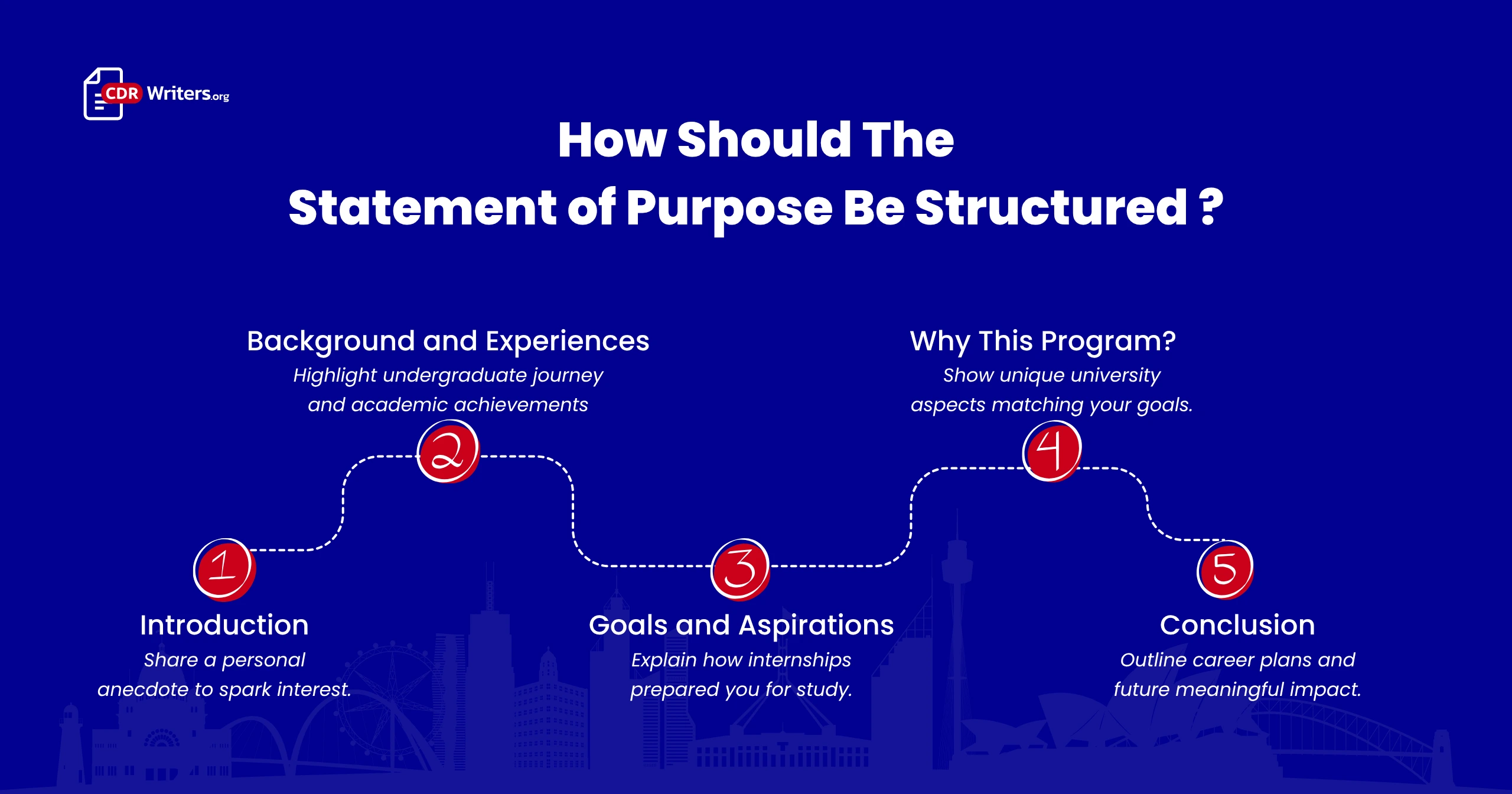
Crafting a strong Statement of Purpose (SOP) is essential for making your application stand out when applying to universities abroad. A well-organized SOP tells a cohesive story that reflects your academic background, professional experiences, and future goals. Here’s a recommended structure for writing an effective SOP:
Begin with a personal anecdote from your early life that sparked your interest in the subject. This narrative should show how that initial curiosity evolved into your current academic and professional aspirations.
Describe your undergraduate journey, highlighting notable academic achievements. Focus on specific courses or subjects that deepened your interest in the field and influenced your decision to pursue further studies internationally.
Share relevant hands-on experiences—such as internships, research projects, or training—and explain how these opportunities have helped develop your skills and prepare you for graduate-level study.
Demonstrate your knowledge of the university you’re applying to by discussing what draws you to it. This could include particular faculty, research initiatives, specialized facilities, or unique aspects of the program that align with your goals.
Conclude by defining a clear outline of your goals, both short-term and long-term. Explain how the program fits into your career plan and how you intend to apply what you learn to make a meaningful impact in your field.
Situation – Task – Action – Result. All research experiences must have a specific result (publication, data set, findings, prototype).
Identify 2-3 faculty colleagues with work that is similar to your own. Read their latest papers and cite particular projects, rather than just their general project.
“Analyzed data” → “Used R to analyze 12,000 patient records from 4 hospitals. Numbers are a means to credibility and specificity.
Edit the program fit paragraph at a minimum. The most effective SOPs align to a particular lab, program track, or interdisciplinary program exclusive to that institution.
When limits are exceeded, it is indicative of poor judgment. If it is falling well short, it means that there is a lack of substance. Set your targets at 90–100% of the stated limit.
The expression “I designed and conducted” is better than the expression “Experiments were designed and conducted. A passive voice makes you come across as a participant in the story, but a passive participant.
Phrases that are prohibited: “Ever since I was a child,” “I have always been passionate about,” “Your program is one of the best in the world. These make for a generic SOP right away.
Low GPA semester? Research interruption? It’s better to say something about a family health crisis that happened during the third year that affected my academic performance, and since then I have… rather than let reviewers wonder.
You can have a prof from your undergrad school or a grad student at your target school guide you to norms and red flags in the field that aren’t getting taught by the general writing profs.
This will identify phrases that are not understood or that are not being used correctly, and will capture sentences that are grammatically correct but not understood. If you get stumped reading it, a reviewer will too.
What strong SOPs do instead:


CDR reports, resumes, VETASSESS, and RPL applications can be challenging to prepare. Our team of professionals has effectively helped clients obtain approval with professional services that address all of these needs.
CDR Writers is a renowned company registered in Australia to provide CDR writing, RPL report writing, and reviewing services. Crafting a well-written SOP is not an easy task. However, it is essential to write an impressive SOP to get into a reputed firm, university, or college. An effective SOP features clarity, structure, and an understanding of what the institutions are looking for. Applying to your dream college? Whether it’s Ivy League or the University of Melbourne, you must prep a slick statement of purpose with help from SOP writing services. We at CDR Writers assist you in preparing an effective Statement of Purpose to submit to universities.
Most graduate programs require a 500-1000 word (1-2 page) paper, single-spaced. Typically, an 800–1,000 word paper with extensive research content is required for STEM PhD programs, and a 500–700 word paper with moderate research content is expected for MS programs. Please adhere to the limit as outlined in the specific program instead of general advice.
A statement of purpose is analytical and forward-looking and emphasizes your academic background, research interests, and professional objectives. A personal statement emphasizes personal experiences, character, and motivation. SOPs are most common for graduate programs; personal statements are more common in law, medicine, and undergraduate admissions. Many schools use the terms, so be sure to read the prompts carefully.
No. Make the program fit paragraph (Paragraph 5) specific to each school by identifying specific faculty members, labs, and program features, etc. The best candidates create very distinct SOPs for each institution — based on a range of research interests, faculty relationships, or program strengths. Any SOP that is generic is easily recognisable and can negatively affect your chances.
It is okay to use AI (ChatGPT, Claude) to write or revise your SOP, but use it wisely. AI can assist with structure, clarity, and grammar. The research details, faculty connections, and career goals should, however, be written by you; otherwise, the SOPs written with AI can be easily identified and may be general. Imagine AI as a writing assistant, rather than a ghost-writer.
In most programs, the SOP has been considered as important or even more important than the GRE, particularly because many of the best programs have eliminated the requirement for submission (MIT, Stanford, Harvard). When there are score floors, the SOP is the major differentiator in a program. Polling of faculty admissions committees has repeatedly ranked research experience and research statement as the #1 factor in PhD admissions.
Get a free consultation today. Our engineers will assess your profile and tell you exactly what you need — at no cost, no commitment.

Expert CDR, ACS, and VETASSESS assessment writing service. 5,600+ documents written. 99% approval rate. Serving professionals from 65+ countries migrating to Australia. Free consultation available.
Disclaimer:
CDR Writers is an independent document preparation service. Not affiliated with EA, ACS, VETASSESS, IML, or any official authority.
Sun-Fri · 24 Hours a Day
Copyright © 2020 – 2026 CDR Writers
99% Success | Trusted in 65+ Countries | 4.9/5 Rated | 100% Secure Payments
