
Online

Continuing Professional Development (CPD) in the current fast-changing world of engineering and professions is no longer just a mere formality, but rather an obligatory measure to be taken by professionals who want to gain some recognition, obtain licensing, or even be able to migrate. CPD of NER is a crucial activity among engineers seeking NER (National Engineering Register) evaluation in Australia, as it shows professional competence, lifelong learning, and adherence to the standards of the industry.
Become a member of an exclusive community that values engineers and their adherence to high professional standards. If you’re an engineer in Australia seeking a place on the National Engineering Register (NER), fulfilling its Continuing Professional Development (CPD) prerequisites is a pivotal step in your career. The CPD for NER registration is a vital document in your application.

The CPD for NER is an Engineers Australia scheme of Continuing Professional Development for the National Engineering Register – Australia’s publicly searchable register of professionally recognised engineers.
The National Engineering Register is not automatic. To be eligible for listing, engineers need to show evidence of continuous professional development, and CPD is the key evidence method. The CPD record that you include with your NER application demonstrates that you’re not just sitting on a degree that you picked up years ago – you are showing that you are keeping your engineering skills up to date and expanding them.
CPD is defined by Engineers Australia as: CPD is the systematic maintenance, enhancement and expansion of knowledge and skills, and enhancement of personal qualities required throughout an individual’s engineering career in the performance of professional and technical duties.
The CPD habits that you develop for your first application will be the ones that you build on throughout your registration.
A lot of engineers will leave the CPD section at the last minute; some will not even add anything there, just a list of course names. It’s a big strategic mistake.
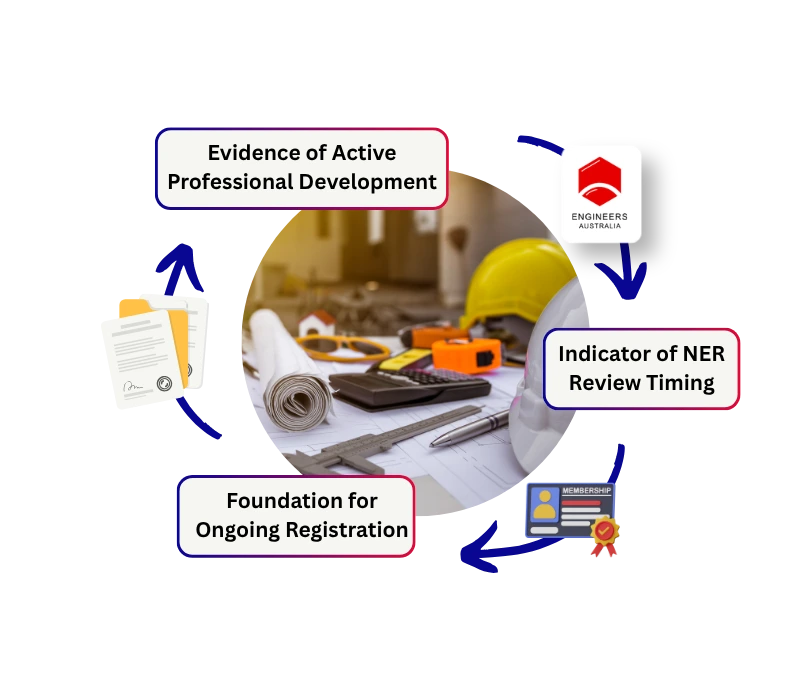
The CPD record has three different purposes in the NER application process:
Function 1 — Evidence of Active Professional Development:The CPD is used by assessors to ensure that your nominated engineering area is kept up to date. Any listing that is short or vague indicates business sloth.
Function 2 — Indicator of NER Review Timing:The number of CPD hours you present at application directly impacts the date of your first 5-year practice review. This allows engineers to submit 150 hours over three years for a full 5-year review window. If only 50 hours in the last 12 months are submitted, they will be reviewed sooner.
Function 3 — Foundation for Ongoing Registration: It is not a single event that mandates NER registration. CPD audits are carried out by Engineers Australia every five years, or as part of the CPD audit, at any time a registered engineer might be chosen.
Engineers Australia’s CPD policy (updated February 2025) provides for two paths to CPD hours at the time of NER application and a CPD requirement for ongoing registration.
Pathway | Hours Required | Timeframe |
Pathway A | 150 hours | Preceding 3 years |
Pathway B | 50 hours | Preceding 12 months |
Note: At the application time, there is no minimum CPD hour requirement; you will only need to explain what you have done to achieve CPD. But the time of your first review depends on the pathway you take.
Upon registration, the maintenance requirement will be apparent:
If you are an Engineer working in several areas: If your NER registration spans more than one area of practice, then you will need to document at least 50 hours in each of those areas over the 3 years. Hours can be accumulated for multiple disciplines when multiple disciplines have an overlap in hours.
For Academic Engineers:40 hours of industry involvement are required out of the 150 hours in each three-year period.
Career Break Provision:CPD period may be extended to 5 years for engineers who take a break in their career between 6 months and 5 years. This can only be applied in a CPD audit.
Take our free Eligibility Test — answer 5 quick questions about your engineering background, qualifications, and visa goals. We’ll identify your assessment body, ANZSCO code, and the exact documents required. Takes under 3 minutes.
Engineers Australia has identified nine categories of CPD activities. There are specific conditions for each type, and some require hour limits. One of the most frequently occurring mistakes in CPD is the selection of activity types or the misclassification of them, which can contribute to audit difficulty.
Type I
What Qualifies: Postgraduate courses, formal qualifications, structured courses in a university, online courses with an assessment element(s) through recognised platforms.Hour limit: No maximum.What to record: Course title, Institution, Date, Hour, Outcome.
Type II
What Qualifies:Short courses, webinars, workshops, seminars, conferences, technical meetings, and discussion groups. The activity should be led by an acknowledged expert in your area.Hour limit: No maximum.What to record:Activity name, provider, date, duration, and attendance.
Type III
What Qualifies: Engineering tasks that create new engineering knowledge or enhance professional practice outside of your job description. It can be learning new software or working on a different engineering task, or even a new discipline. No ordinary chores do.Hour limit: The maximum CPD hours is 75 hours for the 3-year period (combined for types III and IV, 110 hours).What to record:What you learned, how you used it, how it enhanced your engineering career.
Type IV
What Qualifies: Reading of technical books, standards, manuals, research papers, and engineering articles. The activity has to enhance the professional practice.Hour limit: 35 hours in the 3-year period.What to record:Title, author, source, date read, time read.
Type V
What Qualifies: Certificate tasks, tasks involving the engineering profession and its ethics, membership duties, administrative or support duties, client work, and teaching.Hour limit: Up to 50 hours in a three-year period.What to record: Organisation, your role, professional contribution made, hours spent.
Type VI
What qualifies: Preparing, reviewing or presenting technical material for professional learning. Publish engineering papers, present at conferences, contributing to technical standards.Hour limit: No maximum (Research, Drafting and Presentation time may all be claimed).What to record: Title, audience, date, hours spent preparing and delivering.
Type VII
What qualifies: Management, leadership, business administration, project management, health and safety or any other non-technical professional skills related to your engineering career.Hour limit: No maximum.What to record: Course title, provider, date, and length of course.
Type VIII
What Qualifies: Planned learning that does not have a clear learning purpose, or is not directly related to engineering practice and falls into Types I-VII.Hour limit: On a case-by-case basis, with solid evidence.What to record: Structure of activity, learning goal, learning outcome, time spent.
Type IX
What qualifies: NER registrants can note that they work in an organisation that has a third-party certified management system based on relevant standards.Hour limit: 10 hours for CPD per period.What to record: Organisation, Management System Type, Certification Information.
Engineers who are studying for both NER and Chartered (CPEng) may wonder if they should keep two sets of CPD records. No, the same CPD activities and hours can count for both, but there are differences regarding the required breakdowns.
Requirement | NER | CPEng (Chartered) |
Total hours (3 years) | 150 hours OR 50 hours (12 months) | 150 hours minimum |
Technical/practice area | 50 hours minimum | 50 hours minimum |
Risk management | 10 hours minimum | 10 hours minimum |
Business/management | 15 hours minimum | 15 hours minimum |
EA membership required? | Not mandatory | Required |
Review cycle | 5 years | 5 years |
Audit frequency | At least once per 5-year cycle | At least once per 5-year cycle |
The important thing to note is that, unlike engineers, Chartered engineers are also required to be members of EA, which also entails obligations. There is no requirement to be a member of NER to be registered, so this is the more accessible route for many engineers.
This is the step-by-step plan that differentiates an engineer from a problem child in CPD. This is the practical approach that will make an engineer a problem child or an engineer who passes the CPD review.
Record all professional learning activities that have occurred within the specified period (three years or 12 months). At this stage, do not filter — record all of the following:
For each of the activities, match it to one of the EA types (I through IX). Be mindful of the time limits of Types III, IV, and V. If you have a strong workplace learning component (Type III), then you need to include learning activities to ensure you do not exceed the 75-hour limit without meeting your overall cap.
This is what most engineers fail to take or underwrite. Write 1 to 2 sentences to explain for each activity:
A good CPD record is one that tells you what you’ve done, not just the title of the activities. Assessors must be convinced of the authenticity and relevance of the learning.
Weak entry (avoid):
Participated in a Webinar on structural load calculations. 2 hours.
Strong entry (use this approach):
Attended Engineers Australia Webinar: Revised AS 1170.1 load combination requirements — March 2024 — (Type II – 2 hours), which updated my knowledge of the permanent vs imposed action classifications, and I used on the structural design review for [Project Name] in April 2024.
Record the number of hours by type of CPD, and check against the requirements:
Engineers Australia requires that the Engineers Australia CPD report include the following:
Maintain supporting evidence for each activity recorded. Evidence will not be required at the application stage, but may be requested by Engineers Australia during a CPD audit for any individual entry. Evidence types include:
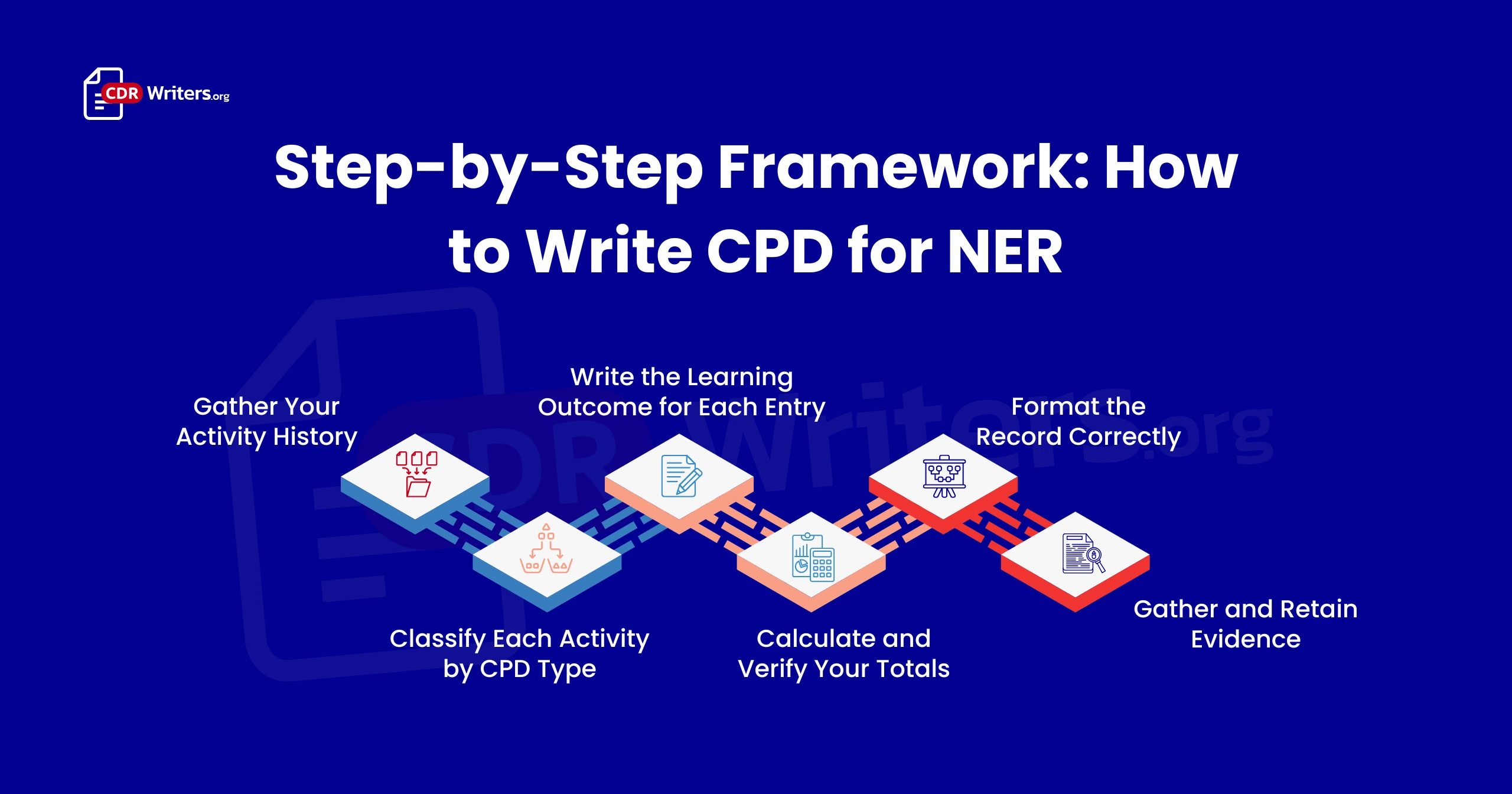
The format recommended by the EA for each CPD entry is:
Practical example row:
Date | Type | Activity | Provider | Hours | Outcome |
March 2024 | II | AS 1170.1 Structural Loads Webinar | Engineers Australia | 2.0 | Updated understanding of load combination classifications, applied in the April 2024 structural review |
July 2023 | I | Graduate Certificate in Structural Engineering | RMIT University | 40.0 | Advanced knowledge in reinforced concrete design and seismic analysis |
November 2023 | V | Mentoring of Graduate Engineer (4 sessions) | [Employer name] | 4.0 | Strengthened technical communication and knowledge transfer skills |
Key formatting rules:
Engineers Australia anticipates that to satisfy the NER requirements that:
CDP activities that you are doing should be spread over the following areas:
Problem: Normal tasks, such as reviewing drawings you’ve created, attending normal team meetings, and going through normal inspections you’d otherwise do, are not considered CPD. CPD demands actual learning that is new.Fix: What is one thing you learned or improved in a skill? If the response is no, the activity is not qualified. If so, record what was new.
Problem: Engineers with a strong dependence on workplace learning (Type III) may inadvertently accumulate the 75 hours and then fall short of the number.Fix: Determine the number of hours for each type of work done before finalising your record. Enrich heavy Type III records with structured learning activities.
Problem: Statements such as “Attended a technical seminar. 2 hours.” leave no option for the assessor to evaluate.Fix: Each entry must have a learning outcome sentence. A single sentence that establishes a connection between the activity and your engineering practice is enough and can have a great impact on the way that an assessor reads your record.
Problem: If the CPD record is not in the format provided in the CPD statement of experience template, then the engineer must submit a statement of experience.Fix: Ensure you use the official EA CPD template. If it is necessary to use an alternate format, include the statement of experience as EA prescribes.
Problem: Retrieving evidence for CPD activities that occurred several years in the past is challenging and is not always complete. Upon audit, Engineers Australia may require substantiation for certain entries, and non-substantiation of evidence can result in the exclusion of those hours.Fix:Take evidence as soon as possible following each activity. Build a basic folder in digital format that is colour-coded by year and month.
Problem:General Management courses, health and wellbeing courses, and courses that are not related to engineering practice will not gain credit and will reduce the strength of your record.Fix: All activities need to be related to engineering practice. If you can’t say exactly what that link is in one sentence, the activity isn’t likely to qualify.
Problem:Engineers sometimes think that the “one page” limit implies that the CPD is small. Indeed, one page equates to structured, dense evidence-rich information which is easy to assess in a few seconds.Fix: Each line of your CPD record should have meaning. Quality over volume.
Engineers Australia has a formal audit and practice review cycle. The important information for NER registrants is:
Frequency:Not less than once every five years of registration. Further, Engineers Australia can choose any registered engineer at any time within their registration period to undergo a random CPD audit, not only when it is their turn for the review.
Trigger: Audits may be scheduled (routine) or triggered by the flag in your record.
What EA Reviews During an Audit:
Audit Outcomes:
If your record is determined to be inadequate, Engineers Australia will inform you, and tell you that you have the right to review your record. If your Chartered or NER status is lost due to a CPD audit, you will be given nine (9) months to make a formal application for review. That review should be in writing and be one or more of the following: the auditor failed to consider material, took irrelevant material into consideration, failed to follow due process, or was biased.
How to Prepare Before Your Audit:


CDR reports, resumes, VETASSESS, and RPL applications can be challenging to prepare. Our team of professionals has effectively helped clients obtain approval with professional services that address all of these needs.
Please use this checklist before submitting your NER application CPD record:
Hours and Coverage
Type Compliance
Content Quality
Format
Evidence
Supporting evidence is kept and submitted for each activity.
Evidence such as dates, titles, and provider names, if applicable.
Records will be kept for at least 5 years.
As a long-time engineering documentation company, cdrwriters.org offers end-to-end CPD learners writing services to NER applicants.
Our CPD Writing Features:
We do not simply write; we place your professional development in the best position possible in order to achieve the greatest assessment success.
To apply to the NER for initial registration, you need to have completed 150 hours of CPD in the last three years or 50 hours in the last 12 months. Continuing education (CE) is required at 150 hours every three years (including CE specific to the practice area, risk management and business skills).
Yes. Engineers who are NER and Chartered may complete the same CPD activities and hours towards both NER and Chartered status. No need to keep two separate records.
No – certificates or proof are not required for your NER application. But when Engineers Australia conducts a CPD audit, it may ask to see evidence for any activity that you have entered. Retain all documents relating to the support for at least five years.
Yes, but only activities that are really new learning that is not part of your regular work. Normal everyday activities will not count. No more than 75 hours of Workplace learning (Type III) can be counted over a three-year period, and Workplace learning and Private study (Type IV) cannot add up to more than 110 hours over three years.
If your assessment is found to be inadequate, Engineers Australia will inform you. You can request a review within 90 days of your NER registration being revoked; this can be done in writing.
Get a free consultation today. Our engineers will assess your profile and tell you exactly what you need — at no cost, no commitment.

Expert CDR, ACS, and VETASSESS assessment writing service. 5,600+ documents written. 99% approval rate. Serving professionals from 65+ countries migrating to Australia. Free consultation available.
Disclaimer:
CDR Writers is an independent document preparation service. Not affiliated with EA, ACS, VETASSESS, IML, or any official authority.
Sun-Fri · 24 Hours a Day
Copyright © 2020 – 2026 CDR Writers
99% Success | Trusted in 65+ Countries | 4.9/5 Rated | 100% Secure Payments
