
Online

Stage 1 Competency Assessment is Engineers Australia’s assessment of an engineer’s knowledge, ability to apply this knowledge in practice, and professional behaviours at a level that is consistent with the entry-level competency in the nominated occupational category (Professional Engineer, Engineering Technologist or Engineering Associate). It is the standard that is required to meet for the Migration Skills Assessment (MSA), and the standard is achieved by undertaking an accredited qualification or by providing a Competency Demonstration Report (CDR) that aligns to three elements: PE1 (Knowledge and Skill Base), PE2 (Engineering Application Ability), and PE3 (Professional and Personal Attributes).
If you have completed an Engineers Australia accredited program, you will automatically be considered to have met the Stage 1 requirements for the appropriate occupational category, as any graduate of a fully accredited program will be deemed to have met Stage 1 requirements for the appropriate occupational category. All others (non-accredited degrees, mismatched jobs, or qualifications not in the Washington, Sydney or Dublin Accords) will need to do so with a CDR.


Besides, one has to be able to learn and build up the enlarged knowledge in multiple branches of engineering through formal and non-formal learning, having the set of essential skills and competencies that define the expert. These are the things that one should look at when carrying out the Stage 1 competency assessment artwork.
The first step among the six stages of competency assessment for the international engineers who dream to migrate to Australia to practice their profession in their specialized field of engineering is the competency assessment among the available six stages of competency assessment. The assessment is founded on the Competency Demonstration Report (CDR), which is a document that provides sufficient evidence of the engineer’s competence, skills, knowledge, and experience in the practice area. For the candidate to be qualified for the assessment, the CDR has to be developed in compliance with the guidelines and format that is offered by Engineer Australia. The CDR is scrutinized, and the assessors verify if the engineer has the competence to practice engineering in Australia. In the case that the CDR is accepted, the engineer will receive the result of Stage 1 competency and will be allowed to move to the next step of the assessment. This is the first stage competency that is necessary for migration, and before the engineers can practice as engineers in Australia, they have to clear this stage.
Certification in the engineering profession requires the candidate to pass the Stage 1 Competency apart from the educational qualifications. Membership eligibility is therefore determined by this assessment In this assessment.
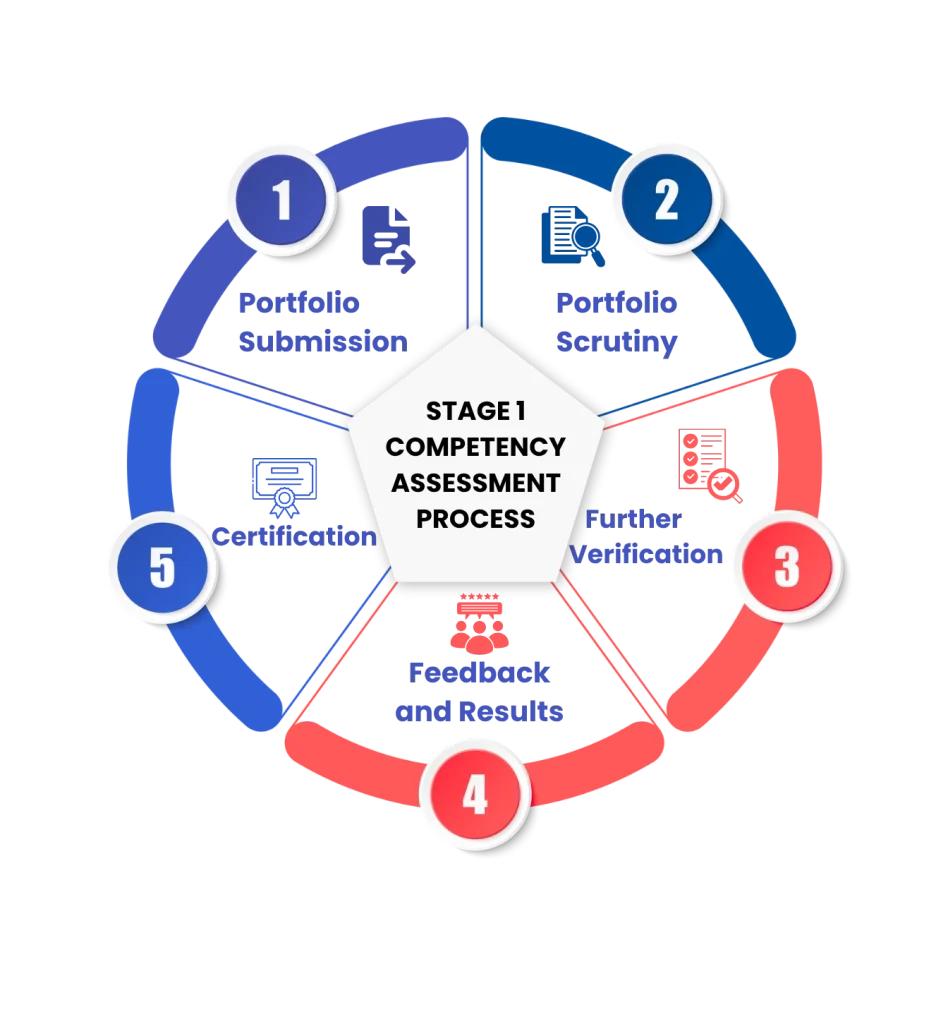
The following are the phases that most organizations pass through when conducting the Stage 1 Competency Assessment. Firstly, the candidate is expected to provide a portfolio that demonstrates work experience, accomplishments, and evidence of compliance with standards of competencies. This portfolio is scrutinised by the assessors, who then rate the candidate on his or her capability to meet the assessment objectives.
After a portfolio assessment is done, the candidate may be called for an interview or receive a practical test in order to confirm his/her level of abilities and knowledge. This may mean illustrating objective activities or examples relevant to their field of work.
Upon the end of the assessment, the candidate gets the feedback and the final result of the assessment. If successful, they are awarded a certification or recognition that enables them to practice individually or to escalate to the next level.
Stage 1 Competency Assessment is part of a larger system. Knowing the entities around the page is what makes a page rank for one keyword and another page earn topical authority on the entire cluster of pages:
Take our free Eligibility Test — answer 5 quick questions about your engineering background, qualifications, and visa goals. We’ll identify your assessment body, ANZSCO code, and the exact documents required. Takes under 3 minutes.
One of the repeated questions that can throw people off — and is a great “People Also Ask” signal — is what does Stage 1 match up to Stage 2 competency?
Stage 1 Competency | ||
Purpose | Entry into the profession/migration eligibility | Chartered status (CPEng) — recognised expert practice |
Who it’s for | Graduates and migration applicants | Practising engineers with several years of experience |
Evidence required | CDR (Career Episodes + Summary Statement) or accredited degree | Detailed practice reports, referee reports, professional interview |
Outcome | Positive/negative assessment letter for visa or membership | Chartered Professional Engineer (CPEng) registration |
Review window | 28 days to request Stage 2 Review if negative <cite index=”10-2″>(additional fee applies)</cite> | Formal review/appeal process through EA panel |
Each Career Episode in a CDR must relate to these three elements: PE1, PE2, and PE3 – Engineering Knowledge and Project Application, Professional Responsibility.
<cite index=”3-2″>Understanding of engineering fundamentals, natural and physical sciences, and the specific engineering field, including underpinning mathematics, statistics and computing</cite>. It also demonstrates knowledge of design practice, standards and current developments in design.
Evaluates the use of engineering knowledge in actual projects and tasks, such as how the applicant uses tools, methods, and resources to solve engineering problems. Structured problem-solving and decision-making with clear application ability are demonstrated.
Addresses “how” to behave — not “what” you know — in terms of ethical behavior, communication, teamwork, responsibility, commitment to continuous professional learning.
Engineering managers also exist as a category of application for migration by Engineers Australia. Additionally, all applicants seeking a skill assessment from Engineers Australia must demonstrate proficiency in the English language by taking one of the following tests: IELTS, for either the General or the Academic streams, and TOEFL iBT® or PTE ACADEMIC™ for tests taken from November 1, 2017 on.
IELTS | IBT TOEFL | PTE ACADEMIC | |
Listening | 6 | 12 | 50 |
Reading | 6 | 13 | 50 |
Writing | 6 | 21 | 50 |
Speaking | 6 | 18 | 50 |
The results of IELTS, TOEFL iBT®, and PTE ACADEMIC™ must be no older than two years from the date of application submission.
Some of the applicants may be allowed to provide the test results in English as plan B and they include
The assessment is based on the core competency component: your ANZSCO occupation. All other aspects of the assessment, including the competency component and points, rely on your ANZSCO occupation.
Australian accredited degree → automatically met. Washington/Sydney/Dublin Accord degree – streamlined. All Other Items Asked → CDR is required.
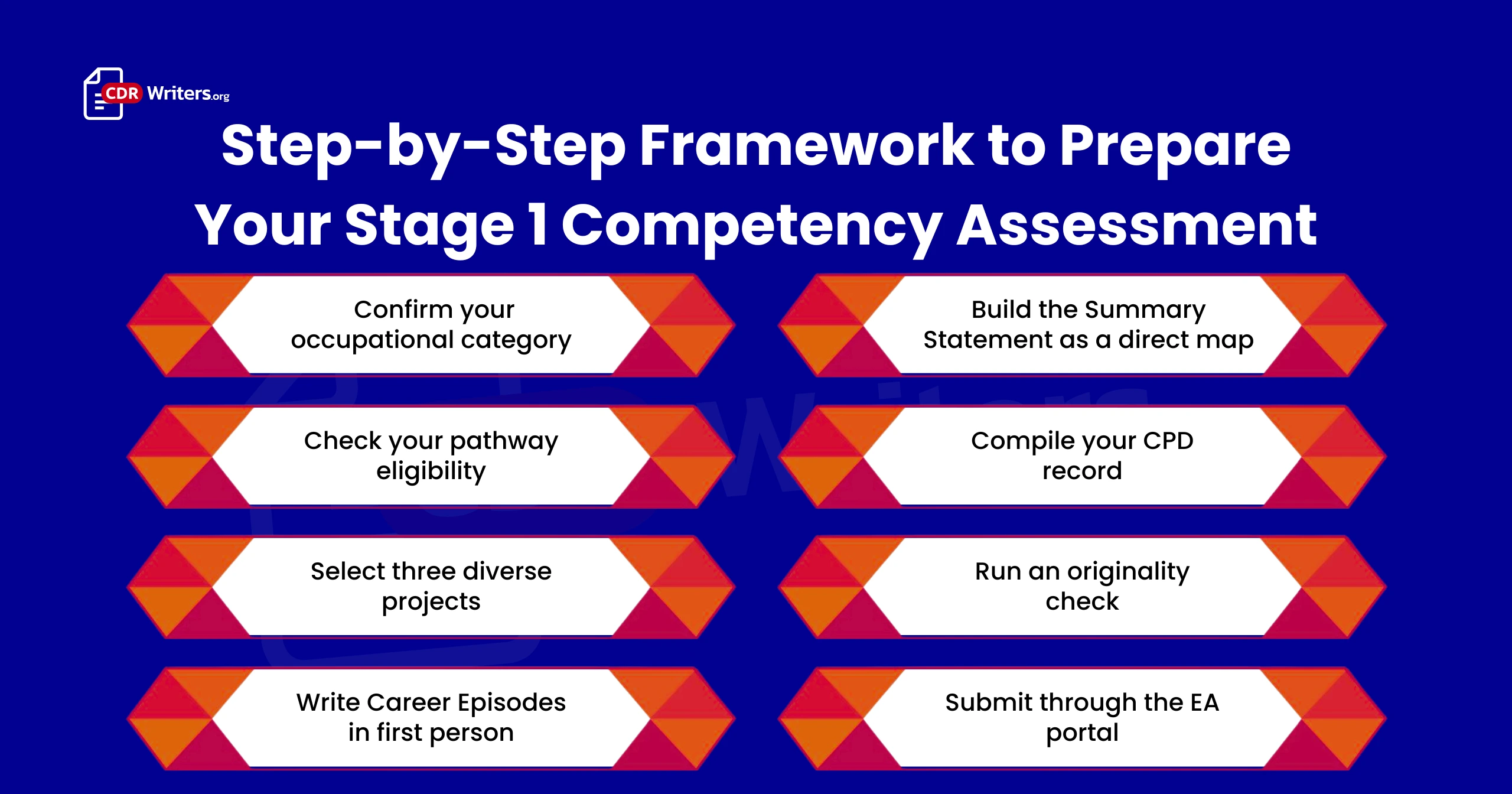
Covering a wide range of design, problem-solving, and stakeholder management, not three of the same project.
Should include specifics such as decisions made, calculations done, tools used, and the results that were achieved; generic team narratives (“we designed…”) will be flagged.
Each PE1/PE2/PE3 sub-element mapped to the corresponding paragraph(s) in the Career Episodes that support it.
Activity for ongoing learning.
Prior to submitting — plagiarism is considered cheating and will result in a grade penalty (see statistics below).
Respond to evidence gaps within 30 days; follow up on your result.
Applying for Engineers Australia’s Stage 1 Assessment Membership can be a tough nut to crack when preparing a Competency Demonstration Report (CDR). As the key membership body for engineers in Australia, Engineers Australia has very strict standards for evaluating a CDR and anticipates receiving nothing but a genuine report when a candidate submits a full and comprehensive CDR adhering to its rules and regulations as well as its standards of professionalism. It is also important to note that within the CDR process, there is the Stage 1 Competency Assessment, which is the purpose of proving your competency in the chosen occupational field of being either a professional engineer, engineer technologist, or engineering associate.
To develop a good and comprehensive Stage 1 Competency Assessment, there should be expertise in technicality. CDR Writers can make this process easier for you by helping you connect with writers that have knowledge in engineering and that are conversant with Engineers Australia. Personal help throughout the CDR process and at various of their subphases can be provided by our team.
Candidates should note that the Stage 1 Competency Assessment is compulsory to gain membership with Engineers Australia as well as to be recognized in chosen occupational field. The assessment tests your actual knowledge that you can use in practice and proves that you are a professional in the sphere.
The Stage 1 Competency Assessment for Engineers Australia is divided into three main categories: education records, resources, competency, and attributes. Every one of these classes is useful for the evaluation of abilities, vocation, and expertise, which are fundamental for work in a foreign country as per Engineers Australia. That is why to pass the assessment, you need to give full information for all three categories, but separately.
Our team at CDR Writers can ensure that you have excellent samples for all the three competencies. If you wish to attempt the Stage 1 Competency Assessment on your own, we can help you and provide you with the information for a section or a particular competency if you have any problem with any section.
As for the first stage of competency assessment, a competency demonstration report is an essential part of the process. It contains the details of your work experience, education, and some mechanical puzzle sample problems solving aptitude. About CDR: The CDR must be accurate and free from plagiarism. We also have a plagiarism check and removal service if you do not want a plagiarized CDR report. A CDR is composed of three career episodes and a summary statement, and the MSA spells down the word limits for each component. Our team will be glad to write all the necessary episodes and the summary statements within the word limit to provide you with all the information.


CDR reports, resumes, VETASSESS, and RPL applications can be challenging to prepare. Our team of professionals has effectively helped clients obtain approval with professional services that address all of these needs.
It is very important for international engineers who intend to work in Australia to submit their application for the Stage 1 Competency Assessment. The programs contained in this assessment test your aptitude and ability in engineering so as to determine if you can start the practice on your own. Firstly, the client completes a career episode/creditability report involving the submission of a competency demonstration report (CDR) that presents the applicant’s skills and competencies. This report helps Engineers Australia to decide whether you possess necessary competencies by considering engineering knowledge.
In order to help you through this process, CDR Writers provides professional help on preparation of your CDR, which involves the Stage 1 Competency Assessment. Our professionals know the requirements of Engineers Australia and will assist the client throughout this process. We make sure your CDR is correct, original, and formatted as it should be.
The Stage 1 Competency Assessment as a molding apparatus is also the first ask for those foreign engineers who are intending to work in Australia. It requires the completion of a Competency Demonstration Report (CDR) for claiming engineering competence of a particular profession. You have to meet these standards as Engineers Australia reviews this report.
For the engineers practicing in Australia, the first stage of competency assessment is compulsory to pass before being allowed to practice. It is one of the migration steps that help engineers receive Stage 1 competency and make them qualified for further stages of the assessment.
Required documents include a photo identity proof, English Language Competency Report, qualification documents, an up-to-date CV or resume, three Career Episode Reports, and a Summary Statement.
Yes, CDR Writers provides expert assistance in crafting your Competency Demonstration Report, including the Stage 1 Competency Assessment. Our team ensures your report meets all guidelines and standards set by Engineers Australia.
Proficiency in English is crucial. Applicants must demonstrate language skills through tests like IELTS, TOEFL iBT, or PTE ACADEMIC. Some applicants may be exempt, such as those with an Australian engineering qualification or native English speakers.
Start by choosing a service and paying for it. Provide your CV and necessary information. Schedule a meeting with our team to discuss specifics. After completing the report, we send you a draft for review, make revisions based on your feedback, and finalize the CDR.
We offer affordable rates, unique and expertly-prepared content, and prioritize on-time completion. Our team ensures adherence to guidelines for optimal results in your Stage 1 Competency Assessment.
Get a free consultation today. Our engineers will assess your profile and tell you exactly what you need — at no cost, no commitment.

Expert CDR, ACS, and VETASSESS assessment writing service. 5,600+ documents written. 99% approval rate. Serving professionals from 65+ countries migrating to Australia. Free consultation available.
Disclaimer:
CDR Writers is an independent document preparation service. Not affiliated with EA, ACS, VETASSESS, IML, or any official authority.
Sun-Fri · 24 Hours a Day
Copyright © 2020 – 2026 CDR Writers
99% Success | Trusted in 65+ Countries | 4.9/5 Rated | 100% Secure Payments
