
Online

Creating an accurate NSCA Summary Statement is one of the most critical steps in the migration process from overseas to Australia if you are an internationally qualified architect seeking to migrate to Australia. Professional competency is a key focus in the Australian job market, and the Australian Architects Accreditation Council (AACA) requires applicants to demonstrate that their knowledge and experience is in line with the professional standards in Australia.
The NSCA Summary Statement is evidence that your education, professional experience and architectural competencies meet the requirements of the National Standard of Competency for Architects. It isn’t just a resume of your work history – it’s a competency mapping report that is structured to link your work experience to the competency standards expected of registered architects in Australia.
As part of CDR Writers, we help internationally qualified architects structure their NSCA Summary Statement documents professionally, so that they clearly demonstrate their architectural knowledge and capability and satisfy the documentation requirements of the AACA.


The Summary Statement is a link between your work and Australia’s competency framework.
The NSCA Summary Statement is a competency mapping document which forms part of the assessment process undertaken by the Australian Architects Accreditation Council (AACA).
It is mainly used to show an applicant’s competence against the competencies outlined in Australia’s National Standard of Competency for Architects (NSCA).
Applicants will not be required to discuss the projects in a general way, but should provide specific examples of the projects that they have completed to illustrate the projects’ application of each of the required competencies.
This includes areas such as:
managed projects, worked with stakeholders, and met professional standards – rather than just stating your responsibilities.
The NSCA Summary Statement is one of the most important documents used to demonstrate practical experience to meet the Australian architectural requirements.
If your competency statement is not prepared well, the assessor might not be able to see if the experience meets the professional competencies.
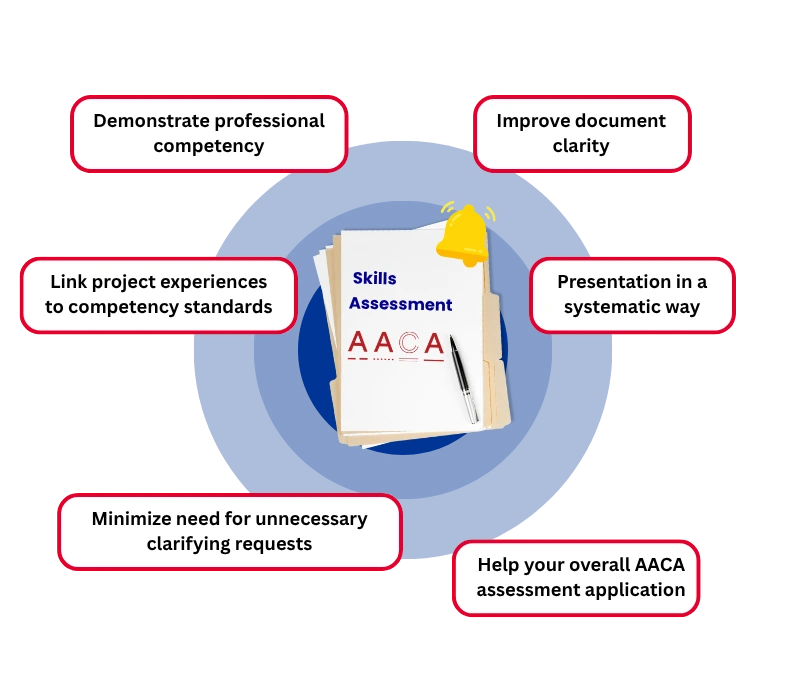
A Summary Statement that’s well prepared helps:
The document should address how you used architectural knowledge, addressed technical issues,
The National Standard of Competency for Architects (NSCA) outlines the knowledge, skills and professional behaviours required of architects wanting to be registered in Australia.
It is a nationally recognised competency framework which is consistently used across the architectural profession throughout Australia.
The framework assesses an architect’s ability to handle professional responsibilities safely, ethically and competently.
While international applicants may have extensive experience, they need to show that they have the skills in line with Australian expectations.
The competencies in the competency framework typically cover the following areas:
The architects should be aware of professional ethics, legal responsibilities, business procedures and risk management.
Competencies include:
Candidates would be expected to show the potential to take client briefs and deliver them in a realistic architectural way.
Examples include:
The system can assess technical architectural skills.
The applicant should have experience with:
It’s important for architects to be aware of the regulatory process.
Examples include:
This competency concentrates on making clear records needed for building.
Examples include:
Applicants should have a strong management capability to manage architectural projects during the construction process.
Examples include:
Many different stakeholders are involved in the work of architects.
Communication skills: with:
The importance of sustainable architecture is becoming a growing priority in Australia.
The applicant needs to have an understanding of the following:
Take our free Eligibility Test — answer 5 quick questions about your engineering background, qualifications, and visa goals. We’ll identify your assessment body, ANZSCO code, and the exact documents required. Takes under 3 minutes.
In most cases, the internationally qualified architect applying for an assessment via AACA (the Australian Architects Accreditation Council) will be required to submit the NSCA Summary Statement.
It is especially applicable to all professionals who want to prove that their qualifications and experience in architecture obtained abroad satisfy Australian competency requirements.
Applicants commonly include:
You should map your experience to the competency framework, not just use chronological order, whether you’ve worked in residential, commercial, institutional, healthcare, hospitality, industrial or mixed-use developments.
A professionally written Summary Statement for an NSCA needs to give organised evidence of competencies.
Typical sections include:
Basic information of a candidate needed for identification.
A brief description of your educational background, work history, and career trajectory.
The central part, in which each competency is connected with concrete evidence from your work in practice.
Particular projects that exhibit specific skills.
These examples should explain:
The Summary Statement may include references to supporting evidence including:
For each competency, provide specific, relevant examples that support the competency, not a generic description of the competency.
Unfortunately, many applicants make avoidable errors that sabotage their application.
Some of the most frequent problems are:
A Summary Statement is NOT a CV. It should describe abilities – not tasks.
The assessor will look for elaboration of how your work meets specific competency criteria.
There are many applicants who talk about projects, but do not relate them directly to the appropriate NSCA competencies.
Explanations of architectural decisions, design considerations, regulatory compliance, and project coordination, as appropriate.
The projects should highlight your individual contribution and not overall company successes.
Creating a successful NSCA Summary Statement means more than just giving a description of your work experience. Your document should clearly show how your knowledge, skills and responsibilities relate to the competency standards set by the Australian Architects Accreditation Council (AACA). Each competency needs to be illustrated with practical examples from your architectural experience, so that the assessors can have an idea of how much depth and experience you have in your profession.
Here is a step-by-step process that many successful candidates use to write a Summary Statement.
Carefully read the competency framework that AACA requires before you start to write. Every competency is intended to have a specific purpose and embodies knowledge that is expected of architects working in Australia.
Do not write about all projects completed but choose projects that best illustrate technical and professional skills. The competency framework is essential for structuring your examples and making them relevant.
Choose projects that showcase a variety of responsibilities throughout your architectural career. The following list of experiences is intended to help you choose your projects so they demonstrate experience at various stages of project delivery:
Routine assignments are less likely to show some evidence of the project’s work than projects with measurable outcomes and substantial responsibilities.
This is the most important section of the NSCA Summary Statement.
Don’t just include what you are responsible for but describe a competency that is illustrated by each of your projects. For instance, if a competency is project coordination, explain the ways that you worked with engineers, consultants, contractors, and clients to produce successful architectural results.
Likewise, if a competency is related to sustainability, describe the decisions for sustainability that you made and why they were important to the goals of the project.
For each competency, evidence and examples should be provided from your work experience that demonstrate the competency.
Detailed project information should be provided for each competency.
Instead of writing:
“Prepared construction drawings.”
A better explanation would be:
This way, assessors can see both your work and see how you used your professional judgment.
An effective Summary Statement is organized and is easy to follow.
Use:
Do not repeat or use unnecessary technical jargon that may be confusing or divert from the competency evidence.

A carefully framed Summary Statement can make all the difference in presenting your professional experiences.
These are some of the best practices to be followed:
Talk about what you do in your organization or project team, NOT what you did. Your assessor is not assessing your employer’s performance; they are assessing your performance.
Identify instances in which you used architectural knowledge to address a design, planning, or construction problem. Give reasons for decisions where appropriate.
If you have experience in any of the following areas, display them, including:
A wide array of project work can illustrate different aspects of your work.
Architecture is a team sport. Describe your interaction with structural engineers, civil engineers, mechanical consultants, quantity surveyors, contractors, local authorities and clients through the project life cycle.
Meeting planning regulations and building codes, safety standards and ethical practices are all prominent considerations in the Australian architectural practice.
Where relevant, explain your involvement in:
Be sure to give accurate information, backed up with honest project experience. Don’t overstate your duties or involve work not directly related to you.
Using real-life projects makes the Summary Statement more realistic and convincing!
Naturally, even experienced architects can find themselves having to clarify their documentation if it is so brief that it does not provide enough detail.
Some of the typical causes are:
Applicants will occasionally reference projects without providing an explanation of how they have demonstrated the skills listed.
General phrases like “worked on architectural projects” aren’t particularly strong indicators of professional skills.
Assessors should have sufficient information for them to grasp the scope, complexity and role of the project.
There can be discrepancies between the employment reference, the portfolio, the CV and the Summary Statement which may result in further questions.
Architectural skills should have real-world examples of design development, construction documentation, coordination, compliance and project delivery.
Creating an NSCA Summary Statement is a time-consuming process that involves careful planning, technical writing, and understanding the expectations for AACA competency.
International practice is different from Australian practice, where the competency-based method for qualifications assessment is not familiar to many internationally qualified architects.
Professional help is available for:
Professional support is about showcasing your current skills and experiences in a clear, organized, and assessment-ready way – not rewriting them.
At CDR Writers, we are familiar with the documentation requirements that are expected of Australian migration and skills assessments. We have a proven track record helping professionals with all assessment authorities, such as AACA.
We offer architects the following services:
We work with applicants to make their work experience clearer, more accurate and appropriate for assessment.
From the most seasoned architect to your first AACA evaluation, we strive to make the documentation process easy and professional, yet with attention to detail.


CDR reports, resumes, VETASSESS, and RPL applications can be challenging to prepare. Our team of professionals has effectively helped clients obtain approval with professional services that address all of these needs.
Your NSCA Summary Statement should not simply be a supporting document; it should showcase your professional competence, architectural knowledge and practical experience in relation to the Australia-recognised competency standards. Providing a well-formed Summary Statement allows AACA assessors to easily comprehend your role within the architectural world, your decision-making skills and your preparedness for contributing to the Australian architecture profession.
This document needs to be well planned, competency mapped accurately and project evidence is needed. Your Summary Statement should not just reiterate your job duties, but should instead demonstrate how you used the principles of architecture, how you had to deal with challenges, how you related to multidisciplinary teams, and how you achieved successful project outcomes.
From residential to commercial, healthcare, industrial or public infrastructure projects, showcasing your expertise with a structured and professional approach can bolster your application for the AACA Skills Assessment.
At CDR Writers, we realize that all architects have different experiences in their career. The documentation support services are targeted at internationally qualified architects in preparation of organized, accurate and professionally formatted assessment documents that meet the expectations of AACA. Whether you need to look over your work for your project or work through the process of structuring your competency documents, we are here to assist you in creating a fully completed and presented application.
For anyone considering migrating to Australia as an architect, it’s worthwhile to take the time to put together a detailed NSCA Summary Statement as it will enhance the clarity of your application and help the assessment process run more smoothly.
A well-crafted NSCA Summary Statement can be a helpful tool in the presentation of your professional experience in the AACA skills assessment process. Rather than leaving important competencies open to interpretation, a structured and evidence-based Summary Statement helps demonstrate your capabilities with clarity and confidence.
When you need trustworthy support in documenting your AACA, CDRWriters.org can help. Our team of experts is available to assist you in organizing your project experience, reviewing your documentation, and preparing a professionally formatted NSCA Summary Statement including your architectural background.
Don’t wait any longer to get ready to pass your Australian architecture skills assessment with confidence; get in touch with CDR Writers today.
NSCA Summary Statement is a document that is submitted in the course of the AACA assessment process, which is based on competency. It illustrates the alignment of education, skills and experience of an architect to the National Standard of Competency for Architects (NSCA) in Australia.
Depending on the assessment pathway that an internationally qualified architect will be using to request assessment through the Australian Architects Accreditation Council (AACA), an NSCA Summary Statement may be required to be submitted as part of the application.
No. A Resume and an NSCA Summary Statement will offer a brief overview of your work experience and how it reflects the competencies outlined in the National Standard of Competency for Architects.
A thorough Summary Statement will include:
The following structure should be used to make sure that the content matches the competency framework that AACA requires.
No word count is set. The document should be sufficiently detailed to clearly illustrate each competency and not include extraneous or redundant information.
Yes, where appropriate. A single architectural design project can show development in a couple of competencies, as long as relevant examples are provided and competency is explained.
Some of the most frequent mistakes are:
Preventing these problems will help to make the application better and clearer.
Get a free consultation today. Our engineers will assess your profile and tell you exactly what you need — at no cost, no commitment.

Expert CDR, ACS, and VETASSESS assessment writing service. 5,600+ documents written. 99% approval rate. Serving professionals from 65+ countries migrating to Australia. Free consultation available.
Disclaimer:
CDR Writers is an independent document preparation service. Not affiliated with EA, ACS, VETASSESS, IML, or any official authority.
Sun-Fri · 24 Hours a Day
Copyright © 2020 – 2026 CDR Writers
99% Success | Trusted in 65+ Countries | 4.9/5 Rated | 100% Secure Payments
