
Online

Australia remains one of the top choice destinations for skilled workers looking to pursue a better career and a better life. Applicants, however, need to pass a skills assessment conducted by the Australian Skills Assessment Authority before applying for Australian Permanent Residency (PR). This process determines if your skills, work experience, and professional competencies are considered to be Australian standard for your nominated occupation. A frequent cause of delays or failure in assessments is inadequate or incorrect paperwork. Knowing what each Skills Assessment Document for your application entails can help you gain a better understanding of how your application will be assessed.
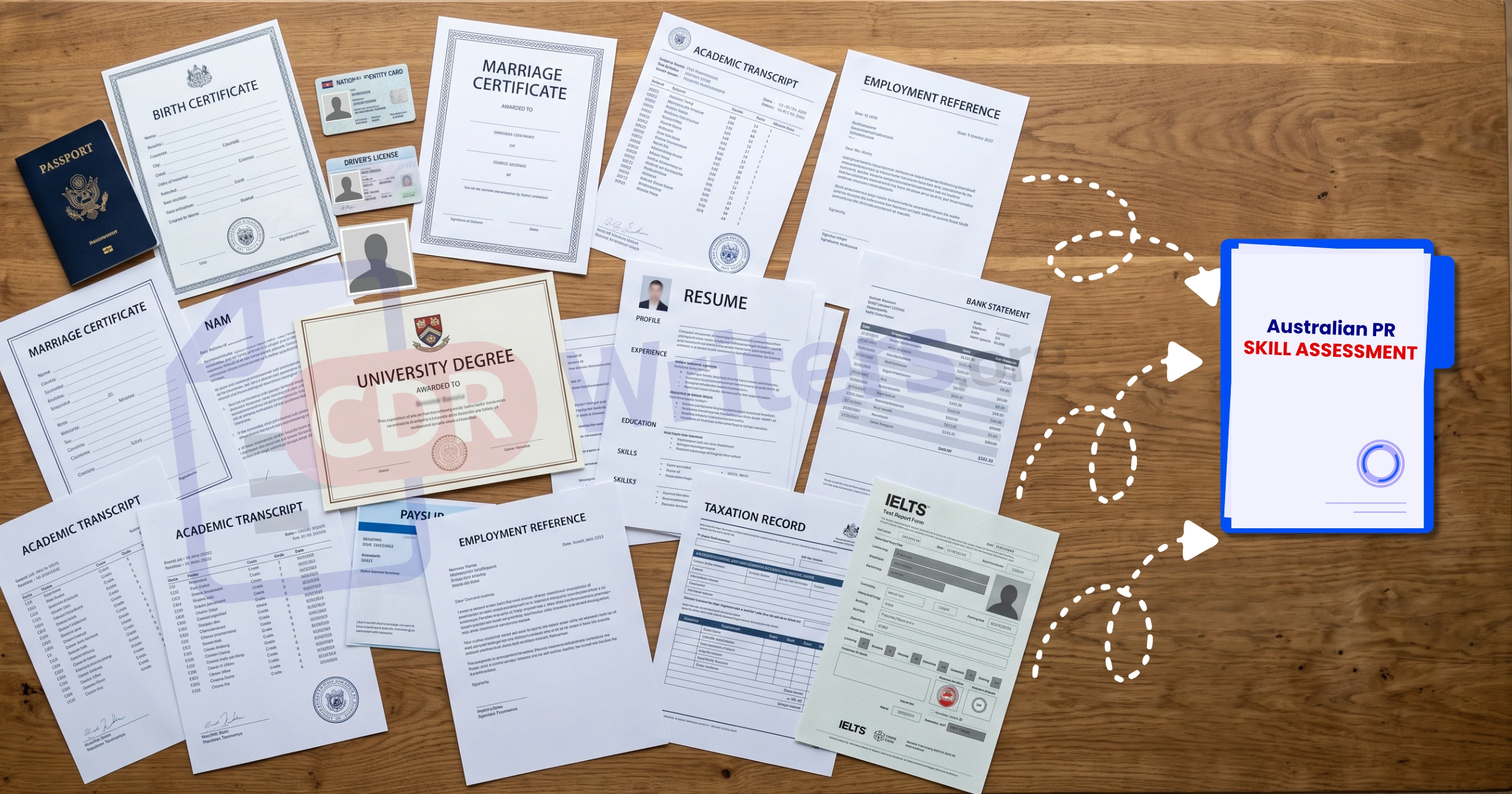
A skills assessment is an official assessment process undertaken by an authorised Australian assessing body to establish that your education, work experience and skills are appropriate to the occupation you are applying for.
Australia’s Skilled Occupation List has an assessor for each occupation. The following are some of the major assessing authorities:
Some documents may be required in different ways or not needed, or may be different depending on your occupation and assessing authority. There are a few key documents that are used in many assessments, however.
Your application will have a high likelihood of success if your supporting documents are good and accurate. Each Skills Assessment Document is a form of proof of eligibility.
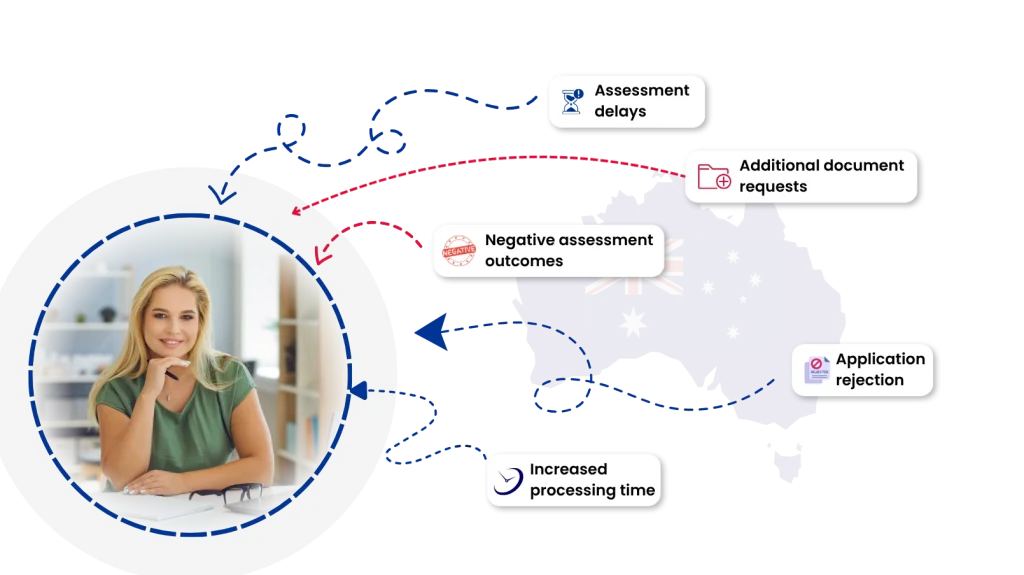
Incompleteness of documentation can result in:
When preparing materials for submission, you want to prevent any unwanted complications by preparing your documents carefully.
The following are the major documents that most applicants are required to provide when applying for the skills assessment process.
Your identity documents contain your personal information and nationality.
Typically, the following documents are required:
Make sure your passport is valid during the assessment period. If you have any discrepancies in the names in the documents, please provide a marriage certificate or name change certificate.
Australian authorities look at educational qualifications among their most vital documents being evaluated.
Commonly needed documents are:
Graduation completion certificate (if a Degree certificate is not yet issued)
The following should be evident on your transcripts:
The issuance of educational documents should be done by recognized institutions.
Employment reference letters attest to your work history.
An effective work letter contains:
A number of assessment bodies match the responsibilities you list with occupational standards from Australia. For this reason, generic experience letters typically can’t be used.
Letters for reference should accurately describe your work in the job without over-embellishment.
Documents of salary can be used to substantiate the employment.
Accepted evidence could be:
Certain assessment agencies might ask for more than one source of income.
A professional CV is brief, concise, and covers all of your education, work history, technical skills, certifications, and accomplishments.
When writing a CV, it should contain:
Make sure that your CV is consistent with your completed documents.
There are some occupations that must be registered as a profession before getting assessed.
Examples include:
Where appropriate, provide current registration certificates from the appropriate professional body.
While some assessment authorities don’t ask for English test results at the time of skills assessment, many applicants file applications for PR with English results later on.
The following English tests are accepted:
Check the language requirement test for the job at all times!
If your name is inconsistent, say, on your educational and employment records, present supporting legal documents like:
It helps to avoid verification problems if the documents are consistent.
Some positions appreciate professional membership as a contributing element.
Such as with:
These are not always required, but they will add to your professional profile.
For some roles, particularly engineering and IT, further technical information may be necessary.
Examples include:
These documents are evidence of application of skills.
Candidates who apply for this position through the Engineers Australia (EA) Competency Demonstration Report (CDR) pathway will need to provide more documents.
These generally include:
Each document needs to meet Engineers Australia assessment guidelines and demonstrate engineering practice competency.
Your work experience claims are backed up by employment contracts.
Typically these documents will contain:
Employment contracts are used as supplementary evidence to the reference letters.
Promotion letters contribute to career development.
They indicate:
These documents can boost your employment record.
Employment records issued by the government boost the credibility of your application.
Examples include:
These documents are available as independent proof of employment.
Travel history may be requested for applicants with overseas work experience on occasion.
These records may contain:
These documents are very useful in establishing your physical presence when working.
It is as important to prepare correct documents as it is to collect them. Here are a few tips:
Organize documents to follow a logical sequence.
For example:
Well-organized files facilitate the verification process.
Some grading agencies will accept certified copies instead of originals.
Assessment and certifications should be conducted by qualified staff following assessment criteria.
All information should be consistent throughout documents.
Verify:
Inconsistencies, no matter how minor, can result in further verification.
Scans with blurred or cropped images can slow processing down.
Ensure documents are:
All documents in a language other than English must have a certified translation in English.
Use accredited translators accepted by the assessing authority.


CDR reports, resumes, VETASSESS, and RPL applications can be challenging to prepare. Our team of professionals has effectively helped clients obtain approval with professional services that address all of these needs.
Avoidable documentation errors result in many applicants getting negative ratings.
Common errors are:
Letters of reference that do not include specific job duties do not meet assessment criteria.
Do not take up any job without proper supporting documents.
Verification checks are often carried out by the authorities.
Keep passports, registrations, and licenses valid.
Employment should be synchronized between:
All assessing authorities have document requirements that they publish.
Always check the most current official guidelines before submitting.
It is a difficult challenge to compile a Skills Assessment Document portfolio, particularly for people who are not used to applying for Australian immigration.
Professional consultants can help by:
A qualified professional ensures that there are fewer mistakes and an increased chance of success.
The key to a successful Australian PR skills assessment starts with accurate, complete and well-documented information. Each Skills Assessment Document is an important document showing your educational qualifications, work experience, and competency for your nominated occupation.
Don’t hurry through the process, but make sure that each document is carefully prepared. Ensure that all details are accurate; adhere to the requirements of your assessing authority; and ensure that everything is consistent throughout your application.
Enlist the assistance of a professional, such as an engineer through Engineers Australia or a different assessing body, and the process will be even easier – and less fraught with problems with documentation.
Skilled professionals can rely on CDR Writers for high-quality documentation, such as Competency Demonstration Reports (CDRs), employment reference letters and thorough skills assessment assistance. Our professional team has the knowledge to what Australian assessment authorities are looking for and can assist you to develop a well-prepared application with confidence.
Get a free consultation today. Our engineers will assess your profile and tell you exactly what you need — at no cost, no commitment.
Expert CDR, ACS, and VETASSESS assessment writing service. 5,600+ documents written. 99% approval rate. Serving professionals from 65+ countries migrating to Australia. Free consultation available.
Disclaimer:
CDR Writers is an independent document preparation service. Not affiliated with EA, ACS, VETASSESS, IML, or any official authority.
Sun-Fri · 24 Hours a Day
Copyright © 2020 – 2026 CDR Writers
99% Success | Trusted in 65+ Countries | 4.9/5 Rated | 100% Secure Payments
