
Online

If you’re considering a move to Australia for work, understanding the Skilled Occupation List Australia is crucial. This list outlines the occupations that are in demand across the country, making it a key resource for anyone looking to immigrate through skilled migration. The Australian immigration skills list is designed to help skilled workers find opportunities that match their qualifications and experience.
The Skilled Occupation List (SOL) is a significant reference for those who want to work or migrate to Australia on a skilled visa route. The list specifies details of eligible occupations, occupation codes, applicable visa programs, caveats, and the skills assessing authority.
But Australia’s skilled visa system is not based on one single list of occupations for all visas. The occupation requirements can vary depending on the visa subclass and stream. Applicants are therefore advised to verify their occupation for the current Australian Government requirements before embarking on a visa or skills assessment application.
Checking the occupation list is just the beginning for engineers and other professionals. You might also need a positive skills evaluation by the relevant assessing body before you can undertake a migration pathway.

Skilled Occupation List Australia: A government tool to identify occupations applicable to various visa programs in Australia.
The current Skilled Occupation List (SOL) from the Australian Government includes the following information:
The current government search tool enables the user to choose a specific visa and use it to find occupations related to the visa.
This does not imply that because you have listed your occupation on any of the Australian occupation lists, you are automatically eligible for all skilled visas.
You need to check:
There are various lists of skilled occupations and visa-specific arrangements in Australia.
The current Home Affairs occupation search includes visa programs such as:
Australian Government also states there are varying occupation-list arrangements for different subclasses of skilled visas. Examples include the Core Skills Occupation List (CSOL) for certain employer-sponsored occupations and the MLTSSL, STSOL and ROL continuing to be in the government’s occupation-list framework for occupations relevant to those programs.
The ANZSCO code is one of the most crucial ways to understand an occupation.
ANZSCO is the Australian and New Zealand Standard Classification of Occupations. It defines a standard classification framework for occupations and details the skills, qualifications, and experience required for each occupation.
An applicant should NOT use a job title to indicate their intended career path alone, e.g. “Civil Engineer”. They should also ensure that their nominated occupation has a corresponding education and/or occupational experience code.
ANZSCO information is published by the Australian Government’s occupation list, along with visa and assessing-authority information.
Your ANZSCO code provides an impact on:
A wrong occupation selection can lead to issues in the skills assessment and visa application process.
The skilled workers list Australia is a frequently searched term, referring to the list of occupations that are eligible for skilled migration.
A skilled occupation will normally involve a specific level of skills, knowledge, qualifications or professional experience.
There is an important difference, however:
Being a skilled worker
And
having an occupation eligible for a particular Australian visa.
A person may have a lot of work experience and not be able to satisfy the requirements of a particular occupation and visa category that may apply to their pathway for migration.

Therefore, applicants must carefully evaluate their occupation on the basis of government requirements and not the job title only or general lists of “in-demand occupations”.
Those who are searching for “critical skills list Australia” are typically interested in the jobs that are essential for the Australian economy or in great demand.
But it is important to note that the Critical Skills List, Skilled Occupation List, and Occupation Shortage List must not be assumed to be synonymous.
Australia’s immigration occupation lists are for particular visa and migration purposes, and Jobs and Skills Australia publishes labour-market shortage information using its Occupation Shortage List (OSL).
The OSL includes information on occupations with shortages around Australia and can indicate if an occupation is a shortage at the national, regional or metropolitan level.
So, when an occupation is in shortage, this does not automatically mean that someone who applies for an Australian skilled visa will automatically be granted the visa.
Jobs and Skills Australia maintains the Occupation Shortage List (OSL), which details occupations that are in shortage on the Australian labour market.
The OSL is a snapshot of occupation shortages, according to Jobs and Skills Australia. Data can be presented at various levels of occupation classification and includes shortage ratings.
A shortage might be in one or more of the following categories:
The OSL is thus useful to understand the demand for labour in the Australian labour market but is not necessarily an accurate reflection of the occupations needed for a particular visa.
Skilled Occupation List | Occupation Shortage List |
Used within Australia’s immigration framework | Labour-market shortage analysis |
Published through the Australian Government/Home Affairs framework | Published by Jobs and Skills Australia |
Helps identify occupation/visa requirements | Identifies occupations experiencing shortages |
Includes visa and assessing-authority information | Provides shortage ratings and labour-market information |
Relevant to visa eligibility depending on the program | Does not itself grant visa eligibility |
The phrase “Australian immigration skills list” is often used as a general term for Australia’s occupation lists used for skilled migration.
However, it is important to note that there is no one definite list of requirements to assume that each of the Australian visa types is eligible.
Home Affairs has an online searchable database of the Skilled Occupation List from which applicants can choose a visa and explore the occupations within that visa application program. The government information also shows which assessing authority is relevant, and which category from the list of occupations is applicable.
So when verifying your occupation, always begin your search with the visa subclass you plan to apply for.
For instance, the skills requirements for a points-tested skilled visa can be different
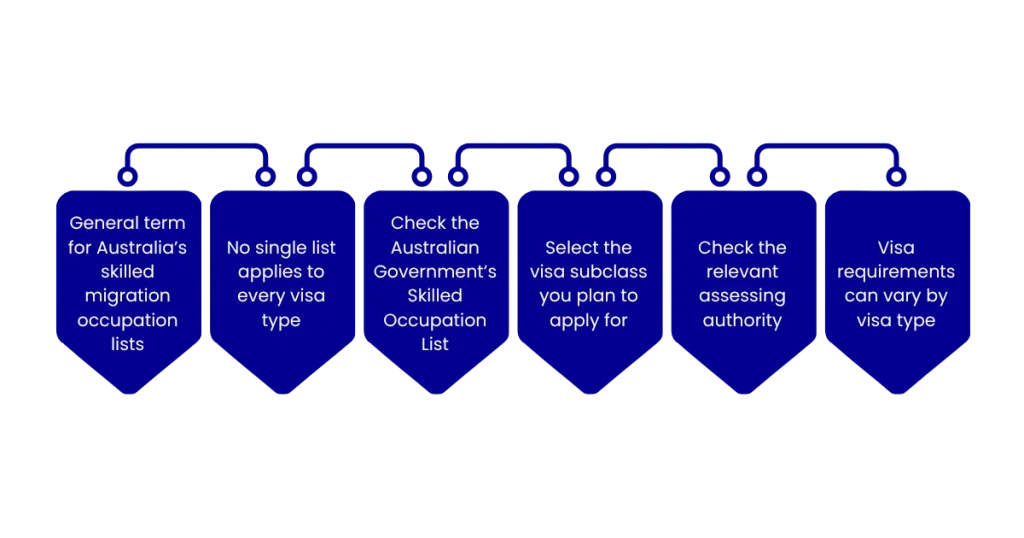
to those for an employer-sponsored visa.
It is important to take the Australia skilled migration list into account when looking at the visa pathway you wish to pursue.
There are a number of popular skilled migration visa categories that are often studied:
The Skilled Independent visa is a points-tested visa for skilled visa holders meeting the necessary requirements.
The Skilled Nominated visa is a points-tested visa that includes a state nomination.
The Skilled Work Regional visa allows skilled workers who meet the requirements to live and work in regional areas (where available).
Pathways with employers have their own set of occupation, employer, position and visa requirements.
Examples of the current occupation framework include the Employer Nomination Scheme subclass 186 Direct Entry pathway and the Skills in Demand subclass 482 Core Skills pathway.
The key point is that the eligibility of occupations should always be verified for each visa and stream and is not necessarily the same across each visa and stream.
Engineering is one of the most critical areas of the Australian skilled migration program.
Depending on the nominated occupation and pathway, engineers may require a formal skills assessment by Engineers Australia prior to the migration process to Australia.
Engineers Australia has been authorised by the Australian Government to assess engineering qualifications, skills and experience for migration purposes.
Engineering jobs may encompass:
Always check the most up-to-date government occupation information for the exact occupation, ANZSCO code, visa eligibility, and assessing authority.
For engineers looking to move to Australia, reviewing the occupation list is just one of the steps in your migration.
There are currently four occupational groups for migration skills assessment recognised by Engineers Australia:
Qualifications and circumstances will mean that you might need to complete a specific assessment pathway.
Engineers Australia identifies pathways such as:
The CDR pathway may apply to applicants who may not have an accredited engineering qualification, or applicants wanting to be assessed for an engineering occupation other than their qualification title.
That is the reasons why engineers need to be cautious when choosing their occupation and assessment pathway before preparing their migration documents.
Competency Demonstration Report (CDR) is an assessment process for Engineers Australia for some applicants where competency requirements must be met by the CDR process for their qualifications or circumstances.
Applicants are assessed by Engineers Australia against the relevant competency standards, using the pathway.
Documentation that may be part of a CDR application includes:
It should be noted that assessment requirements may change and applicants are requested to ensure their application is prepared in accordance with the most recent Engineers Australia assessment requirements.
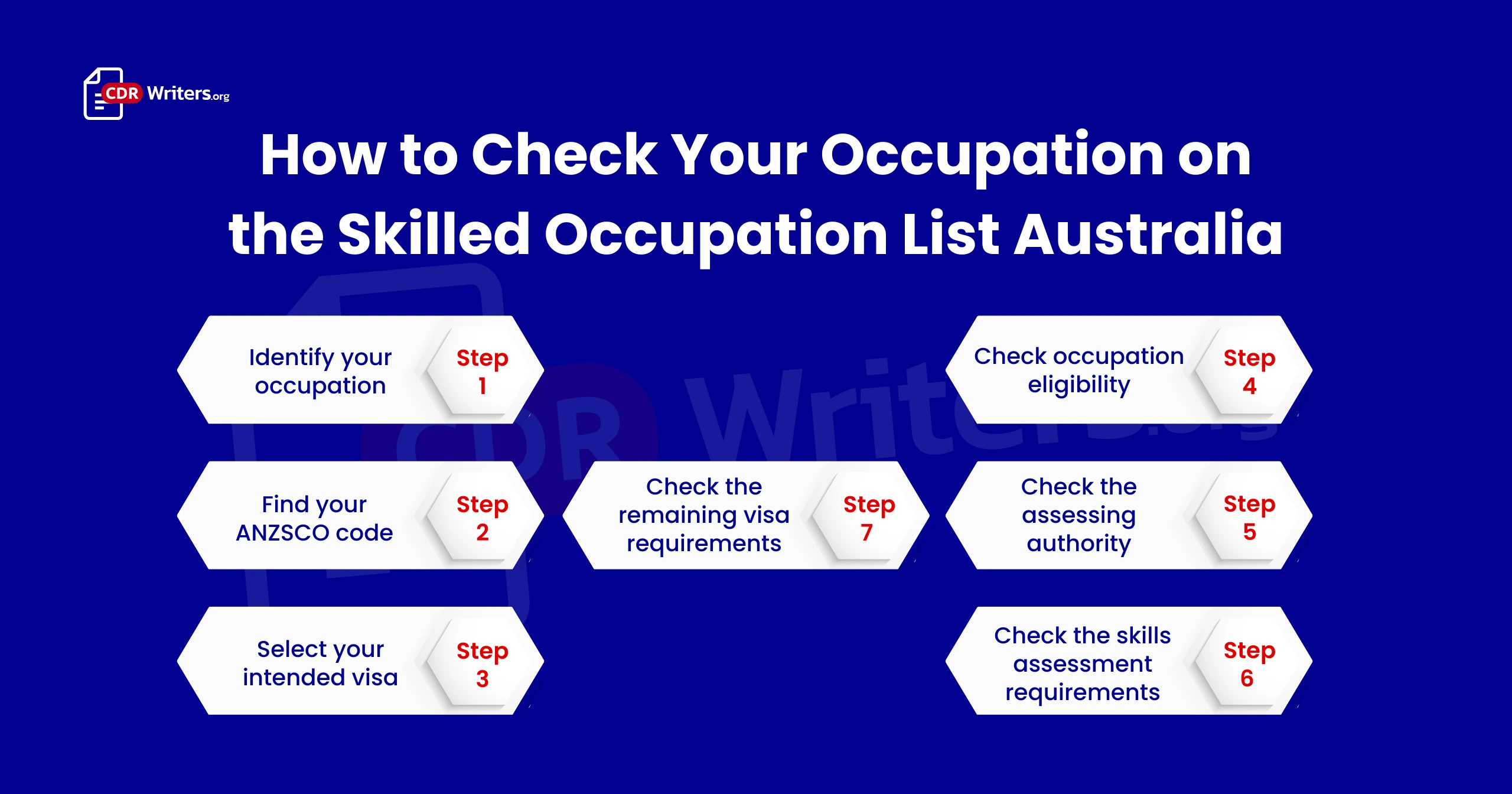
To ensure that your occupation is correct, follow these steps:
Begin with the job most closely related to your real work experience, skills, and education.
Look for the appropriate ANZSCO occupation and read the description.
Check the Australian Government’s occupation list search and dive into the visa you are interested in.
Review if your occupation is listed for the visa or stream.
Where appropriate, the occupation information states which skills assessing authority is relevant.
Each assessment authority will have its own requirements.
Engineers Australia offers migration skills assessment pathways for engineers based on qualifications, accreditation and nominated occupation.
You might also be asked to provide information about:
No.
Just because a job is listed as a visa category, it doesn’t mean that it is automatically eligible for the visa.
Applicants will need to meet the criteria for their particular visa category.
The following are some of the visa requirements:
The occupation list must be seen as a component of a broader migration process – not an indication of permanent residency.
There is possible confusion between these terms.
The Australian Government occupation-list system offers information about occupations for certain visa categories, including occupation codes, visa associations, caveats and assessing authorities.
Occupations identified on the Occupation Shortage List are those in which there is a labour market shortage, as determined by Jobs and Skills Australia.
A skilled migration visa is not automatic for every occupation when there is a shortage, as well. There is also a need for skilled migration visas when a labour shortage exists, but not all occupations are eligible for all skilled migration visas.
Similarly, visa eligibility should not be decided upon based on if an occupation is on a labour-market shortage list or not.
Always make sure to check the current visa requirements for the visa you wish to apply for.
This list applies to General Skilled Migration visas such as subclasses 189, 190, and 491 and is based on ANZSCO 2013.
Occupation | ANZSCO Code | Visa(s) | List | Assessing Authority |
Registered Nurse | 2544 | 189, 190, 491 | MLTSSL | AHPRA |
Software Engineer/Developer | 2613 | 189, 190, 491 | MLTSSL | ACS |
Civil Engineer | 2332 | 189, 190, 491 | MLTSSL | Engineers Australia |
Accountant (General) | 2211 | 189, 190, 491 | MLTSSL | CPA, CA ANZ, IPA |
ICT Project Manager | 1351 | 189, 190, 491 | MLTSSL | ACS |
Quantity Surveyor | 2332 | 189, 190, 491 | MLTSSL | AIQS |
Mechanical Engineer | 2335 | 189, 190, 491 | MLTSSL | Engineers Australia |
Early Childhood Teacher | 2411 | 189, 190, 491 | MLTSSL | AITSL |
Psychologist | 2723 | 189, 190, 491 | MLTSSL | AHPRA |
Social Worker | 2725 | 189, 190, 491 | MLTSSL | AASW |
View the full and updated Skilled Occupation List on the official Home Affairs website.
The CSOL supports employer-sponsored visas like subclass 186 and 482 and aligns with ANZSCO 2022.
Occupation | ANZSCO Code | Visa(s) | List | Assessing Authority |
Registered Nurse | 2544 | 482, 186 | CSOL | AHPRA |
Software Engineer | 2613 | 482, 186 | CSOL | ACS |
Electrician | 3411 | 482, 186 | CSOL | TRA |
Plumber | 3341 | 482, 186 | CSOL | TRA |
Carpenter | 3312 | 482, 186 | CSOL | TRA |
Chef | 3513 | 482, 186 | CSOL | TRA |
Aged or Disabled Carer | 4231 | 482, 186 | CSOL | VETASSESS |
Accountant (Financial) | 2212 | 482, 186 | CSOL | CPA, CA ANZ, IPA |
Medical Laboratory Scientist | 2346 | 482, 186 | CSOL | AIMS |
Automotive Electrician | 3212 | 482, 186 | CSOL | TRA |
For the complete and most current CSOL, refer to the official PDF:Core skilled occupation list australia 2025 pdf.
Checking only the job title
There can be two occupations with the same title but different occupational classifications.
Ignoring the ANZSCO code
Occupations can be important when applying for a visa and skills assessment.
Using an outdated list
The migration requirements in Australia may vary at any given time. Please ensure that all the latest government data is consulted prior to applying.
Assuming shortage means visa eligibility
The Occupation Shortage List is different from the lists of occupations eligible for immigration.
Assuming one occupation list applies to every visa
Visa and stream-specific requirements will be checked.
Ignoring the assessing authority
There are some jobs that need a formal skills assessment by a designated authority.
Assuming occupation eligibility guarantees PR
Being a listed occupation is just a part of migration.


CDR reports, resumes, VETASSESS, and RPL applications can be challenging to prepare. Our team of professionals has effectively helped clients obtain approval with professional services that address all of these needs.
The assessing authority is of particular importance for engineers.
According to Engineers Australia, it is the Australian Government-approved body to evaluate engineering qualifications, skills and experience for migration.
There is a possibility for an applicant to undertake an applicable accredited pathway if they hold engineers’ accredited qualifications, or they may require the CDR pathway if they do not have engineers’ accredited qualifications.
For this reason, applicants should ensure that they verify:
Occupation → ANZSCO code → Qualification → Assessment pathway → Engineers Australia requirements
This can help minimize the risk of a wrong assessment pathway being chosen.
The Skilled Occupation List Australia is a helpful first step in the process of planning for skilled migration, but it’s not all that is involved in the migration process.
Applicants must select their occupation, ensure that their occupation is matched to their visa, find out the assessing authority for their occupation, check the occupation against their intended visa, and be aware of all visa requirements before applying.
Engineers Australia migration skills assessment may also be required for engineers. An accredited pathway or pathway through a Competency Demonstration Report (CDR) may be required for applicants depending on their qualifications and circumstances.
When preparing an engineering migration application, it is important to know the needs of the occupation before you begin your skills assessment or CDR, to ensure you are applying your skills assessment or CDR the right way and to ensure you are choosing the right pathway for your engineering migration application.
The Skilled Occupation List Australia is an Australian Government resource of information on occupations that are relevant to specific visa programs, such as occupation codes, visa programs and assessing authorities.
No. Australia’s immigration system includes the Skilled Occupation List, and the Occupation Shortage List is a report on labour shortages by Jobs and Skills Australia.
Use the Australian Government’s Occupation List search tool to find the current status of the visa and select the relevant visa, and check your occupation, ANZSCO code, caveats and assessing authority.
ANZSCO is the Australian and New Zealand Standard Classification of occupations. It offers a uniform definition of occupations and details regarding the abilities, qualifications and experience required.
No. All requirements of the visa pathway must be met. This can encompass skills assessment, English, points, nomination and others.
Get a free consultation today. Our engineers will assess your profile and tell you exactly what you need — at no cost, no commitment.

Expert CDR, ACS, and VETASSESS assessment writing service. 5,600+ documents written. 99% approval rate. Serving professionals from 65+ countries migrating to Australia. Free consultation available.
Disclaimer:
CDR Writers is an independent document preparation service. Not affiliated with EA, ACS, VETASSESS, IML, or any official authority.
Sun-Fri · 24 Hours a Day
Copyright © 2020 – 2026 CDR Writers
99% Success | Trusted in 65+ Countries | 4.9/5 Rated | 100% Secure Payments
