
Online

If you are looking to migrate to Australia as an IT professional, it is crucial that you know all about the ACS Processing Time. Information and Communications Technology (ICT) occupations are assessed by the Australian Computer Society (ACS). Many visa routes require applicants to have a positive skills assessment from ACS before they can apply.
Many software engineers, developers, ICT business analysts, system administrators and other technology professionals ask themselves, “How long does ACS take to process an application?” It varies depending on various factors such as the kind of application, accuracy of documents, workload at ACS, and more information required.

The Australian Computer Society Skills Assessment is an official evaluation procedure to check if an applicant’s skills and experience align with Australian requirements for the occupation they have nominated in ICT.
ACS evaluates applicants for jobs like:
Skilled visas like Subclass 189, 190 and 491 normally involve submitting a Letter of Intent (EOI) for skilled migration visas, and it is often essential to have a positive ACS assessment to be able to file for these visas.
The skills assessment process is among the initial steps in the migration process; knowing the timeline can assist applicants in planning their visa application effectively.
Typically, the Processing Time of a standard ACS will range from 8 to 10 weeks from the date that all the appropriate documents and payment have been successfully received.
There is no fixed processing time; however, it may differ based on:
It is important to always give yourself extra time when planning your visa application, particularly if applying for invitation rounds or state nominations that have tight deadlines.
In most cases, the process will be similar to the following timeline:
Applicants submit:
After the submission has been made, ACS provides an acknowledgement receipt.
When documents are submitted to ACS officers, they will check to make sure that:
ACS may ask for additional information if there are documents that are missing or unclear.
Evaluators review:
This stage typically takes up the bulk of the overall processing time.
Once successful, applicants will be notified with one of the following:
The last assessment letter can then be utilized for migration purposes.
Yes.
If there is not enough evidence in the application, it may be unsuccessful.
Common reasons include:
Careful review prior to submission can greatly increase success rates.

The speed of an application running through the system depends on a number of factors.
The most substantial cause of delays is due to missing documents.
Typically, some items are missing, such as:
Candidates are advised to read the requirements of ACS carefully before applying.
ACS reserves the right to make further verification checks on claims of employment.
This can involve:
The application process for documents that must be verified is likely to be lengthier.
The volume of applications to ACS is higher during migration times, and that is expected to increase the time to assess the application.
Applications are sometimes used more:
If you select the wrong ANZSCO occupation, you may experience some delays and may even fail to achieve success.
The job applicant must choose the job occupation that suits their daily work and experience.
Should ACS need clarification or documentation, the processing clock stops until the applicant supplies the necessary documents.
Prompt response may result in a decrease in delays.
A common question that is asked by many who apply for ACS is the question of whether or not they receive an expedited or priority service.
At present, applications are generally accepted by ACS in FIFO (First in, first out) order. Standard migration assessments are usually not available on a fast-track service offered by the public.
Hence it is advisable that applicants apply as early as possible to avoid complications due to the timing of the visa processing.
While there is no way to directly influence ACS workloads, there are a number of best practices that can greatly enhance an applicant’s chances of receiving a faster response.
Make sure that all documents are:
The following should be included in employment references:
References often aren’t written very well and result in follow-up questions.
ACS would like to have strong evidence of employment in the form of:
The more robust the evidence, the more likely the assessment process is to run smoothly.
Please read the occupation descriptions in ANZSCO before submitting the application.
The closer the occupation chosen matches the real work activities, the more accurate the assessment will be and the fewer problems encountered.
Before submitting:
Simple mistakes can add weeks to the assessment process.
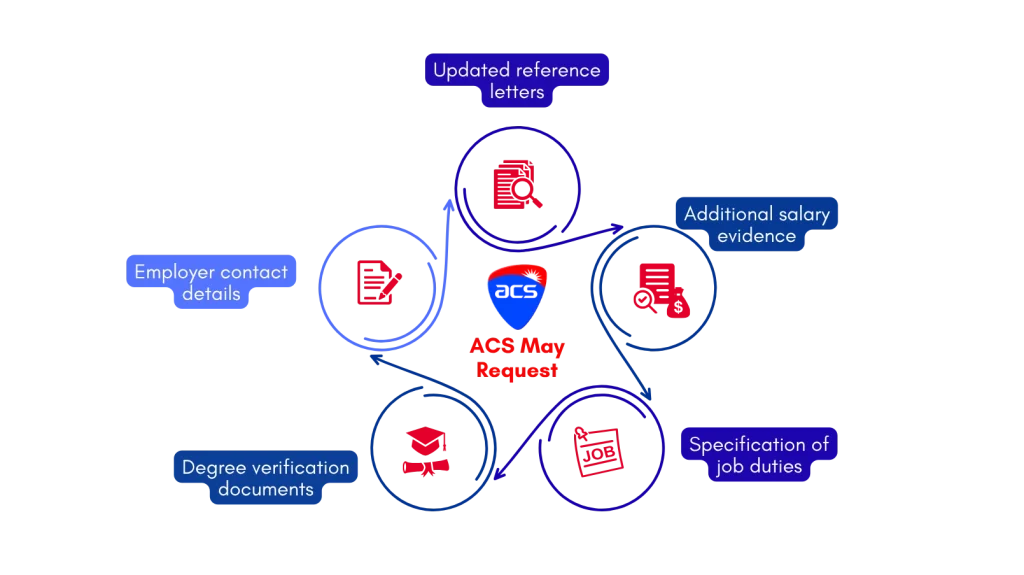
It isn’t a bad sign if you receive another information request, since it’s not the end of the world.
ACS may request:
It is important for the applicant to be prompt in their application and submit only requested information to reduce delays.
If applicants are given a positive result, they can proceed with the remaining phases of the migration process.
These may include:
Applicants should not delay their progress along the migration pathway if they wish to progress to the next phase of the assessment due to the validity of the ACS assessment.
In most of the ICT occupations, ACS follows the same assessment processes.
Whether an applicant applies as a:
The general average assessment period is not significantly different.
However, if an employee has more complicated work experience or qualifications, it may take longer to review.
There is no way that a registered migration agent or professional CDR and skills assessment consultant can affect the processing timelines of ACS.
But with the help of experienced professionals, you can help by doing these things:
A complete application is likely to be processed more easily than an application with multiple corrections.


CDR reports, resumes, VETASSESS, and RPL applications can be challenging to prepare. Our team of professionals has effectively helped clients obtain approval with professional services that address all of these needs.
Many applicants are making mistakes in their applications which are causing delays with the process.
These include:
There are some simple ways to avoid these pitfalls and save weeks of waiting.
As the skills assessment is a prerequisite for many migration streams, realistic timelines need to be built into migration plans.
A suggested time sequence might be:
Preparation is the key to preventing unnecessary stress and opportunities lost.
Familiarizing yourself with the anticipated ACS Processing Time is crucial when you’re ready to apply for Australian skilled migration as an ICT professional. Typically, the assessment period is 8-10 weeks, however, this time may differ based on the quality of the application, supporting documents and workload of the ACS.
The most effective way to minimize delays is to prepare a well-documented, accurate and complete application from the outset. Careful attention to occupation choice, salary documentation, and strong employment references can vastly enhance the assessment experience.
Patience and preparation are the hallmark of any aspiring Australian migrant’s skills assessment journey through the ACS.
Get a free consultation today. Our engineers will assess your profile and tell you exactly what you need — at no cost, no commitment.

Expert CDR, ACS, and VETASSESS assessment writing service. 5,600+ documents written. 99% approval rate. Serving professionals from 65+ countries migrating to Australia. Free consultation available.
Disclaimer:
CDR Writers is an independent document preparation service. Not affiliated with EA, ACS, VETASSESS, IML, or any official authority.
Sun-Fri · 24 Hours a Day
Copyright © 2020 – 2026 CDR Writers
99% Success | Trusted in 65+ Countries | 4.9/5 Rated | 100% Secure Payments
