
Online

Getting the appropriate skilled assessment for internationally qualified Nurses and Midwives intending to migrate to Australia is an essential aspect of the skilled migration pathway. The ANMAC Skills Assessment is used to establish if an applicant’s skills, professional registration and work experience are relevant to Australian skilled migration.
The Australian Nursing & Midwifery Accreditation Council (ANMAC) is the organisation that carries out skills assessments to determine the fitness of internationally qualified nurses and midwives who want to apply for selected Australian skilled migration pathways. ANMAC is independent of the professional registration by the Nursing and Midwifery Board of Australia (NMBA) via the Australian Health Practitioner Regulation Agency (Ahpra).
A successful skills assessment does not automatically lead to Australian nursing registration or a visa. Rather, it is a part of a larger migration process. The applicant needs to know which assessment process is applicable to them, to make their documents correct, and to ensure uniformity of their professional history.
At CDR Writers, we aim to assist applicants in making their understanding of the ANMAC assessment process, documentation requirements, and preparation requirements easier.


An ANMAC skills assessment is different to Australian professional registration. Skills assessment and registration are two different processes, and applicants need to be aware of the requirements of both before commencing their migration process.
An ANMAC Skills Assessment is an evaluation or estimation of a qualified nurse or midwife’s skills and experience in a profession or workplace relevant to skilled migration to Australia.
Applicants are assessed against the requirements for the occupation they nominated and the assessment pathway they have followed in order to be assessed by ANMAC. The assessment may take into account such things as:
The result of the assessment can be significant in the context of an Applicant’s Skilled Migration Application.

Applicants need to research the right ANZSCO occupation and which ANZSCO assessment pathway is relevant to them before applying.
ANMAC skills assessments are more applicable to nurses and midwives who might require a skills assessment for Australian skilled migration.
Applicants may include:
These will vary depending on the applicant’s occupation, their professional registration and their migration pathway, amongst other factors.
One of the most crucial aspects of the application procedure is the preparation of proper documentation.
Applicants might be required to submit evidence for the following areas of assessment on the pathway:
Typical ID requirements include a valid photo ID. Details in the information on the documents of identity should match the information used when applying.
Evidence of educational qualifications, such as certificates, academic records, transcripts or other documents as requested by ANMAC, may be required to be submitted by the applicant.
Professional registration may be required as evidence demonstrating the applicant’s professional standing and eligibility.
If you are from outside of the country, you may need proof of registration from a relevant overseas regulatory body.
If experience is relevant to the assessment, applicants should have prepared accurate evidence of their employment history, if any.
This can contain employer records, references, statements of work, dates of employment, position titles, hours worked, job description, etc.
Assessment pathways and the applicant’s circumstances may lead to different requirements for English language.
Applicants are advised to check for current ANMAC requirements and do not rely on any information provided by third parties’ websites.
Other documentation may be requested by ANMAC as appropriate to the applicant’s situation.
All documents must be original, complete and consistent and must be presented in the format expected by the assessment authority.
Take our free Eligibility Test — answer 5 quick questions about your engineering background, qualifications, and visa goals. We’ll identify your assessment body, ANZSCO code, and the exact documents required. Takes under 3 minutes.
One of the most frequently confused areas is the difference between the ANMAC skill assessment and nursing registration in Australia.
ANMAC is responsible for skills assessment for migration, whereas nursing and midwifery professional registration is managed by the Australian registration system.
Depending on circumstances, an applicant might have to go through the application process twice.
The purpose of the assessment is related to skilled migration. ANMAC assesses the applicant’s qualifications, professional background and other evidence required in accordance with the assessment criteria that apply to the applicant’s qualification.
The concept of professional registration relates to one person’s ability to legally practice as a nurse or midwife in Australia. The Australian health practitioner regulatory system is responsible for administering registration requirements.
As a result, applicants must not presume that they are registered to practise in Australia because they have achieved an ANMAC outcome.
The assessment process for an applicant will depend on their professional and migration status.
For some applicants, there is a modified assessment pathway if they are eligible on the basis of Australian registration or other eligibility criteria.
Before submitting an application in this pathway, potential ANMAC applicants should read the current ANMAC requirements carefully to ensure that the application is submitted in the appropriate assessment category to avoid possible delays or complications.
For applicants, where the qualifications and/or professional experience are in question, a complete Skills Assessment may apply.
This information and documentation may differ depending on the applicant’s background and nominated occupation.
ANMAC requirements may be updated, so please always check the latest requirements before submitting an application.
A properly structured package of documents can ease the application process and minimize possible pitfalls.
Where appropriate, applicants should prepare the following:
Specific document requirements vary by the pathway and by the type of applicant. It is therefore recommended that applicants always check their documents against the most up-to-date official ANMAC requirements prior to submission.
The processing time for ANMAC varies based on the assessment pathway, number of applications received, document completeness, need to verify the application, and requests for additional information.
Candidates are not advised to presume a particular processing time which might be published on unofficial websites, as processing could change.
The easiest way to minimize unnecessary delays is by submitting a complete application that includes accurate documentation at the outset.
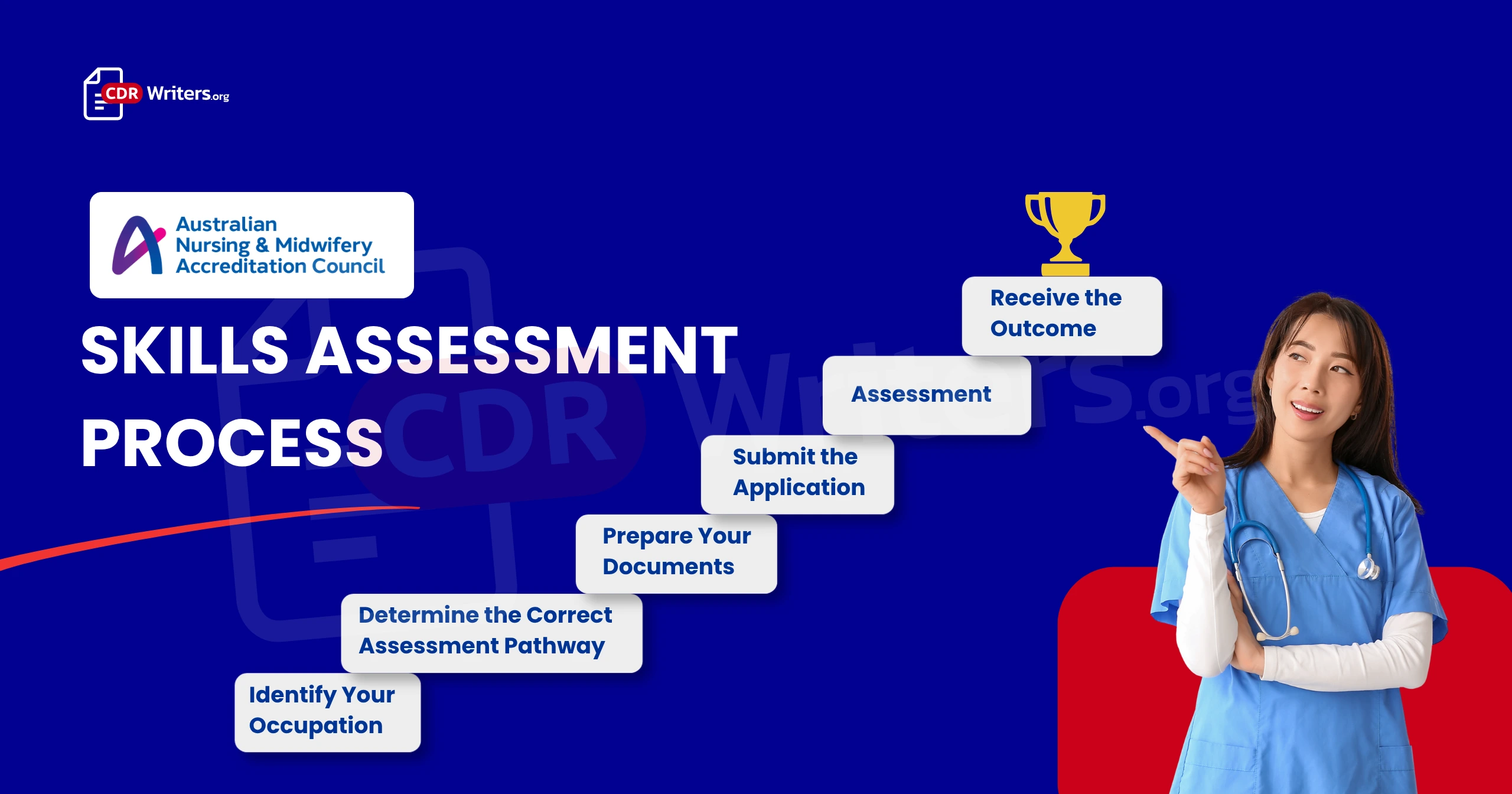
The overall process can be broken down into several steps.
The first thing you need to do is figure out what nursing or midwifery job will be a good job to move to.
The occupation suggested for you should be based on your professional qualifications and experience.
Explore all the ANMAC assessment pathways and decide which pathway is relevant to your situation.
Choosing the right path from the outset can help avoid delays.
Gather all necessary identification, educational, registration and employment paperwork, as well as other supporting documentation.
Verify consistency of names, dates, qualifications, employment dates and registration information throughout the application.
When the necessary documents are ready, apply in accordance with ANMAC’s current application process.
Applicants are reminded to review their information before submitting, as incomplete information or errors may impact processing.
The application and supporting evidence is reviewed by ANMAC, based on the appropriate assessment criteria.
Applicants will be asked to submit further information and/or documentation if necessary, within the deadlines indicated.
Once assessed, the applicant is given an outcome as per the relevant process.
The result can then form a key component of the applicant’s Australian skilled migration (ASM) journey if applicable.
ANMAC does charge a fee for skills assessment services, which will vary depending on the type of assessment and the current fee schedule.
Applicants will need to verify the most up-to-date official fee information from ANMAC as fees are subject to change
Applicants are advised to also include other costs of the migration process such as English language test costs, professional registration costs, document certification costs, translation costs, visa application costs, and any other professional and/or related costs.
In cases where evidence is not provided that supports the applicant’s claim, there may be problems for the applicant in making their application.
Some of the problems that are likely to occur are:
If missing certificates, transcripts, registration evidence, or employment documentation occur, there will be further requests or delays.
There may be variations in information, such as names, dates, job titles, periods of employment, or qualifications information, on different documents, which may give rise to assessment issues.
Taking an incorrect route to apply may cause additional problems.
Job applications must be backed by suitable evidence. Candidates should not include any general or incomplete information about their experience.
Any document in a language or format not suitable for the required language or format may require translation or supporting evidence.
The requirements and procedures for ANMAC may change. Using an old checklist or information from a forum only may result in the submission of the wrong checklist.
When planning to move to Australia, internationally qualified nurses may have to deal with multiple different requirements.
They might experience:
These steps are undertaken at the same time by different organisations and have different requirements, so applicants should not consider the ANMAC assessment as the whole migration process.
Midwives intending to move to Australia might also require an assessment that is relevant to their nominated occupation and migration pathway.
The process of preparing may include evidence of:
Applicants must be sure to match their skills and experience to the occupation nominated.
The key to good preparation is to start before the application is even submitted!
Maintain a full record of nursing or midwifery education, registration and work experience.
Ensure that the documents you are going to submit are not only complete but readable as well.
Make sure that all the documents have the same personal details, names of qualifications, registration information, work dates, and other relevant data.
You should not assume all nurses/midwives will use the same assessment process. Your course of action will be determined by your specific situation.
Please read the latest requirements and instructions from ANMAC prior to submitting an application.


CDR reports, resumes, VETASSESS, and RPL applications can be challenging to prepare. Our team of professionals has effectively helped clients obtain approval with professional services that address all of these needs.
There are several documents and requirements in the ANMAC process, and the applicant might not be sure what evidence is relevant to their situation.
An applicant can receive the following kinds of help from a professional:
But having a professional application does not mean that there will be a positive outcome of an assessment. The final decision with the respective assessing authority.
Careful consideration needs to be given to your occupation, qualifications, registration history, employment evidence, and supporting documentation when preparing your ANMAC Skills Assessment. Well, a well-prepared application can help you to overcome some common administrative issues and give a better picture of your professional background.
We at CDR Writers can help applicants who require assistance in understanding the process of the assessment and in preparing their documentation. We aim to guide nurses and midwives to carry out the evaluation with awareness of the need and the process.
If you are an internationally qualified nurse or midwife embarking on your Australian migration journey, it’s essential to understand the ANMAC process. Check your eligibility, determine the right path, assemble your paperwork, and double-check the requirements before you make your application.
ANMAC is the Australian Nursing & Midwifery Accreditation Council. It carries out skills assessment for eligible nurses and midwives for relevant Australian skilled migration purposes.
ANMAC and AHPRA are not the same. ANMAC is engaged in skills assessment for migration, and AHPRA is responsible for the registration process on behalf of Australia’s National Boards, including the Nursing and Midwifery Board of Australia.
Not necessarily. The requirement for an ANMAC assessment varies depending on occupation, migration pathway and individual.
ANMAC skills assessment is not equivalent to professional registration. There are generally Australian registration requirements to meet before you can practise as a registered health professional.
The processing time may be different depending on the type of assessment conducted, number of applications received, completeness of the documents and verification needs. Applicants are advised to refer to the latest published processing information from ANMAC.
Get a free consultation today. Our engineers will assess your profile and tell you exactly what you need — at no cost, no commitment.

Expert CDR, ACS, and VETASSESS assessment writing service. 5,600+ documents written. 99% approval rate. Serving professionals from 65+ countries migrating to Australia. Free consultation available.
Disclaimer:
CDR Writers is an independent document preparation service. Not affiliated with EA, ACS, VETASSESS, IML, or any official authority.
Sun-Fri · 24 Hours a Day
Copyright © 2020 – 2026 CDR Writers
99% Success | Trusted in 65+ Countries | 4.9/5 Rated | 100% Secure Payments
