
Online

✦Australia Immigration Guide
Priority visa processing, reduced documentation, faster outcomes — discover how accredited sponsorship status transforms the employer-sponsored visa experience for businesses and skilled workers alike.
Check Your Eligibility
Jump to 186 Visa Guide
Accredited Sponsorship is the highest-tier employer status in Australia’s immigration system — and it changes everything from how fast visas are processed to how much paperwork you need.
Speak with a registered MARA migration agent about your accredited sponsorship application.
Accredited Sponsorship is a more prestigious level of accreditation granted by Australia’s Department of Home Affairs to employers with a proven history of being an approved Standard Business Sponsor. It is not the point of entry to be a sponsor; it is a level of recognition that acknowledges employers who have been consistently meeting their sponsorship duties, and sponsorshiped workers are regularly present.
An accredited sponsor will be given priority processing on visa nominations and visa applications for the Temporary Skills Shortage (TSS) visa (subclass 482), the Employer Nomination Scheme (ENS) visa (subclass 186) and, in some instances, the Regional Sponsored Migration Scheme (RSMS).
There is no single searchable list of accredited sponsors provided by the department for Home Affairs. Rather, the status of being accredited is stored in ImmiAccount on the approved profile of the sponsor for each employer. This implies that the “list” is actually the current list of employers that have fulfilled the strict requirements set by the Department.
Accredited sponsorship status provides clear benefits to affect workforce planning, talent acquisition, and sponsored employee experience. The advantages are:
Applications are prioritized more than normal processing times for sponsorship-based visa applications, by factoring in the nomination from accredited sponsors.
Sponsors facing accreditation are less closely examined in the process, resulting in fewer delays from the Department requesting further documentation.
The documentation for nominations by accredited sponsors is reduced, which minimizes the administrative burden for HR and migration teams.
Businesses will be more certain about making offers to overseas workers, without the extended uncertainty.
Employers with accredited sponsorship status will signal to migrants and migration agents that they have a track record of successful and compliant sponsorship.
Demonstrates a compliant history — reducing risk for sponsored workers too.
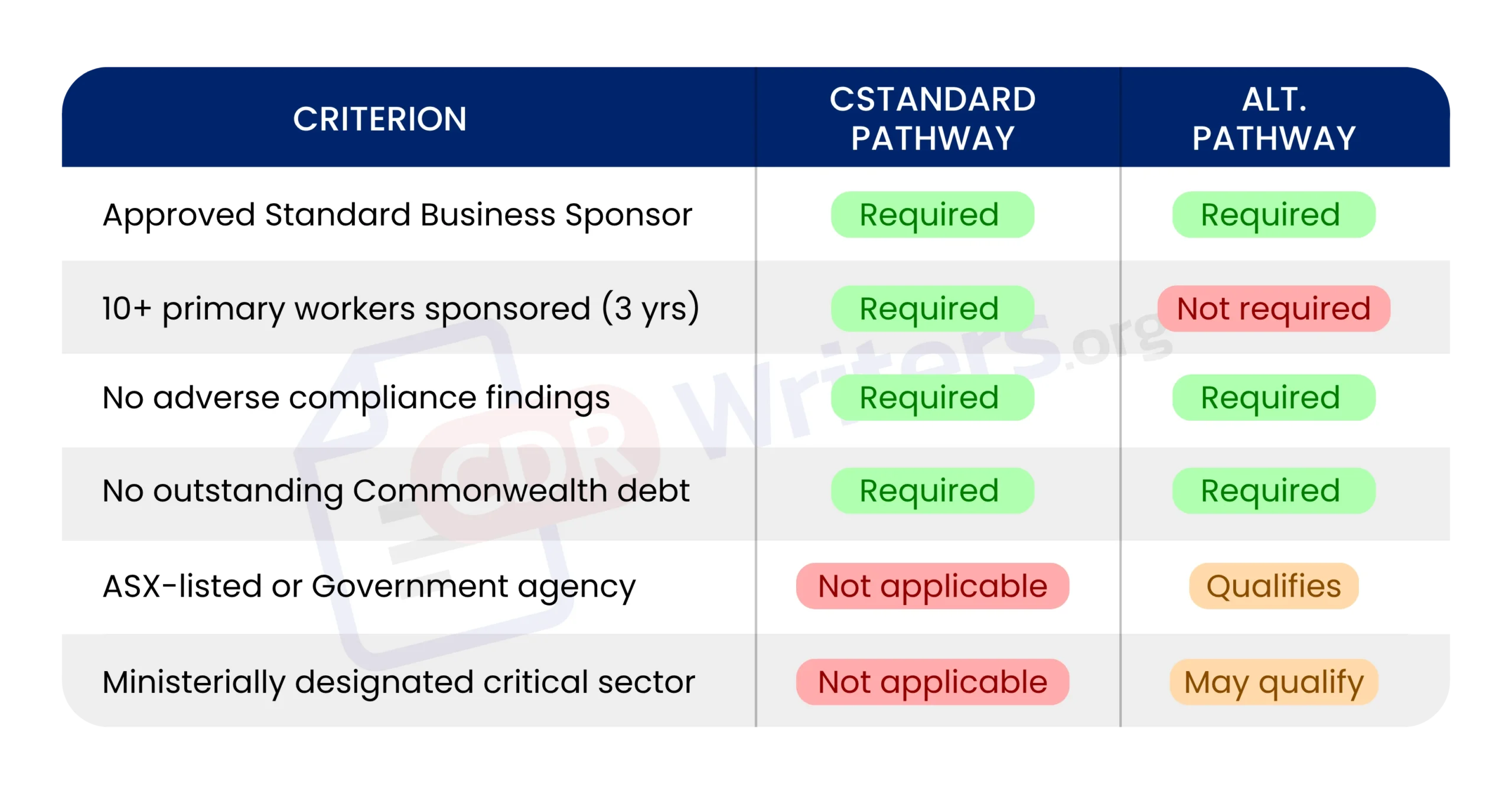
Not all approved Standard Business Sponsors are automatically eligible to become an accredited Standard Business Sponsor. The Department of Home Affairs has certain conditions for granting this elevated status.
In general, an employer must:
If you know where to look, it’s easy to confirm that you are an accredited sponsor. The way to do it:
If the accredited status of your profile is unknown or you think you should be accredited but your profile doesn’t reflect this, you have two choices:
Please note that, even though an institution is an accredited sponsor, this status is not guaranteed forever. Sponsors will have to keep fulfilling all the obligations and may also need to reapply or renew their status on a regular basis. Compliance is therefore not only a legal obligation, but it’s also essential to ensure your accredited sponsorship status continues into the future.
The list of accredited sponsors for Australian employer-sponsored migration is one of the most searched-for lists, and there’s a reason for that. The ENS subclass 186 visa is the most popular visa for skilled visa holders and is also an employer-sponsored visa.
There are three streams of subclass 186 visa:
🔄
Worked for the same employer for two years in an eligible occupation (TSS visa).
This is for workers who have their skills assessed by an appropriate authority (not necessarily with a TSS visa).
If the employer has a specific labour agreement with the Australian Government.
Employers on the 186 accredited sponsorship list are employers who are accredited employers and, as such, are eligible to nominate workers for a subclass 186 visa for priority processing. Importantly, it is not a separate document that is published publicly. It is the up-to-date list of sponsors that have been accredited by the Department and are listed in the Department’s ImmiAccount system.
The biggest benefit for employers on the list of accredited sponsors is the rapid processing of their TRT and Direct Entry nominations, which can be done within weeks instead of months. This is a big plus for companies that wish to keep their foreign employees and provide them with permanency as a retention offer.
The Direct Entry stream is much more efficient for workers sponsored by an accredited sponsor. The Department has a reduced documentation requirement for nominations from accredited sponsors and is less likely to request additional documentation.
Applicants are required to continue to satisfy all substantive visa criteria, such as:
Occupations need to be listed on a skilled occupation list for the Direct Entry stream. It is important to verify the eligibility for the occupation before starting the application process because not all occupations are eligible.
As an employer, it’s a great privilege to have your company listed on the accredited list, from a skilled worker’s point of view. For you personally:
Faster visa processing: your nomination and visa application will be prioritized and result in a visa decision quicker.
Greater employment security: Faster processing means a shorter time for your working rights to be in a transitional stage.
Less documentation stress: Your application will require fewer supporting documents from your employer, and you’ll not have to provide as many.
Increased confidence in the process: The use of an accredited employer will ensure that the sponsor has a good compliance history and less risk that your nomination will be denied on an employer-specific basis.
As a skilled worker looking at a job offer from an Australian employer, it is not only appropriate, but expected to ask your prospective employer or HR team if they have Accredited Sponsorship status. In the visa context, this is a common question, and it’s an indicator that you are knowledgeable about and proactive about your visa journey.
However, sponsored workers also have their own rights and obligations under the visa system. You can only work for your approved sponsor (or related entity), on your nominated occupation and under the conditions of your visa while you are in Australia.
If your business thinks it meets the eligibility requirements, you can follow this step-by-step guide to applying:
Step 1: Confirm standard sponsorship approval
Make sure that your business is an up-to-date Standard Business Sponsor. However, if you are not already an approved sponsor, you will need to go through the process of becoming an approved sponsor first.
Step 2: Gather evidence of your sponsorship history
Gather evidence of sponsoring at least 10 main applicants over the last three years. This includes visa grant records, nomination approvals, and employment documents.
Step 3: Prepare your compliance documentation
Collect evidence to show that the organization has fulfilled all their sponsoring responsibilities, including payroll records to support the market salary rates, evidence of no adverse findings, notification records to the Department (where applicable) and training benchmarks (where applicable).
Step 4: Submit your request to the Department
Requests for accreditation are made via ImmiAccount. Your application will be evaluated by the Department based on the published criteria.
Step 5: Await the outcome
Sponsor applications may take different lengths of time to be processed, depending on the accreditation. Specific timeframes will not be published by the Department, so it is important to put this into your workforce planning timeframe.
It is highly recommended that you use an agent who is registered as a MARA (Migration Agent Rehabilitators Australia) as the process involved can be extremely complex, and the consequences of not are harsh. A qualified agent will determine if you meet the requirements, put together the strongest case to apply and handle the application process for you.


CDR reports, resumes, VETASSESS, and RPL applications can be challenging to prepare. Our team of professionals has effectively helped clients obtain approval with professional services that address all of these needs.
Earning accredited sponsorship is only part of the process. It takes constant effort to keep it up. Sponsors are required to fulfill all other normal sponsorship requirements, such as:
Failure to comply with these requirements may lead to the loss of accreditation and in severe instances to action being taken against the organization’s ability to sponsor overseas workers. The most effective defence against the loss of accredited sponsorship status is to have a proactive compliance program, supported by HR and reviewed regularly by a migration agent.
Australian employers who are looking to secure talent from around the world are given one of the most useful tools to achieve that goal: accreditation. This will ensure businesses can provide quicker, more predictable visa results for skilled workers, and a competitive edge in the current low labour market.
Skilled workers who are sponsored by employers who have accreditation will have a smoother pathway to working and living legally in Australia and have greater confidence of success and fewer delays in the process.
Knowing about the accredited sponsorship status requirements and what is included in the 186 list of accredited sponsorships is a critical first step for employers who are determining eligibility, HR professionals who are managing a sponsored workforce and skilled workers who are planning their pathway to Australian visa status.
If you require advice specific to you, speak to a registered migration agent (MARA registered) or an experienced Australian immigration lawyer.
Standard Business Sponsor is the minimum visa approval needed to sponsor overseas workers to work in Australia temporarily or permanently. An Accredited Sponsor is a sponsor that has a successful track record of compliance and a substantial number of past sponsorships, and has an elevated status that gives the sponsor priority visa processing and less scrutiny and documentation by the Department of Home Affairs.
To verify that you are an accredited sponsor, log in to your ImmiAccount and view your approved sponsor record. Your status will be shown on your sponsorship profile. If the status is not known, please contact the Department of Home Affairs directly or use a registered migration agent.
An employer can nominate a worker for the ENS subclass 186 permanent visa, which has a priority processing pathway, if they are listed on the accredited sponsor list. This is not a document that is published publicly, but rather the real-time approved document listed on each employer’s profile in ImmiAccount.
To become an accredited sponsor, an employer will need to have sponsored a minimum of 10 primary applicants within the last three years, in most cases. Pathways are available for government agencies, ASX-listed organizations and employers in ministerially designated critical sectors, but they do not necessarily need to involve the same volume threshold.
Each visa application will be assessed on its merits, and priority processing and reduced documentation apply to No. Accredited sponsorship. The applicant will need to fulfil the visa eligibility conditions for the occupation, skills assessment (if applicable), English language proficiency, health and character requirements.
Yes, but it will take 10 workers to be held in the standard pathway for 3 years to qualify for sponsoring. Small businesses are eligible to apply if they have a volume and compliance threshold. If there is an alternative pathway, then it is created for firms that operate in specific industries identified by the Minister.
When a business sponsor fails to meet the standards for accreditation (usually as a result of a failure to comply), the business returns to the regular business sponsor status. This will result in the loss of priority processing. Overseas talent recruitment and retention might be impacted, and nominations in process could be significantly extended. The strongest internal compliance program is the best defence against this.
Get a free consultation today. Our engineers will assess your profile and tell you exactly what you need — at no cost, no commitment.

Expert CDR, ACS, and VETASSESS assessment writing service. 5,600+ documents written. 99% approval rate. Serving professionals from 65+ countries migrating to Australia. Free consultation available.
Disclaimer:
CDR Writers is an independent document preparation service. Not affiliated with EA, ACS, VETASSESS, IML, or any official authority.
Sun-Fri · 24 Hours a Day
Copyright © 2020 – 2026 CDR Writers
99% Success | Trusted in 65+ Countries | 4.9/5 Rated | 100% Secure Payments
