
Online

As a Registered Professional Engineer (RPE) of Queensland, it is vital to understand the RPEQ Registration process. RPEQ is the registered qualification name for Registered Professional Engineers qualifications, which have been legally recognised in Queensland and are required to be qualified, experienced and competent.
The Board of Professional Engineers of Queensland (BPEQ) is responsible for RPEQ Registration. Under the Queensland laws of the land, the vast majority of professional engineering services provided in or for Queensland are required to be provided by a registered engineer, unless there is an exemption, including working under the direct supervision of an RPEQ or doing the work in accordance with a ‘prescriptive standard’.
Many engineers find the process is complex, due to the need to assess eligibility, undergo an independent competency assessment by an approved assessment entity, complete supporting documents and submit an application to the Board.
We at CDR Writers assist engineers in comprehending the requirements of professional competency documentation and assessment. Applicants must ensure that all requirements, forms, fees, and policies are current at all times with BPEQ and the assessment body approved for the required assessment before they submit an application.


RPEQ Registration is the professional registration system for engineers who are deemed qualified to register in one of the professions. The engineer who is successfully registered will be able to use the title Registered Professional Engineer of Queensland (RPEQ) in accordance with the relevant requirements.
The rationale behind the registration system is to facilitate standards, competency and accountability of engineering services. According to BPEQ, when an engineer holds an RPEQ, it is an indication that their qualifications, experience and competency have been assessed and recognised in an independent way.
Professional engineering service is usually a service that uses engineering principles or engineering data in an activity like design, construction, production, operation or maintenance, but not just one provided by following a prescriptive standard. The requirements for registration in a specific situation might depend on the type of work performed and exemptions that may apply.

For the eligible engineers, the successful completion of the RPEQ can provide evidence that they have met the education, professional experience and competency assessment requirements for registration in their approved area or areas of engineering.
The engineer’s profession is considered to be an RPEQ activity if it is within the scope of engineering activities regulated by the Queensland engineering framework.
Prior to applying, an applicant’s qualifications and competency shall be independently evaluated by an approved assessment entity. This serves as an important professional standard to show engineering skills in the specified field of engineering.
Professional engineering choices can have an effect on the safety of the public, infrastructure, buildings, industrial activity and the general public. Registration is a component of the framework employed in Queensland to help ensure that engineers providing engineering services and those that are engaging in services to which registration applies are able to comply with recognised standards.
If you plan to engage in providing professional engineering services in or for Queensland, you should be aware if such services are subject to RPEQ Registration. Generally, registration is required, except where there is a relevant exemption which BPEQ recommends.
Specific document needs could differ depending on the assessment entity and individual circumstances. But candidates frequently have to provide supporting documents for qualification, identity, and professional background.
You may need:
Successful applicants may be asked for appropriate identification as per the necessary condition(s).
The professional evidence can consist of:
The applicant who is successful in the application will require the appropriate letter of eligibility to move on to the BPEQ registration stage.
Take our free Eligibility Test — answer 5 quick questions about your engineering background, qualifications, and visa goals. We’ll identify your assessment body, ANZSCO code, and the exact documents required. Takes under 3 minutes.
It is important to determine if you qualify for an RPEQ Registration application before you submit your application.
BPEQ’s current guidance is that applicants should typically have:
Your individual pathway could be based on your qualification, engineering experience, and the assessment scheme used in your region of engineering.
The first among the requirements to qualify for RPEQ Registration is to have a suitable engineering qualification.
The engineering degree accepted as a pathway is identified as having a relevant Washington Accord recognised degree. Alternatively, an academic qualification may need to be assessed as equivalent by an authority accredited under the Washington Accord framework to assess qualifications. Engineers Australia is able to determine qualification equivalency in Australia, says BPEQ.
Therefore, the preparation for overseas-qualified engineers may include a consideration of qualification recognition. Ensure that the required evidence for a particular approved assessment entity has been thoroughly considered before beginning an assessment.
Common Academic documents can be:
Always abide by the document requirements given by the assessment body who are taking your case.
One of the prime factors of RPEQ eligibility is professional experience.
For now, BPEQ requires a minimum of five years of relevant work experience in the last ten years, with a minimum of four years of post-graduate experience.
But just listing the number of years in the job is not sufficient to explain professional competence. It may take into account your experience in engineering, and whether it is relevant to your proposed area of engineering.
Therefore, the engineers should ensure that there is an accurate record of the employment and project.
Some helpful information can be:
Accurate and concise documentation can help you to easily answer the question about your engineering career in the assessment process.
The RPEQ Registration process can be broadly divided into three stages, namely: eligibility, assessment, and registration.
Start with educational qualification and experience.
Ask yourself:
If a pathway is not clear, BPEQ suggests reaching out to an approved assessment entity to discuss individual circumstances and assessment pathway options.
RPEQ Registration relates to certain areas of engineering.
Currently, BPEQ registers engineers in 19 engineering areas, and eligibility is judged based on the engineer’s qualification and competency.
So, it’s crucial to consider your career path in choosing an assessment pathway. Not all approved assessment entities cover all sections of engineering.
Prior to selecting an assessment entity, verify that this assessment entity can assess your engineering area of interest.
An independent assessment is required before applying to BPEQ for registration.
Currently, BPEQ has a list of approved organisations, which have been approved to assess engineers for eligibility and relevant areas of engineering. The available assessment entities and assessment areas should be verified directly using the current list of BPEQs.
Each assessment entity may have different procedures, documentation needs and times of assessment. The typical assessment time is around two to six months as per the assessment process and situation, according to BPEQ.
This means it’s crucial to get ready early on.
An approved assessment entity may require documents about your education, identity, and engineering experience.
Assessment entities can obtain copies of:
Interviews with applicants may be conducted to discuss their engineering experience and educational qualifications, and the reference may be called.
Take care to get your papers together. Inconsistent dates, unclear job descriptions and unsupported experience claims can cause unnecessary hassles.
At the assessment, the assessment entity checks if your qualifications and professional competency meet the requirements for the approved assessment scheme.
The assessment could include an interview, experience review, professional evidence, career information and feedback from referees (depending on the appropriate scheme)
You should prepare for demonstrating accurately:
Avoid overstating responsibilities and submitting false information. All documents, including your answers to the questions and your referees, should tell the same story about your engineering career, and you should tell the truth.
After successfully completing the assessment, the approved assessment entity provides a letter of eligibility for RPEQ.
This is an important document in the next stage of the RPEQ Registration process. BPEQ will inform successful applicants to submit the necessary registration application form with supporting documents, including the letter of eligibility, academic qualifications and identity documents.
After achieving the necessary BPEQ assessment outcome, provide the required information on the current BPEQ registration form.
As forms and administration may change, use the most up-to-date form available from BPEQ and not an outdated one that may have been saved online.
Please ensure that all the necessary documents are included prior to submission.
The following are typical components of an application package:
BPEQ advises that if necessary documentation is not included, it could be a problem in processing.
Once the application is submitted, BPEQ conducts specific checks as required for the application.
As per BPEQ’s current guidance, the Board will provide a secure payment link to applicants for registration payment after performing due diligence checks. Be sure to use the fee schedule and instructions from the current BPEQ as fees and administrative procedures are subject to change.
Once the application is accepted and the appropriate requirements are met, you may be registered as an RPEQ for the approved area(s) of engineering.
It is important to know your scope of competency and to practice what’s in your scope.
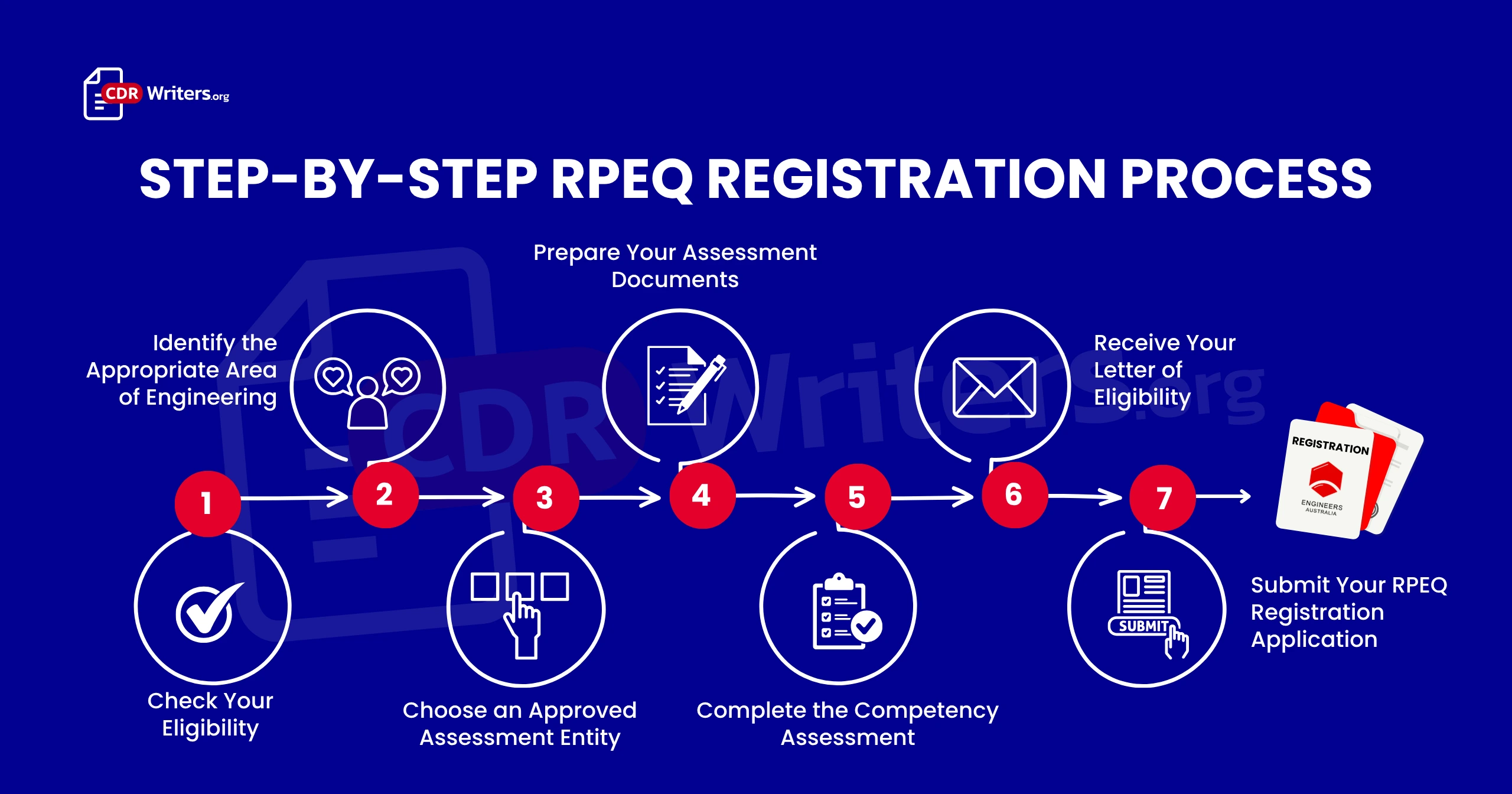
One of the most critical phases in the RPEQ Registration journey is the assessment stage.
The assessment entity assesses the qualifications and competency requirements of the assessment scheme. The process may involve a review of your degree, identity, work experience information, CV or resume, referee contacts, and an interview, BPEQ explains.
Don’t use general terms like:
“He worked on several engineering projects.”
Instead, clearly explain:
You may be called on by your referees as part of the assessment process. Select individuals who have a true understanding of the professional work and can appropriately talk about your engineering experience.
Please advise your referees and make sure the periods of employment and responsibilities listed in your application are correct.
The interview could go into your educational and engineering background.
Go over your professional resume prior to the interview. Have a clear understanding of what you will be doing and be ready to communicate that in a straightforward, transparent, and honest way.
It is important that you are familiar with all documents submitted with your assessment.
BPEQ recognises two types of registration:
A practising registered engineer can undertake professional engineering work in accordance with the relevant requirements of registration and within their engineering and competence.
Non-practising status is for RPEQs who are not currently practising engineering, e.g. during a career break. According to BPEQ, non-practising RPEQs are not allowed to undertake professional engineering services while holding their non-practising status.
The applicant must choose and keep appropriate status for their professional situation.
RPEQ Registration isn’t just a professional milestone. Continuing requirements for registered engineers.
The present continuing registration scheme for BPEQ, from 1 July 2026, specifies that continuing registration shall be based on compliance with the relevant assessment entity’s scheme, or if applicable, the BPEQ scheme. There is potential that RPEQs may be subject to CPD audits, and non-practising RPEQs are not subject to compliance audits while they are not practising.
Engineers need to keep suitable evidence of their CPD activities. Examples of these documents include completion certificates, attendance records, invoices or receipts, in-house CPD records and attendance confirmation emails.
Please note that requirements and/or continuing registration policy might change and should always be referred to the current policy.
RPEQ registration is a continuous cycle every year. BPEQ states that the renewal cycle for RPEQs is normally from 1 April to 31 May, with the maximum period for any RPEQ being 12 months, from 1 July to 30 June.
It is the engineers’ responsibility to make sure that before they renew, they know what their current continuing registration and CPD requirements are.
Having professional records throughout the year will help ease the renewal process.
Not all assessment entities assess all engineering areas. Please review the list of current approved assessors and available areas before submitting an application.
A hard time evaluating your job history can result from fuzzy job descriptions and contradictory working dates.
Keep a tidy list of duties and responsibilities.
Applicants are advised that they need to be familiar with the requirements of the particular assessment scheme. Be careful not to take it for granted that each professional engineering evaluation is conducted in exactly the same way.
Your CV, application, evidence of experience, answers to interview questions and referees’ reports should be in line.
The policies, forms, fees and administrative requirements of BPEQ may change. Please check the updated requirements from official sources before submission.


CDR reports, resumes, VETASSESS, and RPL applications can be challenging to prepare. Our team of professionals has effectively helped clients obtain approval with professional services that address all of these needs.
Constructing a professional document to be evaluated for an engineering assessment can be difficult, especially when the applicant is required to coordinate years of qualifications, job history and project experience.
CDR Writers can assist engineers who are writing professional documentation. Support can be provided to applicants to organise information about careers, to help clarify the content of professional documents and to help applicants structure their relevant experience.
Applicants are, however, responsible for the accuracy and truthfulness of all information submitted. There is no guarantee of a successful assessment or RPEQ Registration decision by any service provider and the assessment and Registration decisions are at the discretion of the relevant approved assessment entity and BPEQ.
Please check the BPEQ resources for the most accurate information related to eligibility, assessment entities, forms, fees and registration policies.
The RPEQ Registration is an important professional registration where the applicant will have to demonstrate appropriate qualifications, experience, and competency.
By being well-prepared, you can:
The objective should never be to make an application look better with false statements. Instead, your aim should be to show your true education, experience and competency in a clear and professional manner.
RPEQ Registration is a Board of Professional Engineers of Queensland (BPEQ) level of engineering professional registration for eligible engineers. RPEQ is Registered Professional Engineer of Queensland.
In general, engineers who are required to exercise professional engineering skill in or for Queensland do not need to be registered unless an applicable exemption exists (such as working under the direct supervision of an RPEQ, or under work to a prescriptive standard).
Having completed an engineering degree recognised by the Washington Accord or an equivalent qualification recognised by an appropriate accredited authority is an eligibility requirement identified by BPEQ.
For the purposes of the current BPEQ guidance, applicants should have at least 5 years of relevant work experience in the last 10 years with a minimum of 4 years of experience after completing their degree.
Yes. Engineers who wish to register for RPEQ must go through an independent assessment process using an approved assessment entity prior to making application for registration.
Get a free consultation today. Our engineers will assess your profile and tell you exactly what you need — at no cost, no commitment.

Expert CDR, ACS, and VETASSESS assessment writing service. 5,600+ documents written. 99% approval rate. Serving professionals from 65+ countries migrating to Australia. Free consultation available.
Disclaimer:
CDR Writers is an independent document preparation service. Not affiliated with EA, ACS, VETASSESS, IML, or any official authority.
Sun-Fri · 24 Hours a Day
Copyright © 2020 – 2026 CDR Writers
99% Success | Trusted in 65+ Countries | 4.9/5 Rated | 100% Secure Payments
