
Online

A key aspect of writing a Competency Demonstration Report (CDR) for Engineers Australia is to effectively present your engineering experience in a clear and logical manner. A project organized well shows what you actually did, the engineering problems you encountered, how you approached the problems, and how you made decisions.
Engineering Project Arrangement is not just a matter of listing project activities. It is the process of structuring project information so that the individual engineering contribution can be understood.

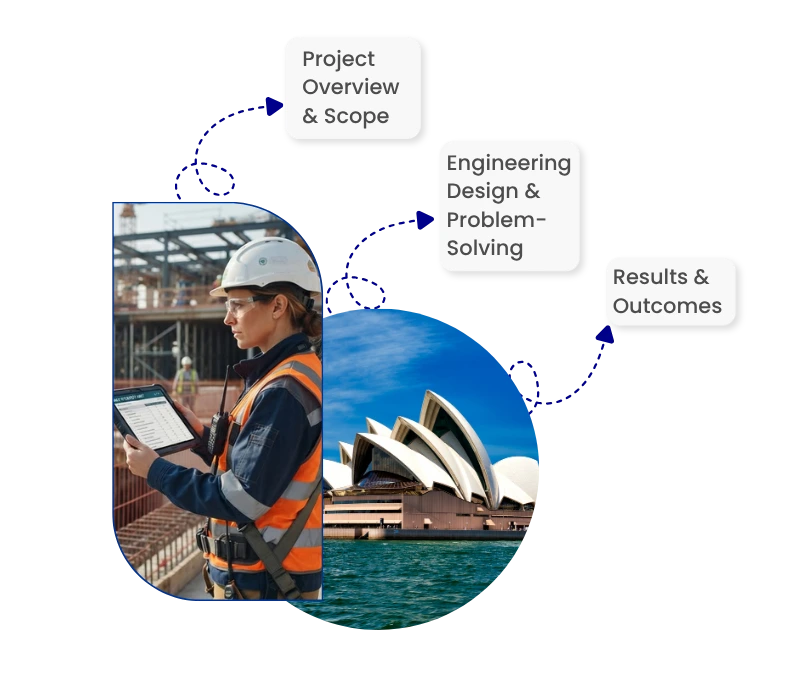
The structure should be designed to allow a reader to easily understand what the project was, what your role was, what engineering work you performed, and what you achieved.
The systematic organization of the important information related to an engineering project is called engineering project arrangement.
This can be for a CDR and include:

It is important to accurately describe your contribution.
CDRs are designed to illustrate your engineering skills using your own learning and experiences. Your Career Episodes should instead convey your own engineering activities, not what an entire organization or project team did.
A well-structured project description can help provide a logical link between:
Project → Engineering Problem → Your Action → Engineering Decision → Result
To illustrate, let’s take, for example:
“The project team designed a new electrical system.”
Describe the specific engineering tasks that you personally carried out, including requirement analysis, choosing a suitable design solution approach, calculations, exploring alternatives, and involvement in implementation.
Start with background information about the project.
Include such things as:
Don’t give a detailed history of the company. Highlight information that assists a reader in understanding the engineering situation.
Clearly explain what the project intended to accomplish.
For example:
You should have a natural link between your goals and the engineering activities you outline below.
Describe the scope of the project.
The scope can include:
It is important to have a clear scope because it helps to make a distinction between the project and other unrelated activities.
One of the most vital components of the project arrangement.
Clearly identify:
To use first-person language, as indicated by the following:
“I’ve studied the current system…”
“I calculated…”
“I selected…”
“I developed…”
“I tested…”
This makes it even more clear what has been accomplished by their teammates and what has been accomplished by you.
Take our free Eligibility Test — answer 5 quick questions about your engineering background, qualifications, and visa goals. We’ll identify your assessment body, ANZSCO code, and the exact documents required. Takes under 3 minutes.
The “What went wrong and how did you solve it” is a good section in a project description.
One beneficial format is:
Problem → Analysis → Options → Decision → Implementation → Result
You may have, for instance, stated that an already in-place system was having performance problems. You could talk about your research of the cause, the possible solutions, the solution you chose, how you carried out the solution, and how you checked your solution.
The explanation should be based on your engineering experience. Don’t cause technical issues or feats that happen to be not actually there.
If they were a true part of your engineering job, they should be described in terms of their meaning and usefulness.
For example, in your discipline this could be:
Don’t make calculations just to make the Career Episode seem technical. All calculations should be related to the engineering decision or activity being considered.
Say what tools you actually used on the project.
Examples may include:
Describe the tool’s use—don’t just mention the software names.
For example:
“Created and modified engineering drawings using AutoCAD for design needs.”
This provides more useful context than simply writing:
“Software used: AutoCAD.”
Projects don’t always go as expected. If you had real technical issues, describe them in detail.
You can describe:
This makes for a natural engineering story.
Wrap up the project discussion by summarising the outcomes of the project.
Results may vary and can be:
If there are measurable results, use accurate numbers.
For instance, rather than:
“This system went a lot more efficiently.”
You can describe the actual improvement, if it has been measured and recorded.
A possible sequence of a practical arrangement:
Project Background
↓
Project Objectives
↓
Project Scope
↓
Your Role and Responsibilities
↓
Engineering Problem
↓
Investigation and Analysis
↓
Engineering Methodology
↓
Calculations/Design/Implementation
↓
Challenges and Solutions
↓
Results
↓
Your Personal Contribution
This form provides a logical sequence from the engineering requirements to the final product.

Now assume that an electrical engineer was involved in an industrial power system improvement project.
The project could be arranged as:
Background:
An existing electrical distribution system needed an improvement at an industrial facility.
Objective:
The goal was to increase reliability and to support new electrical loads.
Role:
The engineer was to design and analyze the current system and also assist in the design of the upgraded distribution system.
Engineering activities:
The engineer checked existing drawings, did load calculations, made equipment estimates, evaluated alternatives, made the drawings, and helped with testing.
Challenge:
The current system posed problems when extra loads were added to it.
Solution:
The engineer studied the options and chose a technically suitable option for the project.
Outcome:
The upgraded system was tested and implemented, as per the project requirements.
This is just an example of a structure. It is important that the engineer’s real project and experience be used for a real CDR and not a fabricated scenario.
Don’t suffer from these common issues:
Your Career Episode should not be like a project report in a company. Concentrate on how you are contributing to engineering.
Don’t overuse passive voice because it can be hard to determine what you did.
You cannot state, “I was responsible for design and testing. Do not use the words simply, “I was responsible for design and testing.
Avoid creating calculations, software, project numbers, roles, and results.
Include technical words when appropriate, and indicate your engineering reasoning clearly enough for an assessor to comprehend.
Describe what occurred following your engineering project and, if possible, include measurable and real results.
The technical contents will vary depending on the engineering specialty.
For example:
Discipline | Possible Project Focus |
Civil Engineering | Structural design, construction, infrastructure |
Mechanical Engineering | Machinery, manufacturing, thermal systems |
Electrical Engineering | Power systems, electrical design, control systems |
Electronics Engineering | Embedded systems, circuits, communication |
Software systems, networks, cloud or computing projects | |
Chemical Engineering | Process design, optimization, production |
Telecommunications | Communication networks and systems |
The arrangement is logical, but technical evidence should be based on the engineer’s own field of engineering and experience in the project.


CDR reports, resumes, VETASSESS, and RPL applications can be challenging to prepare. Our team of professionals has effectively helped clients obtain approval with professional services that address all of these needs.
A well-organized engineering project provides your Career Episode with a nice technical narrative. Rather than just stating tasks, describe the engineering problem, how you solved the problem, the choices you had to make, what work you did, and what you accomplished.
Real experience and engineering facts are the most important to the best project arrangements for a CDR.
CDRWriters can assist you in structuring your engineering experience into a Career Episode while maintaining your engineering work and technical involvement in the project you are preparing the CDR for Engineers Australia about.
Engineering project arrangement refers to the arrangement of information about a project, including background, project goals, scope, engineering activities, personal tasks, technical issues, solutions, and outcomes.
The logical order helps to better understand the engineering situation, your contribution, the technical decisions, and the results of the project.
No. Concentrate on activities that demonstrate your knowledge of engineering, your skills, your problem-solving, your decision-making, and your personal contribution.
Depending on your context and the competency evidence you will get from it, a genuine academic project may be relevant. The project should be a representation of the engineering project that you actually created.
Yes. First-person verbs like “I designed…,” “I analyzed…,” “I calculated…,” and “I implemented…” clearly show for whom an activity was done and what part you played in it when you are describing your own engineering activities.
Get a free consultation today. Our engineers will assess your profile and tell you exactly what you need — at no cost, no commitment.
Expert CDR, ACS, and VETASSESS assessment writing service. 5,600+ documents written. 99% approval rate. Serving professionals from 65+ countries migrating to Australia. Free consultation available.
Disclaimer:
CDR Writers is an independent document preparation service. Not affiliated with EA, ACS, VETASSESS, IML, or any official authority.
Sun-Fri · 24 Hours a Day
Copyright © 2020 – 2026 CDR Writers
99% Success | Trusted in 65+ Countries | 4.9/5 Rated | 100% Secure Payments
