
Online

For professionals seeking migration to Australia, selecting the right skills assessment pathway is crucial. But for many applicants, it is hard to distinguish between a Competency Demonstration Report (CDR) and Recognition of Prior Learning (RPL).
Both pathways require a demonstration of professional knowledge and competencies, but for different purposes and linked with different assessing authorities.
In Australia, Engineers Australia uses the CDR pathway to evaluate eligible engineering applicants and the RPL pathway is often used by the Australian Computer Society (ACS) to assess eligible ICT professionals with a need to demonstrate their ICT knowledge in their professional work.
Knowing the requirements of CDR vs RPL Australia can make it more easy for you to decide which path to assessment is the right one for you based on your qualifications, occupation, and professional history.

The Competency Demonstration Report (CDR) is one of the assessment methods Engineers Australia uses for applicants who meet the eligibility criteria for an engineering migration skills assessment.
It is especially relevant for applicants with unaccredited engineering qualifications and/or those seeking to have their engineering qualifications assessed for a different engineering occupation than their title.
This pathway is based on Engineers Australia’s assessment of an applicant’s qualifications and demonstrated competencies against the requirements of the nominated engineering occupation.
The CDR pathway might be suitable when you:
Assessment will be based on your personal circumstances and the current requirements of Engineers Australia.
Most candidates will require to create the following documents:
Specific requirements will vary depending on the applicant’s situation and the Engineers Australia application instructions at the time of application.
A CDR assessment takes into account if your listed engineering occupation, qualifications and competencies are suitable for that nomination.
Your Career Episodes should document: Your personal engineering activities, Technical decisions you made, Problem-solving techniques you used, Your contributions to the engineering project that were relevant.
Your Summary Statement should relate the appropriate competency elements to evidence in the Career Episodes.
The information you submit must be accurate, self-plagiarized and relevant to your skills and experience.
Please refer to the Engineers Australia Migration Skills Assessment guidelines for the most up-to-date requirements.
Recognition of Prior Learning (RPL) refers to a variety of learning frameworks and assessment practices in the Australian education and skills sector. The meaning is determined by the assessing authority and the purpose of the application.
The ACS RPL pathway provides an opportunity for qualified ICT practitioners who do not have the relevant tertiary qualifications to showcase their knowledge and skills associated with ICT by providing evidence of their professional practice and experience.
Applicants will not be assessed on an ICT qualification as their main qualification, but will be assessed on their professional experience and project documentation.
Please note: RPL cannot be used as a blanket substitute for a CDR report. Engineers Australia and ACS evaluate two different professions based on their requirements.
The ACS RPL pathway could be applicable to ICT professionals who:
For example, an experienced software developer who has gained a lot of their ICT knowledge from work-based projects is not necessarily going to have the necessary tertiary qualifications in ICT and might want to explore the ACS RPL pathway.
But, having worked professionally doesn’t guarantee your eligibility or a positive assessment outcome.
The following documents may be required to support an ACS application, depending on the applicant’s situation and the current ACS requirements:
The applicant should make sure that the documents they submit are accurate and reflect the applicant’s own experience and technical contributions.
The applicant’s knowledge and experience in ICT is the focus for the ACS RPL pathway.
Applicants should provide evidence of the way they have developed and used ICT in relevant projects and professional experiences.
Project Reports should include the technical background, project duties of the applicant, problems solved, methods employed and the applicant’s role.
Candidates are also required to meet the relevant experience, documentation and professional currency requirements.
Refer to the current eligibility information on the official Australian Computer Society (ACS) website and their [migration skills assessment guide.
Both pathways require a set of professional competencies to be recorded, but this is not a one-for-one exchange.
The main differences between these are summarised in the following table.
Comparison Factor | CDR Pathway | RPL Pathway |
Full form | Competency Demonstration Report | Recognition of Prior Learning |
Common assessing authority | Engineers Australia | Australian Computer Society for the relevant ICT migration assessment |
Main occupational area | Engineering | Information and communication technology |
Primary assessment focus | Engineering qualifications, knowledge, and demonstrated competencies | ICT knowledge and competencies demonstrated through professional experience and supporting evidence |
Typical applicants | Eligible engineering applicants who require a CDR assessment | Eligible ICT professionals who need to demonstrate their ICT knowledge through the RPL pathway |
Main technical documentation | Three Career Episodes and a Summary Statement, alongside other required documents | Two RPL project reports and other required supporting documents |
Role of qualifications | Qualifications and their accreditation status help determine the appropriate assessment pathway | Relevant ICT tertiary qualifications and the applicant’s educational background help determine which ACS pathway may apply |
Role of professional experience | Career Episodes demonstrate the applicant’s engineering activities and competencies | Professional experience and project reports are central to demonstrating the applicant’s ICT knowledge |
Assessment requirements | Must satisfy Engineers Australia’s applicable requirements | Must satisfy ACS’s applicable requirements |
Migration outcome | A successful assessment can support a relevant skilled migration application | A successful assessment can support a relevant skilled migration application |
The above requirements are a guideline. Please make sure that you are checking the relevant Assessment Authority’s latest guidelines prior to applying.
Which is most suitable will vary depending on your future job, qualifications and who assesses your future job.
If you have an engineering degree (or any other engineering-related degree) you should begin by finding out which authority evaluates the job you want to pursue.
If Engineers Australia is the assessing authority, determine if your qualification is accredited under an applicable recognised pathway.
The CDR pathway might be a good option if you are not qualified with an accredited qualification or if the occupation you are qualified for is not the same as the occupation you would like to be assessed for.
Not all overseas Engineering graduates are required to submit a CDR. A pathway to accredited assessment may be available for some applicants.
If you are a software developer, programmer, database administrator, cyber security specialist, systems analyst or other ICT-related specialist, look at the ICT assessment pathways that are relevant to you.
Applicants who meet the qualifications and employment experience requirements may be eligible for an ACS pathway other than RPL.
The RPL pathway may be of interest if you do not have the required tertiary qualifications in ICT, but do have significant experience in ICT.
The pathway may vary based on the type of degree earned, course content, work experience, and nominated occupation.
While in-depth professional experience can be beneficial, it is not necessarily a requirement for all skills assessment pathways.
For those in the ICT Sector, explore the eligibility criteria for the ACS RPL, and see if you meet the current requirements.
If you are in your engineering career, check the Engineers Australia requirements and find out what assessment pathway is available for your qualification and occupation.
Don’t choose RPL because you have a lot of experience or CDR because you have an engineering-related occupation.
You might not need a CDR if your engineering qualification is accredited through one of the recognised pathways.
Verify the accreditation of your program, the accreditation period, and the qualifications needed for your desired occupational category.
Other assessment pathways for professionals in ICT may be better than RPL.
Whether or not you require a degree from an accredited institution for your state’s assessment framework is not the only factor in making the right choice as far as the decision goes.
One of the key distinctions between the two pathways is the documentation.
While both need accurate evidence, the nature of the evidence and how evidence is used to demonstrate competency is different.
A CDR application generally involves:
Career Episodes: Three detailed accounts of engineering projects, activities, or professional work that demonstrate your individual engineering competencies.
Summary Statement: A structured document mapping relevant competency elements to evidence in your Career Episodes.
Continuing Professional Development: A statement describing professional development activities relevant to your engineering knowledge and skills.
Academic Records: Degree certificates and transcripts that support your educational background.
Additional Documents: Identity, résumé, English language evidence, and other documents required by Engineers Australia.
Each document should support the same professional profile and nominated occupation.
In general, an ACS RPL application will require:
RPL Form: Document that outlines the ICT knowledge the applicant has and how it was gained.
Project Reports: Two reports showing some ICT knowledge that applies and the applicant’s own contribution to professional projects.
Employment Evidence: Reference and supporting documents to confirm pertinent employment history and duties.
Professional Currency Evidence: Evidence that the applicant has kept relevant ICT knowledge and professional involvement according to ACS requirements.
Additional documents:Identity records and any other document(s) necessary for the corresponding evaluation.
Candidates are advised to check the employment and project reporting requirements with ACS prior to preparing applications.
If the wrong pathway is selected, there could be unnecessary preparation, delays or an application that is not appropriate to the relevant assessment pathway.
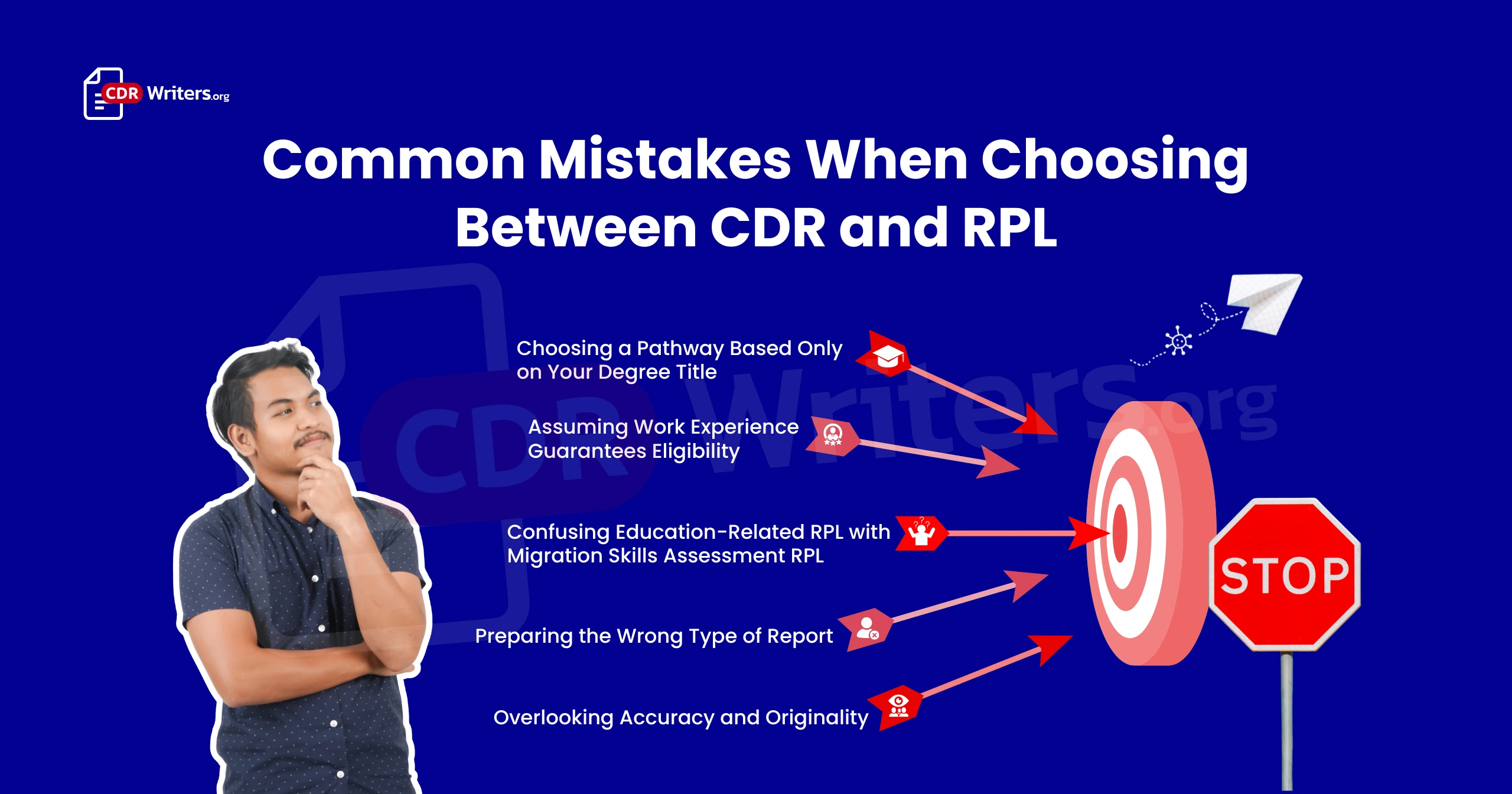
Don’t make these common errors.
Not all degree titles create the proper assessment pathway.
Accreditation status and nominated occupation are important for applicants with an engineering focus. The ACS eligibility requirements must be taken into account for ICT applicants, as well as the educational qualification of the applicant.
Experience is a key criterion, but the authority will want to see certain requirements like qualifications, periods of employment, project evidence, or other documents.
Make sure of the current criteria before putting in the effort to prepare a report.
RPL may be used for the recognition of prior learning and/or skills in other contexts.
ACS migration skills assessment is not a prerequisite to recognition of prior learning by an RTO.
Always check the reason for the assessment and who will be assessing your application.
The CDR Career Episode is assessed to present the skills and knowledge a learner has acquired, whereas the ACS RPL project report is assessed to demonstrate a learner’s capacity to apply skills and knowledge.
Failure to apply appropriate structure, or to draft papers that haven’t taken into consideration the requirements of the authority applicable to your application will lead to a reduced application.
Do what is officially told for a pathway you are going to take.
You need to accurately portray your qualifications, employment history, project responsibilities and technical contributions in the application.
Don’t take credit for the work of others. Never make up projects, qualifications, employment or professional accomplishments.
All reports must follow the rules of the assessing authority with regard to authorship, originality and supporting evidence.
Follow these practical steps before you start your application.
Identify and select the occupation to be assessed and the appropriate Australian assessing authority.
Collect all degree certificates, academic transcripts and other educational records. If the applicant is an engineering student, check to see if the qualification has been recognised by an applicable pathway.
Refer to Engineers Australia or ACS (as appropriate) official requirements. Don’t solely depend on general information or advice regarding other applicants’ situations.
Create a concise employment history to date. Create a clear document of your projects, responsibilities, and technical contributions. Determine the information that backs your claims.
Check the document checklist, experience requirements, and application procedure and fee statement published by the appropriate authority.
Make sure that your reports are factual, well organized, focused on the nominated occupation, and align with your supporting documents.
Successful completion of the skills assessment does not guarantee a visa. Visa eligibility, points requirements, occupation lists, English language requirements, and other considerations are separate issues as per the prevailing migration requirements.Successful completion of the skills assessment does not guarantee a visa. Visa eligibility, points requirements, occupation lists, English language requirements, and other considerations are separate issues as per the prevailing migration requirements.


CDR reports, resumes, VETASSESS, and RPL applications can be challenging to prepare. Our team of professionals has effectively helped clients obtain approval with professional services that address all of these needs.
Learning more about the CDR and RPL Australia requirements could help you determine which level to begin your skills assessment.
The CDR pathway will be suitable for applicants eligible for engineering who have been assessed by Engineers Australia, and the ACS RPL pathway will be suitable for applicants who are eligible for engineering but are required to demonstrate their ICT knowledge by professional experience and project reports.
Each of the two paths is not necessarily a good fit for all applicants. This will depend on your qualifications, your plans for the future, your work experience, and the present requirements of the assessing authority.
Check your eligibility and guidelines before drafting your reports. These are the steps that will help you to make sure that you don’t waste your time and you make a more organized and accurate application.
Should you require any support in understanding the CDR process, structuring your Career Episodes or preparation of supporting documents, do consider checking out the various services provided by CDR Writers and ensure that your application meets the requirements of the relevant assessing authority.
CDR is a pathway for engineers to undertake a skills assessment through Engineers Australia. For the purpose of the ACS migration assessment, RPL is a process that enables eligible ICT workers to provide evidence of their knowledge through work experience and relevant project work.
The pathways have different assessment requirements and are for occupational groups.
There are no universal advantages or disadvantages to either pathway.
CDR may be suitable for an eligible engineering applicant, and ACS RPL may be suitable for an eligible ICT professional if they meet the engineering and/or the ICT requirements, respectively.
The right way will depend on your occupation, qualifications, and your personal situation.
Not just because they have an engineering degree or work in the industry.
ACS RPL is a pathway for skills assessment for migration in ICT. For an applicant majoring in engineering, the first step is to find out which agency is in charge of the job they are going to pursue.
If Engineers Australia is the assessing authority, the applicant should explore the available engineering assessment pathways offered by Engineers Australia.
Not everyone with an IT-related degree will qualify for an Engineers Australia CDR assessment.
The applicant will need to determine a suitable engineering position and meet Engineers Australia’s requirements for that position.
ICT professionals with an intended occupation that is covered by an ACS pathway should explore the applicable ACS pathways.
The pathway for the ACS RPL is for those who are eligible to submit to this pathway and who wish to demonstrate their understanding of ICT knowledge through work experience rather than a relevant tertiary course in ICT.
However, the current requirements of ACS will apply, including those for the required experience and documentation. Please check all eligibility requirements prior to application.
Get a free consultation today. Our engineers will assess your profile and tell you exactly what you need — at no cost, no commitment.

Expert CDR, ACS, and VETASSESS assessment writing service. 5,600+ documents written. 99% approval rate. Serving professionals from 65+ countries migrating to Australia. Free consultation available.
Disclaimer:
CDR Writers is an independent document preparation service. Not affiliated with EA, ACS, VETASSESS, IML, or any official authority.
Sun-Fri · 24 Hours a Day
Copyright © 2020 – 2026 CDR Writers
99% Success | Trusted in 65+ Countries | 4.9/5 Rated | 100% Secure Payments
