
Online

Planning, accurate documentation, and understanding the Engineers Australia migration skills assessment requirements are all essential steps in the preparation of a Competency Demonstration Report (CDR). Prior to applying, engineering graduates and professionals should arrange their identity documents, academic records, evidence of English language skills (where applicable), and the components of the CDR.
A CDR Report Checklist can be used to determine which documents are missing, to review supporting evidence and to prepare an organised application. This is especially helpful for engineers who have to be assessed for their skills via the CDR pathway.

A CDR Report Checklist is a list of documents and report components for the Engineers Australia migration skills assessment for the Competency Demonstration Report pathway.
It assists the applicant to organise the information they need before they begin or finish their online application. Specific requirements are subject to the applicant’s situation, qualifications, nominated occupation and assessment pathway.
Here are some of the elements included in a typical checklist:
Please note: Check the most recent official Engineers Australia application guidelines and the document requirements for the pathway you have chosen. A checklist is a PREPARATION AID and NOT a substitute for the actual instructions.
Organising your documents beforehand can help to make the process of applying easier, and can help you spot potential problems before you apply.
Academic certificates, transcripts, identity papers, and CDR components may have to be obtained from various sources. Having a checklist will help you to identify those documents that are ready and those that need attention.
Sometimes, names can be inconsistent, missing information in academic records, unclear scans, or no translation can make document verification difficult. Having a record to review ahead of time will give you a chance to deal with these questions.
There are several parts to the CDR report that are interdependent. Having a checklist to hand over helps you to ensure that your Career Episodes, CPD statement and Summary Statement are comprehensive and self-consistent.
Where information or documents are missing or do not comply with the requirements, this can result in further information being required or extended processing. While this won’t guarantee a quick evaluation or a successful outcome, careful preparation will minimize avoidable errors.
Below is a list of some of the key documents typically needed for a CDR pathway application.
Your identity documents assist Engineers Australia to confirm your details.
Prepare the following:
What should you check?
Make sure your surname, date of birth, and other identifying information are uniform between your passport and school records. If your name has changed, arrange the necessary documents to support it.
Read and understand the current Engineers Australia rules on acceptable document format and if any further evidence of identification is needed.
Your academic qualifications are one of your skills to be assessed for migration.
Prepare:
Ensure that the name on your degree certificate is correct and matches the names on your identification documents or that any discrepancies are explained and recorded before submitting.
It is also important to ensure that your qualification is suitable for the assessment pathway you have chosen and that your field of engineering work is suitable.
Academic Transcripts include information about your studies and subjects completed.
You should have the following points in your preparation checklist:
Check your transcripts to make sure they are complete and easy to read. If you have more than one engineering qualification, please refer to the current application instructions to see which academic documents are required.
Don’t think that a degree certificate is sufficient as academic documentation.
A professional CV format will place your academic and work experience in chronological order, clearly.
Create a CV that contains:
Your CV should clearly reflect your history and be consistent with your Career Episodes and accompanying documents.
Don’t add anything to job requirements that you can’t back it up with.
In some cases, English language evidence may be required as per Engineers Australia requirements.
Before applying:
If your degree was in English, don’t assume that an English test is not required. Please check specific requirements with Engineers Australia.
A statement on Continuing Professional Development gives details of activities you have taken to keep your engineering knowledge and skills current or advanced.
These activities can vary depending on what your background is:
Follow the checklist below:
The CPD statement should be based on the latest Engineers Australia guidelines. Avoid creating trainer activities or adding to professional development you did not complete.
Career Episodes are the main elements of the CDR pathway. They describe how you used your understanding of engineering and related skills in schoolwork, work experience or other appropriate engineering exercises.
Create three Career Episodes (using the appropriate Engineers Australia requirements).
Use this checklist:
Your Career Episodes outline the work experience you have gained in your engineering job to demonstrate that you have met the competency elements for your nominated engineering occupational category.
When preparing, please refer to all three Career Episodes.
The following is a checklist of elements to look for:
Please check all references prior to submission. An incorrect paragraph number or a competency that lacks supporting evidence may make it challenging for the assessor to locate the evidence you were trying to submit.
The Summary Statement should refer to actual Career Episodes and not just the competency you are stating.
Depending on the applicant’s circumstances, and the requirements of the relevant applications, it may be necessary for some applicants to provide evidence of professional registration or licensing.
If relevant, prepare:
Having no professional registration does not mean that it will automatically disqualify you from applying using the CDR pathway. Determine if the document applies to your situation, and follow the official directions.
When your Career Episodes relate to engineering-related work, and/or your career is being evaluated for relevant skilled employment, employment evidence may be relevant.
Useful records may include:
Follow the checklist below:
There may be more evidence required for a separate skilled employment assessment. It is not assumed that the documents required for the CDR pathway will meet all employment-related assessments.
A document that is not written in English could need an English translation.
Before submission:
Unless explicitly authorized in the instructions, do not translate documents that have been prepared by the official.
The documentation requirements will vary from applicant to applicant.
Additional records or supporting evidence may be required based on background and pathway selected.
Examples include:
Consider your situation in a case-by-case basis and don’t just send documents that do not relate to the application just to make it appear more complete.
Once you have got your documents together and finished your report, review again.
Take this handy checklist with you when you apply.
No. | Document or requirement | Status |
1 | Valid passport biodata page | ☐ |
2 | Recent passport-sized photograph | ☐ |
3 | Name-change documents, if applicable | ☐ |
4 | Engineering degree certificate | ☐ |
5 | Complete academic transcripts | ☐ |
6 | Updated CV | ☐ |
7 | English language evidence, if required | ☐ |
8 | CPD statement | ☐ |
9 | Career Episode 1 | ☐ |
10 | Career Episode 2 | ☐ |
11 | Career Episode 3 | ☐ |
12 | Completed Summary Statement | ☐ |
13 | Professional registration evidence, if applicable | ☐ |
14 | Employment evidence, where applicable | ☐ |
15 | Required English translations | ☐ |
16 | Clear, legible document scans | ☐ |
17 | Consistency across CV, episodes, and supporting records | ☐ |
18 | Review against the latest official application instructions | ☐ |
This checklist is intended to provide a general preparation tool. Official Engineers Australia requirements for the specific application are applicable.
Even if most of the documents are obtained by the applicant, there may be minor discrepancies during the assessment.
If the academic documentation is not complete, a degree certificate may be issued without the accompanying transcripts.
Avoidance: Check the academic documentation requirements and ensure all relevant documentation is accessible.
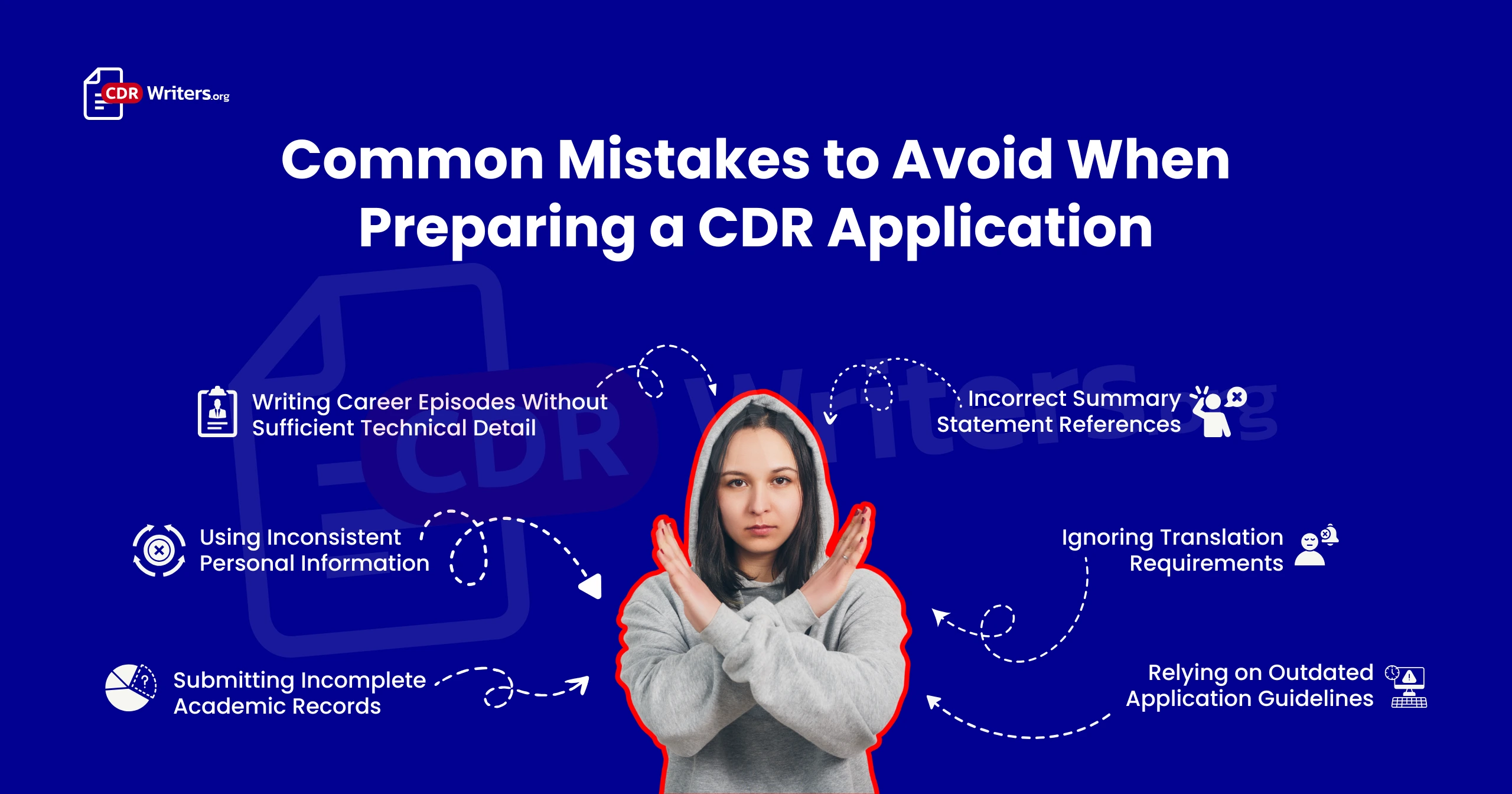
You may have difficulty confirming documents if there are discrepancies in names, dates or other personal information.
How to prevent it: Make sure that all supporting documents are copied and compared with the passport and degree certificate before submission.
Career Episodes that primarily present general project descriptions are unlikely to accomplish the goal of showing your individual engineering contribution.
How to prevent it: Describe the technical issues you had, how you overcame them, your reasoning, and what you personally did.
A failure to properly number the paragraphs or to connect competency elements to Career Episode evidence can make for an impenetrable report.
How to prevent it: Re-read each cross-reference with your final version of your Career Episodes.
Documents that are not in the English language might require an appropriate translation in addition to the original.
How to prevent it: Take time to look at the existing translation directions before planning translations or uploading documents.
Assessment requirements may evolve as a result of changes over time. Older articles or checklists may not be up to date with the process.
How to avoid it: Review the Engineers Australia website right before applying.
It’s easy to get organized with a simple preparation process and not leave out any important details.
You can find out if the CDR pathway is suitable for you and your nominated engineering occupation.
Obtain your passport, photo, degree certificate, transcripts, and any other supporting documents as necessary.
Ensure that your educational, employment, and professional development record is accurate and consistent.
Create 3 appropriate scenarios based on actual engineering experience and satisfy all requirements.
Match up the competency elements with the paragraphs in your Career Episodes.
Ensure all necessary translations are present and that you have legible and clear scans.
When submitting through the Engineers Australia application portal, check your documents against the most recent official instructions.
Please see the Engineers Australia Migration Skills Assessment page for the current application process:


CDR reports, resumes, VETASSESS, and RPL applications can be challenging to prepare. Our team of professionals has effectively helped clients obtain approval with professional services that address all of these needs.
To apply for an Engineers Australia migration skills assessment using the CDR pathway, it is important to prepare a complete CDR Report Checklist. Having organized your identity documents, academic records, CV, CPD statement, three Career Episodes, Summary Statement, and any related supporting evidence can make it easier for you to review your application systematically.
Please submit documents that are accurate, legible, consistent, and translated as needed. Be sure to focus on the technical aspects of your Career Episodes and cross-reference the Summary Statement.
Most of all, follow the most up-to-date official Engineers Australia guidelines to verify requirements for a specific application.
For help in organizing your CDR documents or preparing your report, CDR Writers can help you understand how to prepare a report and what parts of your report may need further review. Your report must always be a true reflection of your engineering experience and meet Engineers Australia’s authorship and ethical guidelines.
Typically required documents are a passport biodata page, a passport-sized photograph, a degree certificate, academic transcripts, CV, appropriate English language evidence, CPD statement, three Career Episodes and a Summary Statement. Other evidence (name change, professional registration, etc.) may be needed depending on your situation.
Please verify the most up-to-date Engineers Australia requirements for your chosen pathway.
Yes. As part of the CDR pathway, there is a CV included in the documentation. It should accurately provide information about your education and employment history and match your supporting documents.
English language evidence may be requested based on the requirements and exemption status. Refer to the current Engineers Australia guidelines to see if they apply to your situation.
There are three Career Episodes needed for the CDR pathway. These should provide a description of engineering activities that are relevant and demonstrate the engineering competency elements as a group for your nominated occupational category.
The Summary Statement links the elements of the competency to paragraphs in your Career Episodes. It assists the assessor in finding the evidence you have provided of your engineering skills.
Get a free consultation today. Our engineers will assess your profile and tell you exactly what you need — at no cost, no commitment.
Expert CDR, ACS, and VETASSESS assessment writing service. 5,600+ documents written. 99% approval rate. Serving professionals from 65+ countries migrating to Australia. Free consultation available.
Disclaimer:
CDR Writers is an independent document preparation service. Not affiliated with EA, ACS, VETASSESS, IML, or any official authority.
Sun-Fri · 24 Hours a Day
Copyright © 2020 – 2026 CDR Writers
99% Success | Trusted in 65+ Countries | 4.9/5 Rated | 100% Secure Payments
