
Online

For engineering professionals aiming to achieve an Australian migration skills assessment via Engineers Australia, preparing their CDR for Electrical Engineering Draftsperson is a vital process. A good application will show how the skills and technical knowledge you have are related to your chosen occupation, as well as how your project experience matches the required competencies.
Competency Demonstration Report (CDR) is a path to assessment for applicants whose qualifications and/or circumstances call for an individual competency assessment. But not all applicants require a CDR. This will be taken on the basis of the qualification accreditation, educational background, and type of occupation being nominated.
A Competency Demonstration Report is a collection of documents that Engineers Australia uses to assess the engineering knowledge and demonstrated competencies as outlined in Engineers Australia’s assessment requirements.
For an Electrical Engineering Draftsperson applicant, pertinent evidence can consist of electrical drawings, wiring diagrams, circuit documentation, CAD activities, technical specifications, and engineering documentation.
The report must be a detailed explanation of how your qualifications and your real work experience in your nominated occupation show knowledge of relevant aspects of that work.
A CDR is not just a series of engineering drawings or a job description. It must be explained technically through a structure with your own activities and knowledge applied.
Make sure that your skills and background are suitable for the job you wish to nominate prior to preparing your report.
Engineers Australia provides migration skills assessment to determine if the applicants fulfil the requirements of their nominated occupation and the relevant occupational category.
The CDR pathway may be suitable if you have a non-accredited engineering qualification, a provisionally accredited Australian qualification, or an accredited engineering qualification, but you want to be assessed for another engineering occupation that is eligible for the CDR pathway.
Qualification is a major consideration when deciding on the pathway. It is therefore advisable to read through the official assessment requirements before starting your application.
A well-sculpted CDR will enable you to communicate your technical expertise and experience in a coherent manner. A positive assessment is not assured, though, and the report is required to comply with Engineers Australia requirements.
Electrical Engineering Draftspersons assist with electrical engineering activities by creating, adapting, and updating technical drawings and documentation.
They might be required to perform the following duties, depending on their job location and project:
The following are examples of the types of activities that can be undertaken to meet the requirements of the enterprise.
When choosing an occupation to match your migration skills assessment, match your qualifications and work activities with the Australian occupation description. Job title does not imply any requirements.
Typically, applicants using the CDR pathway would be required to create a number of documents that will meet the requirements under the current Engineers Australia application process.
The CPD statement outlines activities that you have undertaken to keep and/or develop your engineering knowledge.
These activities may be:
Use real activities and give out the information in the appropriate application guide.
Include as many activities as you have learned from, but don’t fill your CPD statement with activities just to bulk it out so it looks like you learned more.
Standard CDR documentation for a CDR application will consist of three written career episodes.
Every episode should outline a specific engineering task, project or period of relevant work, and include your individual role.
An Electrical Engineering Draftsperson applicant’s appropriate experiences could include creating electrical drawings, reviewing and updating technical documentation, developing circuit diagrams, or assisting with an engineering design project.
In each episode, explain:
Please adhere to the Engineers Australia guidelines for the structure of episodes, paragraph numbering and word counting rather than older online examples.
The summary statement ties the evidence from your career episodes to the related competency elements.
It enables the assessor to see where you have applied the engineering knowledge and professional competencies required.
The preparation is effective:
The total number of career episodes must be submitted so that the 16 career development competency elements from Stage 1 are shown in the career episodes. Always double-check the structure and directions used in the application.
Your CV needs to give a clear overview of your skills, work experience, projects, and technical skills.
Provide correct details regarding your education, responsibilities at work, project involvement, and professional growth.
Be sure to match the dates and descriptions of your career episodes with other supporting documents in your CV.
Some supporting documents may consist of:
Ensure you have the current Engineers Australia document checklist to check what you’ll need to submit.
Career episodes are a critical component of your engineering knowledge and your contribution.
A good episode should explain what you have done, why you have done it, and how it is related to the competency being assessed.
Choose authentic writing that reflects appropriate drafting and technical skills.
Examples may include:
Preparation of electrical drawings: Developing electrical drawings in accordance with engineering specifications and adding necessary technical information.
Wiring Diagram Development: Creating or editing Wiring Diagrams with information provided by the Engineers.
CAD documentation: Creating technical drawings and keeping accurate revisions—using the proper computer-aided design software.
Electrical design revisions: Updating drawings after approved changes to components, layouts, or project requirements.
Technical drawing verification: Reviewing drawings to ensure they are consistent, complete, and conform to approved specifications.
These are examples of the kinds of examples that can be provided. Select projects that are based in your personal experience and connect to your chosen career.
Career episodes should explicitly highlight your contribution to the work done by the team.
For instance, don’t just say that your team finished an electrical drawing package; detail the drawings that you made, the information that you used, the checks that you did, and how you made revisions.
Personal statements can support you in claiming your own contribution.
Be honest about your roles and responsibilities and don’t take credit for engineering decisions, calculations, or approvals that are not yours.
Talk about real-life difficulties faced and how you solved them.
For instance, a drawing revision could cause a problem between the electrical layout and a wiring diagram. Your account might include how you found the discrepancy, how you verified the specs, how you communicated with the appropriate engineer, and how you made the necessary corrections in the documentation after approval.
Only use this type of example if it is one you actually made.
When applicable, explain CAD tools, drawing standards, technical specifications, revision control, and verification. Write about their use, not just the software or standards.
Your report should fairly reflect your skills, experience and contribution.
Avoid plagiarizing another candidate’s experiences or creating projects, responsibilities, calculations, or results.
When editing or preparing the work professionally, check all technical statements and ensure the submission meets Engineers Australia’s current authorship and application criteria.
To ensure that all applicants have the best possible chance of meeting the requirements, they should seek to minimize the common issues found in documents before submitting their applications.
The role you nominate should be appropriate to your qualifications and relevant competencies.
Just because you have a degree in Electrical Engineering or a job title that involves “drafting” doesn’t mean that it is a suitable Electrical Engineering Draftsperson position.
General comments on the team or project itself offer little information about your own technical role.
Describe what you personally did, why you did what you did, and what the results were.
An episode of your career should be long enough, but technical enough, to show what you knew and did.
Where applicable, add applicable methods, tools, specifications, and problem-solving activities.
Each competency in your Competency Summary statement must be backed up with evidence that can be identified in your career episodes.
Please check references for accuracy and fill in any missing information before submitting an application.
If you are applying for a position in an industry that has undergone changes regarding employment dates, descriptions of work, job titles, or job qualifications, this can cause some confusion as to the accuracy of your application.
Review your CV, career episodes, CPD statement and supporting documents as a group.
The formatting instructions, assessment criteria and document requirements for older articles may be outdated.
Please ensure that the most up-to-date official Engineers Australia guidance is followed prior to completion of your report.
A visa decision will not be based on a migration skills assessment.
Applicants are required to meet the eligibility criteria for the pathway they are applying for independent of others. A CDR preparation service does not have any obligation to secure a positive assessment, a visa invitation or migration outcome.
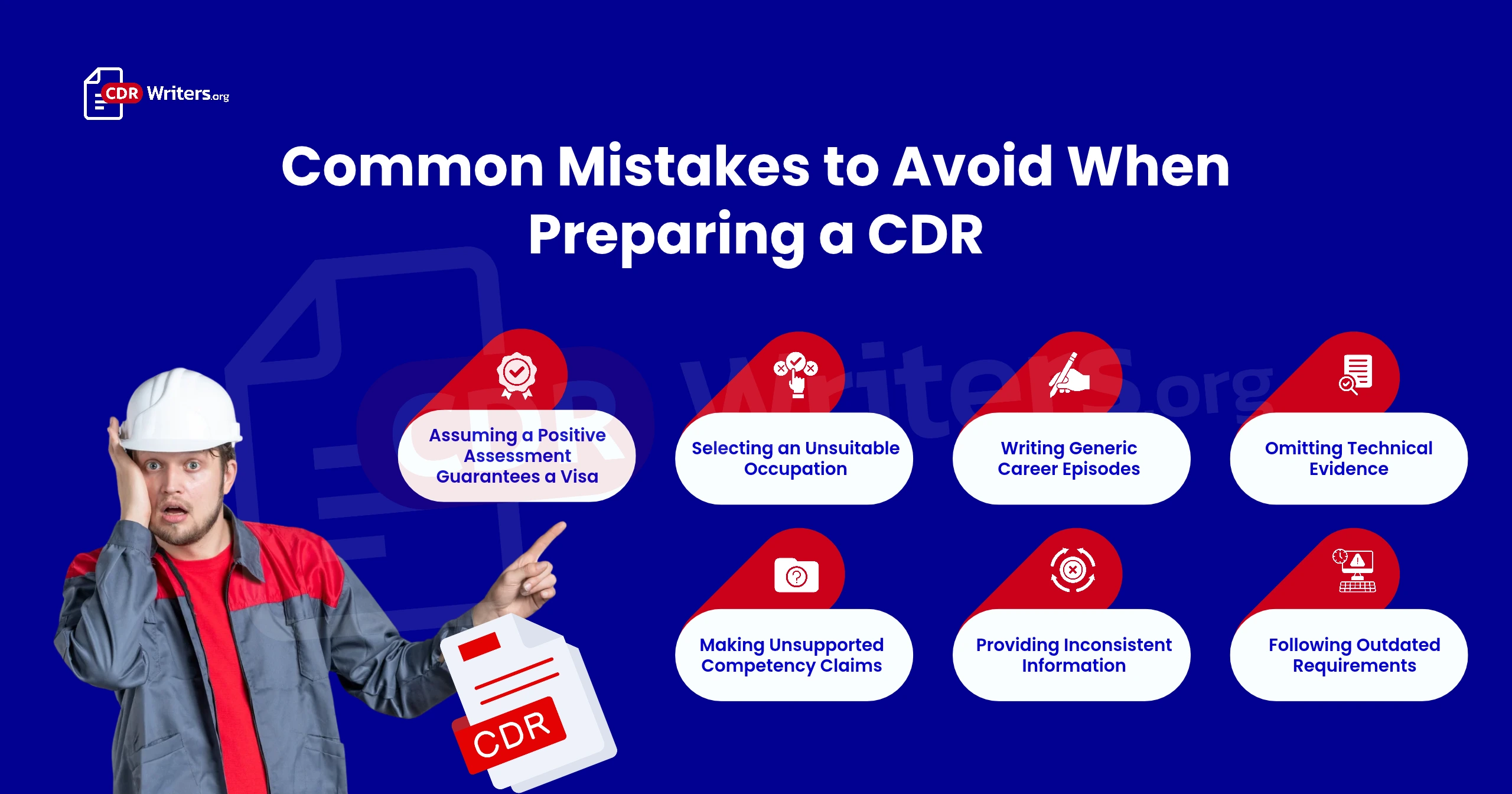
Organising project information, supporting documents and competency evidence in preparing a technical assessment report can be a complex task.
An applicant may receive help from a professional review or writing service in clarifying explanations, correcting inconsistencies, including missing references, or enhancing the technical presentation.
Assistance for an Electrical Engineering Draftsperson should be related to your actual academic background and project experience.
A suitable review should contain the following:
If you wish to prepare or review your documents, you may want to review the CDR Writer services that they provide for the relevant career episode and CDR writing services.
Any support should be to present your own experience accurately. It is your responsibility to ensure that the final submission is accurate and fulfils the assessment criteria.


CDR reports, resumes, VETASSESS, and RPL applications can be challenging to prepare. Our team of professionals has effectively helped clients obtain approval with professional services that address all of these needs.
The first step in creating a CDR for Electrical Engineering Draftsperson is choosing the correct assessment pathway and comprehending what is needed for your chosen occupation.
Your report must reflect honest project experience, describe your own technical involvement, and correlate your career experiences with the applicable competency elements. It is also important to have supporting documents that are consistent and to pay attention to the current assessment instructions.
Review the report before submitting the application: Ensure technical accuracy, evidence, information, and outdated requirements.
Need some help with the organization and review of your technical documentation? CDR Writers can help you look into the services available for preparation. Remember that your final report will accurately reflect your qualifications and experience and meet the Engineers Australia requirements.
The CDR for Electrical Engineering Draftsperson is a competency report for the relevant Engineers Australia migration skills assessment pathway. Provides proof of an applicant’s engineering expertise and individual contributions to projects or activities.
No. The correct assessment route will be dependent upon your qualifications, accreditation, and nominated occupation. Check the Engineers Australia guidelines first before determining if the CDR pathway applies to you.
There are three career episodes that are necessary for the standard CDR pathway. Each should have the following structure (as outlined in Engineers Australia rules): Describe relevant activities and explain what you personally did in these activities.
Real-life projects such as wiring, CAD, engineering design support, and technical revisions of drawings can be included. The projects you select should be based on your actual experiences and should illustrate the appropriate skill areas.
It is important to be aware of the technical requirements that apply to your project work and nominated occupation. Talk about standards that are relevant to what you are doing and don’t pretend that you have had experience with standards that you haven’t used or understand.
Get a free consultation today. Our engineers will assess your profile and tell you exactly what you need — at no cost, no commitment.
Expert CDR, ACS, and VETASSESS assessment writing service. 5,600+ documents written. 99% approval rate. Serving professionals from 65+ countries migrating to Australia. Free consultation available.
Disclaimer:
CDR Writers is an independent document preparation service. Not affiliated with EA, ACS, VETASSESS, IML, or any official authority.
Sun-Fri · 24 Hours a Day
Copyright © 2020 – 2026 CDR Writers
99% Success | Trusted in 65+ Countries | 4.9/5 Rated | 100% Secure Payments
