
Online

An internationally qualified physiotherapist who is seeking to demonstrate that his or her education, knowledge and professional competence match the requirements that are expected of physiotherapy practice in Australia may wish to follow the APC Skills Assessment pathway. The Australian Physiotherapy Council (APC) is actively engaged in recognising the qualifications and skills of overseas qualified physiotherapists via the appropriate assessment pathways.
In many respects, the APC assessment process can be daunting for many international physiotherapists. The requirements could vary from person to person based on their expertise, place of education, career background, and the path they are taking. To begin their application, the applicants must be aware of the assessment process, eligibility, the required documents, and the preparation expectations.


It is important, however, for applicants to be aware that the skills assessment and professional registration are distinct processes and may have different requirements.
The Australian Physiotherapy Council Skills Assessment is the assessment that is applied by the Australian Physiotherapy Council to determine if an internationally qualified physiotherapist has qualifications and competencies that match the standards for physiotherapy in Australia.
This assessment process is pertinent to physiotherapists trained in other countries and who require assessment of their professional qualifications for an Australian pathway to a professional career or to migrate to Australia.
The aim of the assessment is to look at these things:
The successful result may be a significant achievement on the pathway to completing the right Australian registration, employment or migration pathway.
submit any documents unless they meet the requirements.
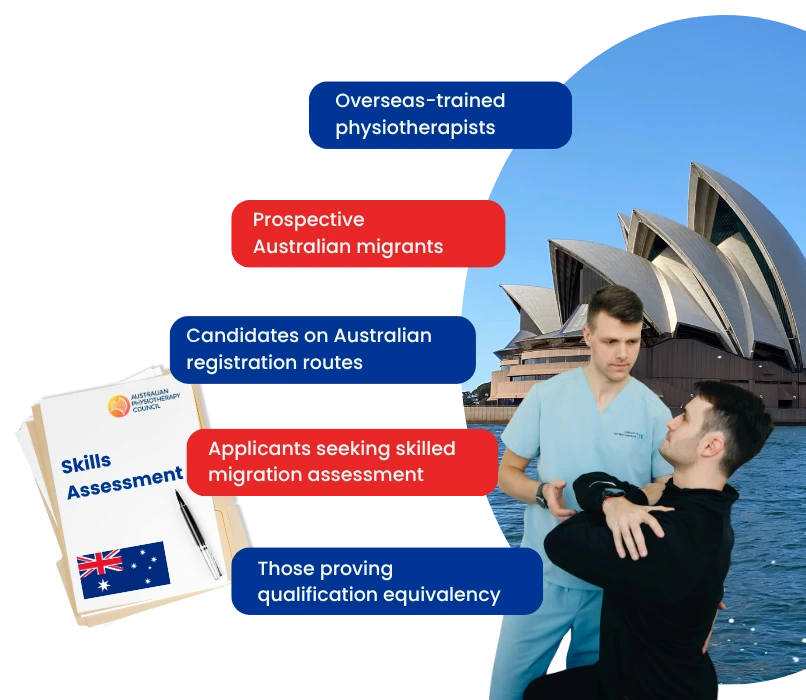
Internationally qualified physiotherapists who have received their training in professional physiotherapy in a country other than Australia may have an interest in an APC Skills Assessment.
Applicants may include:
Specific eligibility criteria are dependent on the assessment pathway. It is very important for the applicants to read the present requirements carefully and they should not pay fees or
Australia has professional standards for health care workers. The Australian healthcare system expects physiotherapists to have the relevant knowledge, skills, ethics and clinical competencies.
The assessment process (APC) is used to assess internationally qualified physiotherapists against the appropriate Australian Standards.
An APC review could be a significant consideration for an applicant as it may help them:
Applicant’s physiotherapy education is evaluated in relation to the requirements of the relevant Australian assessment pathway.
Assessment may be a step in a wider pathway that leads to professional practice or other Australian requirements, depending on the individual’s situation.
If an applicant is applying for a visa category that incorporates a relevant skills assessment under the visa program he or she must ensure that he or she complies with the requirements of the relevant skills assessment authority and visa program.
A few assessment pathways may require more tests or competency tests. The stages may be used to assess whether or not the applicant has attained the required level.
Take our free Eligibility Test — answer 5 quick questions about your engineering background, qualifications, and visa goals. We’ll identify your assessment body, ANZSCO code, and the exact documents required. Takes under 3 minutes.
The assessment pathway may be dependent upon the pathway for which your physiotherapy qualification was obtained and the location of your qualification.
In most cases, the first step in the application process should be to determine which assessment pathway is relevant to the situation. This can include assessing:
Not all overseas physiotherapy qualifications are the same.
The assessment journey can take a number of steps, depending on the applicant’s pathway.
You should carefully decide if you are eligible for the different APC pathway you are applying to before you begin an application.
You should review:
An eligibility review can minimize the chance of applying the wrong way.
Documents are prepared, and the applicant files the application in the appropriate APC process.
Before submission, it is important to ensure that:
If applications are not completed, they may be delayed or require further information.
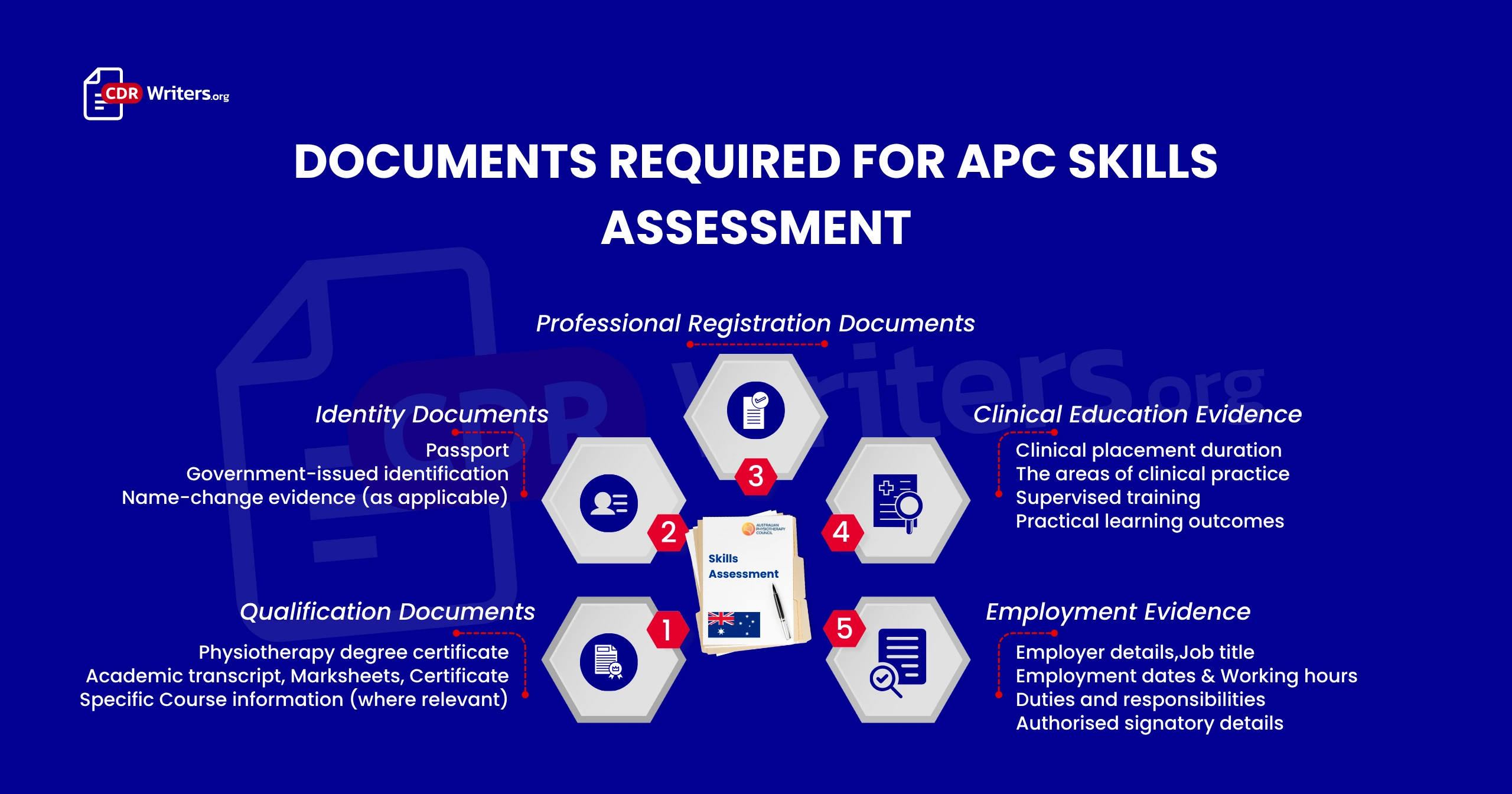
Documentation is a key component of the APC Skills Assessment. The applications must be clear, accurate, and complete.
Some common documents are:
Requirements may be modified, and applicants are advised to always refer to the latest instructions for their assessment pathway.
Additional assessment needs may be required depending on the assessment pathway and applicant’s situation.
These might determine if the applicant has knowledge and skills similar to those in physiotherapy practice in Australia.
The applicant must work out a plan and revise:
The applicant’s submitted information is considered to see if they qualify for the following assessment stage.
The evaluation can take into account factors like:
If the applicant does not submit adequate or clear evidence, they will be required to submit additional information.
Once the applicant has gone through all the prescribed stages, the applicant is awarded a result based on the assessment requirements of the relevant stage.
Carefully read the letter of outcome and understand:
The outcome of an assessment is not to be interpreted as completion of all Australian registration or visa requirements.
One of the most crucial components of an APC Skills Assessment application is document preparation.
Requirements are different for each applicant, but could include proof of identification, schooling, work experience, and credentials.
May require:
All documents must have the same name. If there are different names on your documents, supporting evidence should provide an explanation for the discrepancy.
These may include:
Make sure that scanning is done and understandable.
Physiotherapy is a clinical profession. Thus, evidence of practical and clinical education may be significant.
If documentation is requested, it should be able to show:
Relevant registration/licensing documents may be required if currently or previously registered as a physiotherapist.
Requirements for Work Experience may be different depending on pathway. If employment evidence is required, applicants should provide an employee record that makes it clear that:
Prep should start very early before you apply.
Avoid information only from friends, social media, or old guides. You may meet different requirements and have different situations than other applicants.
Find the right way to go first.
List all the documents you need to submit for your application. And then examine each document to see if it is complete.
A handy checklist can be helpful and include the following:
Small, but significant differences can cause problems.
Check:
If you have exams or competency testing in your pathway, make sure that you don’t procrastinate preparing for them until the last minute.
Create a systematic study plan, theoretical and practical, with clinical reasoning.
It will also be important for international physiotherapists to understand the context of physiotherapy practice in Australia and the expectations held by physiotherapists in that country.
Significant areas might be:
For internationally qualified physiotherapists, one of the most significant differences to be aware of is the difference between assessment and registration.
Qualifications and pathway competencies are measured using an assessment process. Professional registration is not part of this and is based on the relevant registration requirements.
As a result, and after receiving an assessment determined by the APC, an applicant might still need to meet other requirements before they can be registered as a physiotherapist in Australia.
Applicants should carefully plan their journey, and they should identify:
Qualification Assessment → Required Competency Steps → Registration Requirements → Employment or Migration Process
The order and requirements are specific to the person.
Applicants can minimize delays by not making common mistakes.
All internationally qualified physiotherapists don’t go through the same assessment process. Please check the correct route before you apply.
If pages are missing or the evidence is unclear or incomplete, the assessment will be delayed.
If the names, dates, or qualification information are different, there should be a good explanation of this with supporting documents.
If not written in English, documents may need to be translated per assessment instructions.
Letters containing employment evidence only, but lacking in detail, may not contain the information required.
Structured preparation is needed for knowledge and competency evaluations. Past experience alone might not be sufficient.
The processing time for an APC Skills Assessment will depend on the following:
The applicants must refrain from making any permanent travel, job or migration plans based on estimated processing times.
Full and accurate documentation can help prevent unwarranted delays.
An adequately prepared application will make the process easier to manage.
Gathering academic and professional documents may be time-consuming, especially if you require documents from Universities, Hospitals, employers, or Registration authorities.
Assessment requirements are subject to change. Follow the most recent directions for the given pathway.
Keep organised digital and backup copies of:
For example:
Organising your files properly can assist you in reviewing your application prior to submission.
All documents and information should be true and correct. Misrepresentation can cause significant problems with assessment, registration and employment and migration processes.


CDR reports, resumes, VETASSESS, and RPL applications can be challenging to prepare. Our team of professionals has effectively helped clients obtain approval with professional services that address all of these needs.
An APC-related application could include several documents, qualification specifics, assessment phases, and professional requisites. Some people apply for professional advice to help them understand the documentation and application procedure.
Support can be helpful for:
Applicants should ensure, however, that they use any support that is ethical and does not involve them in falsification of their qualifications, documents, employment records, etc., and of assessment evidence.
The applicant is responsible for the accuracy and authenticity of an application.
The APC Skills Assessment is a critical step for many internationally trained physiotherapists who want to pursue their careers in Australia. To successfully begin a journey to success, the student must know the proper assessment pathway, build complete documentation, abide by current assessment requirements, and then complete each assessment step with careful preparation.
Applicants must not rush the application, but should ensure that all qualifications, academic records, evidence of clinical training, and professional documents are organised in advance. An organized process can minimize unnecessary delays and confusion.
When you are international qualified physiotherapist and preparing for an Australian pathway, there are three key points to focus on: ensuring you have the right qualifications; gathering evidence in the correct way; and meeting the requirements of your APC pathway at the time.
The APC assessment process can be daunting, but with some planning and preparation, it’s possible to feel more confident and move forward in your career path in Australia.
Generally, the term APC Skills Assessment is used to describe the assessment process that is measured by the Australian Physiotherapy Council for internationally qualified physiotherapists whose skills and competencies need to be assessed in order to be granted an appropriate Australian pathway.
If your intended pathway and circumstances require it, an APC assessment may be required for internationally qualified physiotherapists who have completed their professional qualification outside of Australia.
No. Assessment and professional registration are two distinct processes. Registration requirements may be more than a physiotherapist has to meet before being able to work in Australia in this profession.
Requirements will vary depending on the pathway but may include identity documents, qualification certificates, academic transcripts, clinical training evidence, professional registration documents and other supporting evidence.
Processing times are variable by pathway, completeness of documents, assessment stages and verification requirements, and the need for further assessment stages.
Get a free consultation today. Our engineers will assess your profile and tell you exactly what you need — at no cost, no commitment.

Expert CDR, ACS, and VETASSESS assessment writing service. 5,600+ documents written. 99% approval rate. Serving professionals from 65+ countries migrating to Australia. Free consultation available.
Disclaimer:
CDR Writers is an independent document preparation service. Not affiliated with EA, ACS, VETASSESS, IML, or any official authority.
Sun-Fri · 24 Hours a Day
Copyright © 2020 – 2026 CDR Writers
99% Success | Trusted in 65+ Countries | 4.9/5 Rated | 100% Secure Payments
