
Online

Writing a Competency Demonstration Report (CDR) for Engineers Australia is not just about writing detailed Career Episodes! Applicants are also required to show how their engineering knowledge, skills, and work activities relate to the respective competency standards. For this process, one of the most critical components is the implementation of Summary Statement Competency Mapping.
A Summary Statement is a document that links the competency elements outlined in Engineers Australia’s competency statement to evidence gathered in your Career Episodes. It assists assessors in determining where and how you have applied the engineering abilities in your academic work, your work experience, and your technical problem-solving experiences.
If you know how to do this mapping properly, you will be able to make your CDR more organized, consistent, and easier to assess. Competency mapping is a guide to help you understand the purpose of mapping, how to prepare for it, what to avoid doing, and how to use it to produce an accurate Summary Statement.
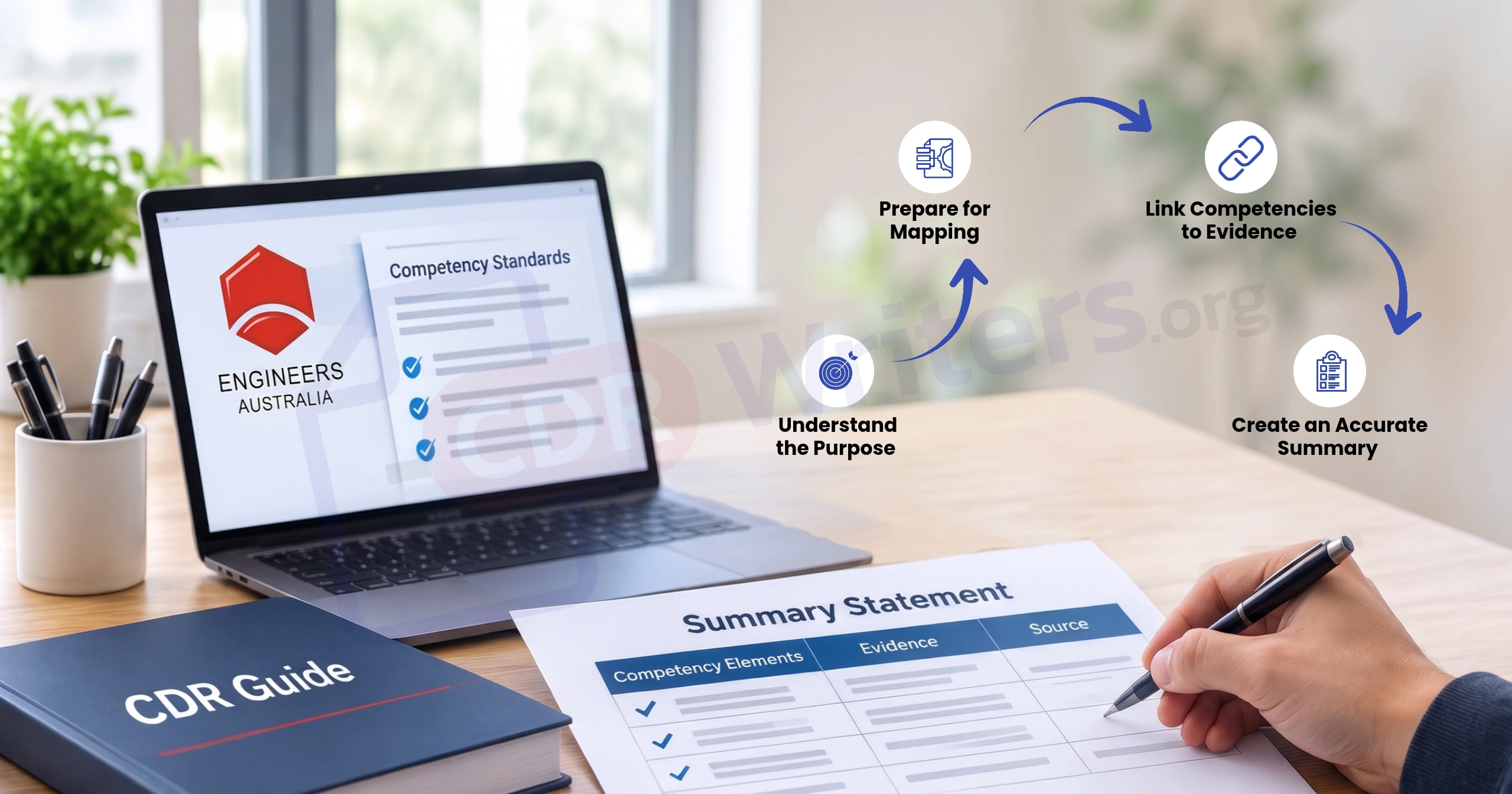
Linking the competency elements listed as required by Engineers Australia to specific paragraphs within your Career Episodes is called Summary Statement Competency Mapping.
A CDR typically consists of three Career Episodes, a Summary Statement and a Continuing Professional Development (CPD) list. Each Career Episode is a single engineering activity or project for which you are personally responsible, and you explain and describe your part, technology choices, and contributions.
The Summary Statement combines the evidence from these episodes into one statement that identifies the paragraphs that address individual competency elements.
For instance, when you describe an engineering improvement you made to a technical problem, analyzed the problem and considered alternative solutions, you might be able to cite paragraphs that support specific problem-solving or engineering application competencies.
The aim is not to provide a mere checklist of competencies. To create clear linkages between the necessary competency elements and the real engineering work outlined in Career Episodes.
Note: The Summary Statement format is dependent on your nominated occupation category and Assessment pathway for your course. Always follow the most up-to-date official Engineers Australia guidelines and the template for your application.
Competency mapping is a process that provides accurate evidence of the level of competency achieved in your engineering experiences that correspond to the requirements of the competency.
These are the primary reasons why it is important.
Your Career Episodes tell the assessors what you did, but they also must see how your experience showed the competencies.
The Summary Statement helps you structure your evidence in your episodes.
Evidence should be provided for each competency element and should include relevant evidence from your Career Episodes. Mapping can work to establish these connections without having to have to look through your entire report without direction.
A well-organized Summary Statement helps your application to be easily read. The use of paragraph references supports assessors in finding the correct technical explanations and examples.
An assessment of your Career Episodes by competency mapping could indicate if your Career Episodes have a satisfactory representation of the required elements.
If a competency does not have a corresponding paragraph, you might need to discuss your Career Episodes and consider the need for more authentic evidence.
When you have finished your Career Episodes, the mapping will help you to review the consistency of paragraph references, technical descriptions, and competency statements across your report.
But good mapping is no guarantee of a successful assessment. The quality of the evidence and your adherence to the assessment requirement(s) continue to be of paramount importance.
To begin with, for Summary Statement competency mapping, you need to be familiar with the competency framework that applies to your engineering career.
Engineering qualifications and competencies are assessed by Engineers Australia in various pathways and occupational categories. The criteria for enlistment may vary depending on your pathway, whether as a Professional Engineer, Engineering Technologist, Engineering Associate, or a pathway relevant to your profession.
These are some examples of general capabilities that might need to be demonstrated.
This area relates to the engineering knowledge and technical underpinning that is required to comprehend and solve engineering issues.
The evidence may involve applying engineering principles, the use of mathematical methods, interpretation of technical information, and understanding of relevant technologies.
This area is about making use of engineering knowledge in real-life scenarios.
These include problem identification, assessment of alternatives, solution design, investigation, and technical results assessment.
This section is about professional behaviours needed for engineering practice.
Evidence can be relevant to communication, teamwork, ethical practice, professional responsibility, project management and continuing professional development depending on the appropriate framework.
These classes are only a general explanation and will not replace the competency elements. Please ensure that all the requirements listed in Engineers Australia refer to the current Engineers Australia requirements for your occupational category.
Use this procedure to write a Summary Statement that is clear and correct.
You should first identify your Engineers Australia (EA) assessment pathway and EA occupational category for your application.
Your pathway determines which competency requirements and Summary Statement format you should use.
Before writing the document, check:
Even if your Career Episodes have technical information, the wrong template can result in inaccurate competency mapping.
Your Career Episodes are the bulk of the evidence you will use to illustrate your engineering skills.
Each episode should contain enough details to make the engineering activity, project, or work period understandable and describe in enough detail the work you did to explain how you made a contribution.
All of the following are typically included in a Career Episode:
Where appropriate, use first-person language to differentiate your responsibilities from your team and organisation.
For instance, say you asked the team to analyze the system; say that you are the one who analyzed the system, the primary source of inefficiency, and the usefulness of alternative design solutions.
Please limit activities to ones that are accurate, reflecting your experience.
After your Career Episodes have been written, break them down into logical paragraphs and add consistent paragraph numbers.
These references may be used to link specific evidence to individual competency elements.
An episode could be set up like this, for instance:
This does not require the use of paragraphs, but is a stylistic example for numbering. The actual paragraphs in your Career Episode should be the same as the references you list in your actual report.
Use the same technique for Career Episodes 2 and 3 and their paragraph numbers.
Note: Complete the numbering of the paragraphs before writing a Summary Statement. If you ever make changes to the structure of a Career Episode, check each reference that is affected.
Open the official Summary Statement for your assessment category and go through each competency element of the assessment.
Avoid starting paragraphs at random. To know what elements you are expected to show.
Ask yourself the following questions about each element:
This can help you identify paragraphs that state an activity but don’t show the ability, and those that show the ability and state the activity.
This is the middle step in Summary Statement Competency Mapping.
Identify the paragraph(s) or the paragraphs that contain direct evidence for each competency element.
Assume a Career Episode is about investigating recurring overheating in an electrical system.
Your account may include that you:
Some aspects of this work may contribute to various competency elements in the competency framework, depending on the specific competency framework and the report’s content.
An entry in the map might appear something like this:
Competency evidence | Illustrative paragraph reference |
Investigation and collection of technical information | CE1.3 |
Analysis of the engineering problem | CE1.4 |
Evaluation of alternative solutions | CE1.5 |
Implementation of the selected solution | CE1.6 |
Evaluation of the final result | CE1.6 |
The information in this document is intended as an illustration of how evidence could be organised and is not an official Engineers Australia competency mapping. The actual competency element(s) should be assessed against the appropriate standard prior to giving a reference.
The content of the paragraph should actually meet the competency element being evaluated.
Once you have located the evidence, write the paragraph numbers in the Summary Statement in the appropriate section.
Each competency element may require you to locate the corresponding paragraphs in the Career Episode in a specific template.
For example:
Competency element | Career Episode 1 | Career Episode 2 | Career Episode 3 |
Applicable element A | CE1.3, CE1.4 | CE2.4 | CE3.5 |
Applicable element B | CE1.5 | CE2.3, CE2.5 | CE3.4 |
Applicable element C | CE1.6 | CE2.6 | CE3.3 |
The competency labels and references listed above are only examples and do not necessarily represent a competency checklist.
Please use the element descriptions and fields as they are contained in the official template. These example references cannot be copied into an application if they do not match the actual Career Episodes from their application.
Just because a paragraph reference is given does not imply that a competency has been met.
Examine each paragraph of the map, and decide if there is enough information to support that paragraph’s element.
Think about the following questions:
If evidence is weak, make changes to the Career Episode as needed.
Avoid simply making up unsupported statements to complete the Summary Statement.
After mapping, check all references with the final draft of your Career Episodes.
For instance, if the Summary Statement is CE2.5, check to see if there is a paragraph in Career Episode 2 that is CE2.5 and that the ideas in the paragraph support the Summary Statement.
Check for:
This cross-check becomes important when you have edited your Career Episodes after creating the initial mapping.
Your Summary Statement should be consistent with the rest of your application.
Check the entire packet for the CDR to ensure that:
Please have this review done before submitting your application.
Imagine a person working as an electrical engineer and is involved in designing a more energy-efficient industrial motor system.
The engineer researched high levels of power usage, looked at operating statistics, considered potential changes, and tested the effectiveness of the solution implemented.
The Career Episode may include the following paragraphs:
Paragraph | Description of the engineer’s work |
CE1.3 | Identified the system’s energy-efficiency problem. |
CE1.4 | Collected operating data and analysed motor performance. |
CE1.5 | Evaluated alternative technical solutions. |
CE1.6 | Implemented or assessed the selected improvement. |
CE1.7 | Reviewed the results and documented the outcome. |
These activities are compared to the corresponding competency elements and paragraphs that provide appropriate evidence are identified during the Summary Statement mapping process.
For example, CE1.4 could support an element related to technical investigation or analysis, and CE1.5 could support an element related to the evaluation of engineering alternatives.
The specific mapping will vary based on the language of the applicable competency standard and the specific technical detail(s) included in the Career Episode.
This example is provided to illustrate the process, and not the answer. It should not be used as a pre-prepared template for their own reporting.
Even the best Career Episode can be difficult to score if the Summary Statement includes references that are inaccurate or competency references that are poor.
Here are some pitfalls to steer clear of.
Various assessment routes can be followed, with varying competency frameworks and documentation.
How to prevent it: Check your assessment category and get the most up-to-date relevant template from Engineers Australia.
A paragraph that is identified by a technical term that is relevant to the competency does not automatically meet the competency.
How to prevent it: Read the entire paragraph and be sure that it contains meaningful evidence for the specific element.
These are difficult to find if they are not in a place referenced in the incorrect text.
How to prevent it: Done before the mapping starts, and double-check each mapping with the final report.
One paragraph could be used to support more than one competency element, but each relationship should be backed up by content.
How to prevent it: Only use a paragraph reference for a paragraph that actually supports a given element.
A general statement of responsibilities does not show application of engineering knowledge or problem solving.
How to prevent it: Give an explanation of the task, what is done individually, the technical explanation, and the result if applicable.
It is sometimes hard to measure a project team’s individual skills if they are not specifically discussed in the context of how they contributed.
Avoidance strategies: Identify and clearly differentiate contributions of colleagues, supervisors, and other project participants.
The Summary Statement is NOT evidence; it is a reference to the evidence.
The easiest way to avoid it: Make sure the appropriate Career Episode paragraphs include the explanation and technical detail.
Changes to paragraph structure can make an otherwise accurate Summary Statement incorrect.
How to avoid it: Recheck the complete mapping after every substantial Career Episode revision.
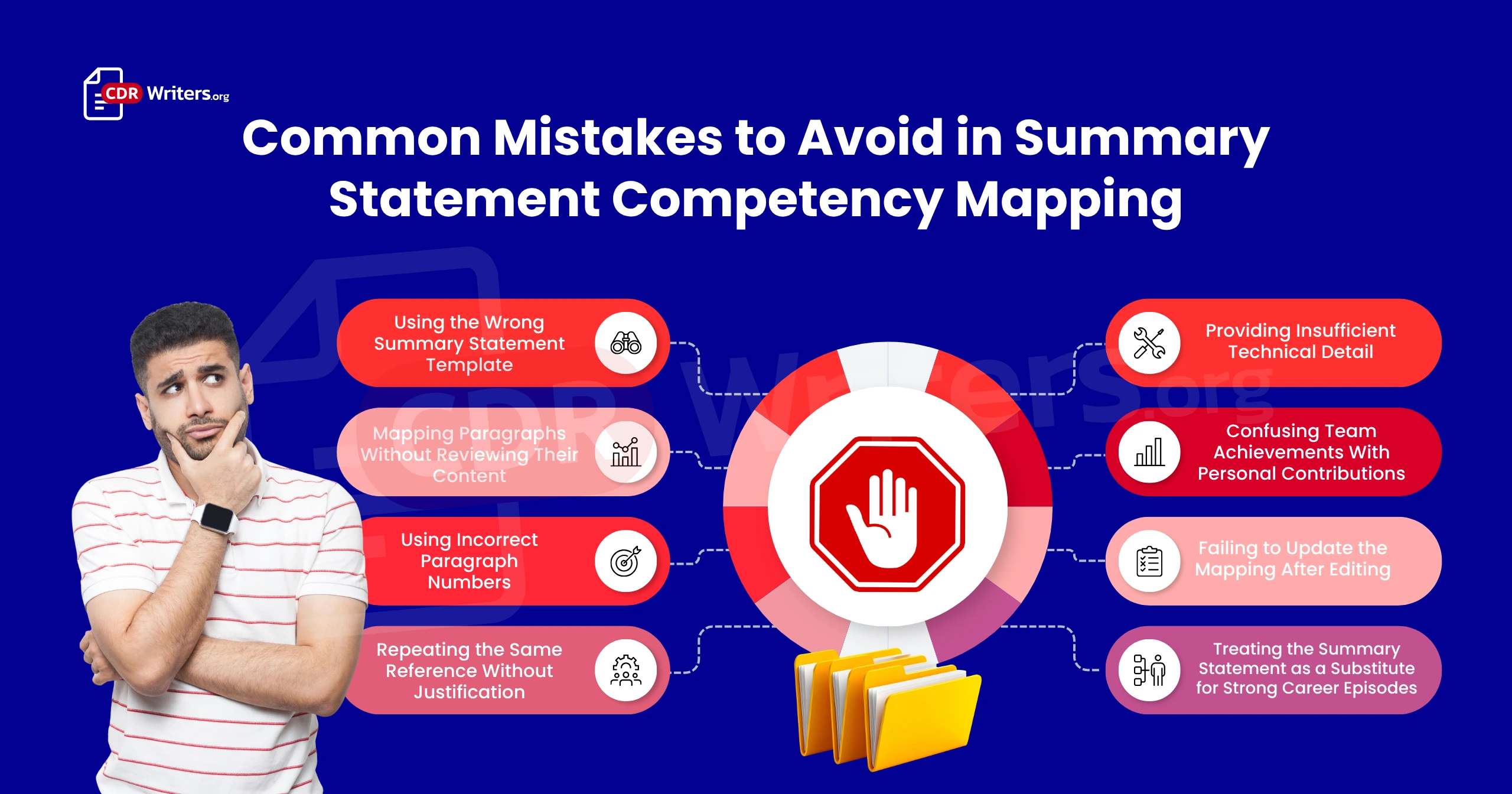
To enhance the quality and consistency of competency mapping, use the following practices.
Begin by checking the official requirements. Use the existing template and competency standards that apply to your assessment pathway.
Technical evidence and paragraph numbers will remain consistent when completing Career Episodes.
Refer to paragraphs with specific references to each competency element.
Ensure that your mapping evidence is evidence-based. Do not assert that a paragraph shows a competency unless the information in the paragraph supports the competency.
Maintain consistency. Consistent paragraph numbering, terminology and description throughout your report.
Systematically review the coverage of each required element to determine if any element is missing or coverage is inadequate.
Give the opportunity for a final review. A second “verification” pass may be a valuable step to catch errors that are often overlooked during writing.
Maintain originality of your report. Career Episodes and competency claims should be true to your qualifications, experience, and engineering contribution.


CDR reports, resumes, VETASSESS, and RPL applications can be challenging to prepare. Our team of professionals has effectively helped clients obtain approval with professional services that address all of these needs.
If the Engineers Australia pathway of interest to the applicant requires it, Summary Statement Competency Mapping is a crucial component in the preparation of a clear and well-organised CDR. It will link your Career Episodes to the competency elements and guide your assessors to find evidence of your engineering knowledge, technical skills, and professional skills.
When writing an accurate Summary Statement, determine the appropriate assessment pathway, make sure to complete Career Episodes, number the paragraphs consistently, align each competency element with relevant evidence, and verify all references before submitting.
Most important of all, don’t just “fill in the table” when doing competency mapping. Every reference should refer to real evidence that demonstrates the competency.
If you require help in the preparation of your CDR, then CDR writers will be able to explain how the documentation process works and structure your report according to the requirements. Make sure that your final submission accurately reflects your engineering experience and is in line with the current Engineers Australia guidelines.
The post-nominal that is added to the name of a Professional Engineer (PE) member of Engineers Australia upon completion of the Postgraduate diploma or Master’s degree in Engineering is known as Graduate membership. It is designed for a new graduate engineering student who has just finished his/her college education.
Generally, graduate membership is offered to those who have completed an accredited Australian or recognised engineering course within the relevant time frame. According to Engineers Australia, at the present time, coursework must be finished within the last four years for applicants to be considered as having completed their coursework.
International engineering students may apply, but it is essential that their qualification is recognised by Engineers Australia. All candidates with overseas qualifications must check to ensure that the engineering qualification is recognised before applying.
These are typical documents that are requested: proof of identity, evidence of engineering qualifications (letter of completion or degree certificate). Where relevant, a previous Engineers Australia assessment letter may also be requested.
Graduate membership is for young engineers and is not the same as the experienced Member grade. The main eligibility interest area is the recognised engineering qualification and the applicable Graduate membership criteria.
Get a free consultation today. Our engineers will assess your profile and tell you exactly what you need — at no cost, no commitment.
Expert CDR, ACS, and VETASSESS assessment writing service. 5,600+ documents written. 99% approval rate. Serving professionals from 65+ countries migrating to Australia. Free consultation available.
Disclaimer:
CDR Writers is an independent document preparation service. Not affiliated with EA, ACS, VETASSESS, IML, or any official authority.
Sun-Fri · 24 Hours a Day
Copyright © 2020 – 2026 CDR Writers
99% Success | Trusted in 65+ Countries | 4.9/5 Rated | 100% Secure Payments
