
Online

In Australia, two significant areas of professional registration that may be encountered by engineers include RPEQ and NER. Both are examples of professional engineering skills, but have different functions and are managed by different processes.
The primary difference between RPEQ vs NER is the scope and legal purpose of each. RPEQ (Registered Professional Engineer of Queensland) is a statutory registration for engineers who are providing engineering services in or for Queensland as a professional engineer. The National Engineering Register (NER) is the national professional register maintained by Engineers Australia.
It is critical for engineers intending to work in Queensland to be aware of the connection between NER and RPEQ. For some, an engineer can fulfil the competency assessment requirements of the RPEQ pathway with their existing NER.

RPEQ is the registered name for a Registered Professional Engineer of Queensland. It is a registration system run by the Board of Professional Engineers of Queensland (BPEQ).
The Queensland professional engineering legislation says that a person must be registered as an RPEQ to provide professional engineering services in or for Queensland, unless there is an exception.The Queensland professional engineering legislation states that a person is generally required to be registered as an RPEQ to provide professional engineering services in or for Queensland, unless a specific exception applies, including being directly supervised by an RPEQ, or working to a prescriptive standard.
RPEQ registration is more than just a credential or professional membership. It is a statutory registration in Queensland.
Currently, BPEQ has 19 areas of engineering that are registered and an RPEQ can only practice in the area or areas for which they are registered.
According to BPEQ, the requirements for applicants are as follows:
The assessment process can involve reviewing qualifications and work experience, an interview, and referee checks.
The National Engineering Register is NER. It is a professional registration system that engineers in Australia are affiliated with.
NER acknowledges all engineers who demonstrate the requirements of professional competency and experience and offers a national qualification for engineers.
NER is NOT a Queensland statutory licence, unlike RPEQ. An engineer does not necessarily have to be an RPEQ to hold NER.
For engineers planning on applying for RPEQ registration though, NER can prove very beneficial.
Feature | RPEQ | NER |
Full name | Registered Professional Engineer of Queensland | National Engineering Register |
Main organisation | Board of Professional Engineers of Queensland (BPEQ) | Engineers Australia |
Geographic scope | Queensland | National |
Nature | Statutory registration | Professional registration/credential |
Main purpose | Legal registration for professional engineering services in or for Queensland | Recognition of professional engineering competence and experience |
Legal requirement in Queensland | Generally required where the legislation applies | Not itself the Queensland statutory registration |
Engineering areas | Registered in specific areas of engineering | Areas of practice are recorded through Engineers Australia |
Relationship | Required for applicable professional engineering practice in Queensland | Can provide a pathway toward RPEQ assessment |
Final registration authority | BPEQ | Engineers Australia |
It is important to note that NER does not ‘supplement’ the requirement for an engineer to be registered under Queensland law, it is a replacement role.
No.
One of the key factors to consider when comparing between RPEQ and NER is this one.
NER is a professional registration offered by Engineers Australia and RPEQ is a statutory registration overseen by BPEQ.
An engineer can be an NER but require to be registered with BPEQ to be an RPEQ.
Engineers Australia now indicates that those who have completed a course and are registered with the NER or Chartered do not require additional assessment in order to meet the criteria for the relevant pathway of the RPEQ. They are able to download an RPEQ Assessment Letter from the Engineers Australia member portal and then apply to BPEQ.
Therefore:
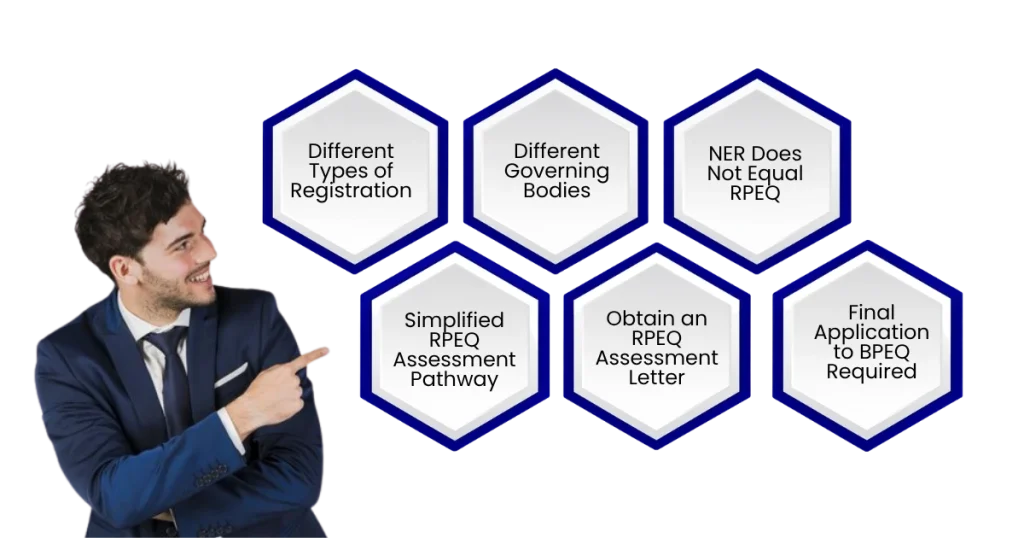
NER → RPEQ Assessment Letter → BPEQ application → RPEQ registration
While the NER credential will streamline the competency assessment process, the engineer will still need to go through the RPEQ registration process with BPEQ.
Yes.
If the engineer already has NER, the process to achieve RPEQ may be easier.
An engineer registered on NER who is not registered in another state is not required to undergo additional assessment for the relevant RPEQ eligibility assessment in terms of their qualifications, experience or competencies. An RPEQ Assessment Letter is available on the engineer’s Engineers Australia member portal.
This process can be considered as follows:
The engineer fulfills the requirements for registration on the National Engineering Register.
Eligible NER registrants can produce their RPEQ Assessment Letter via the Engineers Australia member web page.
The RPEQ Assessment Letter is a document that lists the engineering area(s) for which the engineer is eligible to do work based on his/her NER area of practice.
Additional assessment may be necessary if the required RPEQ engineering area is not exactly aligned with the NER area of practice.
The engineer uses the RPEQ Assessment Letter to apply for registration with the Board of Professional Engineers of Queensland.
This last step is significant because, even if a person is a member of the NER, they are not necessarily an RPEQ.
It is not necessary for engineers to get NER before they go for RPEQ.
Applicants with no existing NER or Chartered qualifications can undertake the Queensland state registration pathway offered by Engineers Australia.
Qualifications and a detailed CV, referee information, evidence of English competence where appropriate, career episodes and CPD information and a competency summary statement may all be required in addition to other documents for a non-member pathway.
Once the applicant has fulfilled the assessment requirements, they will receive an RPEQ Assessment Letter, and they may continue to submit a BPEQ registration application.
The requirements should not be considered as the same, as the two registrations are for different purposes.
Most applicants for RPEQ should have:
These minimum experience requirements are currently listed on BPEQ’s RPEQ registration guidance.
NER’s focus is on professional competency, experience and professional practice via Engineers Australia.
If an engineer is assessing both registrations, NER may be of benefit due to Engineers Australia’s current guidance for Queensland recognition of NER as an accepted pathway to meeting the RPEQ competency assessment element for the relevant engineering area.
Engineers should identify if the work they are proposing to undertake in Queensland is a professional engineering service under Queensland legislation.
The engineer’s position is not necessarily the most important. BPEQ clarifies that the legislation may be relevant to professional engineering services supplied in Queensland or for Queensland, and in some cases, where the engineering is based outside Queensland.
In particular, an overseas-based engineer might need to take Queensland registration into account when providing the engineering services of a professional engineer in Queensland.
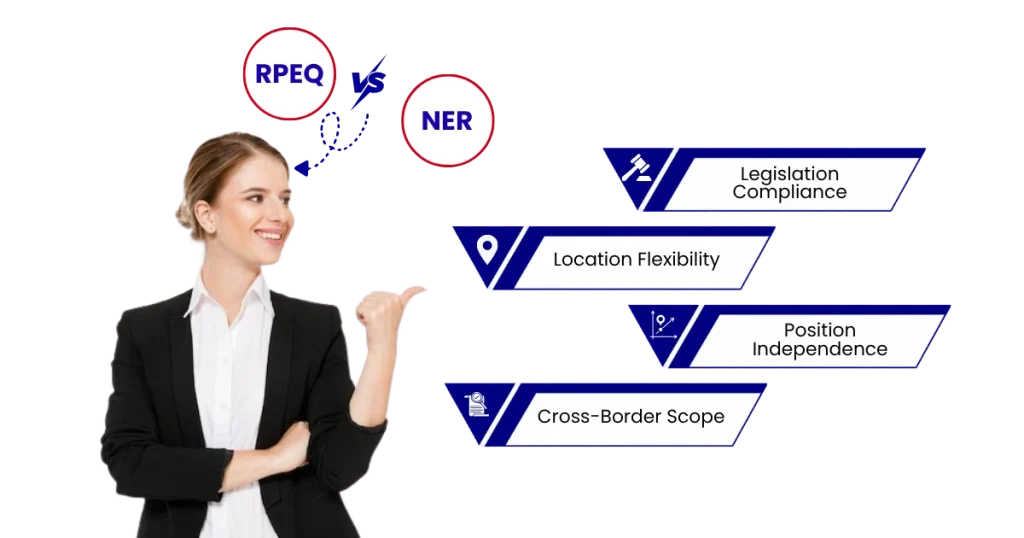
No single solution is available as they are used for various purposes.
You are an engineer who requires national professional recognition and are also likely to be providing regulated professional engineering services in Queensland.
While holding NER, the RPEQ assessment pathway can be more streamlined in the relevant area; both credentials are distinct.
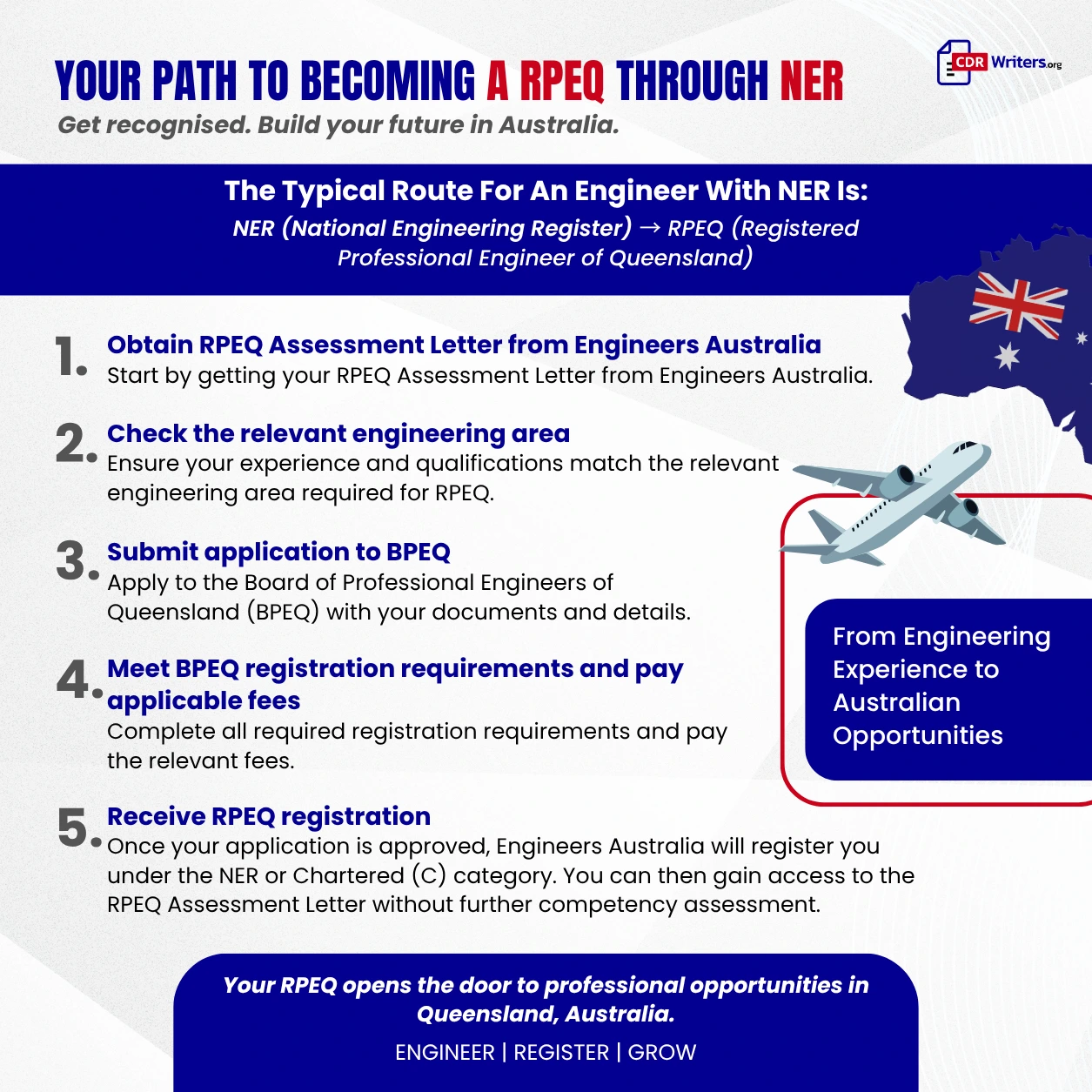
The typical route for an engineer with NER is:
NER registration
↓
Obtain RPEQ Assessment Letter from Engineers Australia
↓
Check the relevant engineering area
↓
Submit application to BPEQ
↓
Meet BPEQ registration requirements and pay applicable fees
↓
Receive RPEQ registration
Engineers Australia states that where the relevant competencies are satisfied, engineers registered under the NER or Chartered (C) can gain access to the RPEQ Assessment Letter without further competency assessment.
No.
This is a common error.
NER may meet the competency assessment requirement for an eligible engineer for the RPEQ pathway but the RPEQ registration is still applied for from BPEQ.
Once they pass the required assessment, applicants have to apply for registration with the Board, according to BPEQ.
It is not appropriate for an engineer to claim to be an RPEQ because he or she has NER.
No.
RPEQ and NER are two separate registration procedures.
The RPEQ does not automatically equate to an NER registration with Engineers Australia.
To obtain NER, an Engineer needs to satisfy the applicable Engineers Australia requirements and go through the NER registration procedure.
RPEQ registration is designed for the public’s protection and to regulate the practice of the profession of engineering.
The aim of the registration system, BPEQ states, is to assure the provision of professional engineering services through competent registered engineers and to assure the public in the quality of engineering.
Therefore, for engineers providing regulated professional engineering services in Queensland, it is more than just a further qualification to add to a CV. It is possible to be legally mandated.
The sequence of steps will vary based on your situation.
If you want to enter the industry in Queensland, but don’t have NER or Chartered status, you can take one of the RPEQ assessment pathways.
The process may be more direct if you already have NER, as Engineers Australia offers an RPEQ Assessment Letter pathway for eligible NER registrants.
Having NER may also have professional value beyond Queensland due to the breadth of its scope for engineers planning a career in Australia more broadly.
The optimal pathway will be determined by your:


CDR reports, resumes, VETASSESS, and RPL applications can be challenging to prepare. Our team of professionals has effectively helped clients obtain approval with professional services that address all of these needs.
The basic answer to the question of RPEQ vs NER is:
NER = national professional registration
RPEQ = Queensland statutory registration
They’re not the same, but they can complement each other.
Engineers Australia’s existing pathway may make the RPEQ competency assessment process much easier in the particular engineering area for an engineer with an existing NER. The engineer is to fill out the registration application with BPEQ.
If your aim is to pursue a career in professional engineering services related to Queensland, it is important to familiarise yourself with the RPEQ. NER may also be of value if your ultimate objective is wider recognition in Australia.
Engineers are advised to research the current requirements with Engineers Australia and BPEQ before applying, as registration requirements, fees, and assessment pathways may vary.
There is no one better than the other. RPEQ is a credential for registration in Queensland, a state in Australia, and NER is a national credential for professionals. RPEQ may be required for the regulated professional engineering services in Queensland that engineers work in.
RPEQ is not the only way to get to NER. This is possible through the Engineers Australia pathway for those who hold an eligible NER credential and do not need to undergo competency assessment in the relevant area to obtain an RPEQ Assessment Letter.
Yes. Registered persons eligible for the NER may also receive an Engineers Australia RPEQ Assessment Letter, and apply for RPEQ registration with BPEQ.
Not by itself. NER is NOT the Queensland statutory registration. If RPEQ registration is required by Queensland legislation, you must satisfy the applicable RPEQ requirements or an applicable exception.
The Queensland registration system is called “RPEQ”. It has legal significance in or for Queensland where professional engineering services are provided.
Get a free consultation today. Our engineers will assess your profile and tell you exactly what you need — at no cost, no commitment.

Expert CDR, ACS, and VETASSESS assessment writing service. 5,600+ documents written. 99% approval rate. Serving professionals from 65+ countries migrating to Australia. Free consultation available.
Disclaimer:
CDR Writers is an independent document preparation service. Not affiliated with EA, ACS, VETASSESS, IML, or any official authority.
Sun-Fri · 24 Hours a Day
Copyright © 2020 – 2026 CDR Writers
99% Success | Trusted in 65+ Countries | 4.9/5 Rated | 100% Secure Payments
