
Online

Australia continues to be one of the most popular destinations for skilled immigrants from around the globe. Each year, thousands of engineers, IT professionals, healthcare workers, accountants and tradespeople apply for permanent residency and work visas. There are two crucial steps in the process of migration: Skills Assessment vs Visa Application, but many candidates get this confused.
It is important to grasp the difference between these two processes because they serve different purposes, have different authorities and different documentation. A valid skills assessment (where required) is not a guarantee of a visa, and visa applications that are not accompanied by a valid skills assessment can result in delays or refusal of visa applications.

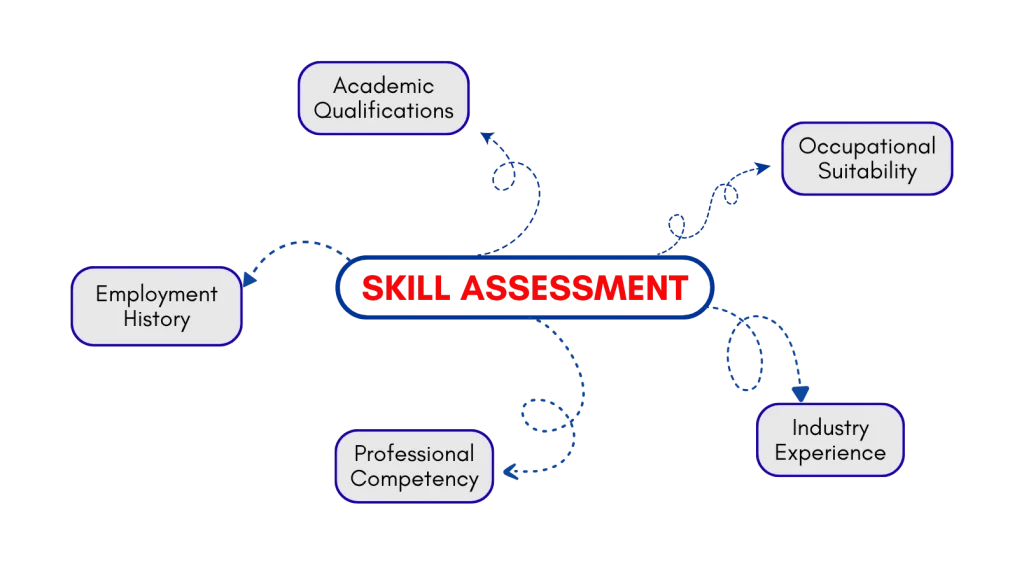
A Skills Assessment is an official assessment by an Australian assessing authority of your skills, work experience and professional competencies.
The main purpose is to establish if your education and work experience aligns with the requirements for your chosen occupation in Australia.
The majority of skilled visas require a skills assessment to be completed and passed.
For example:
Every authority will have its own assessment criteria.
The official application made to the Australian Government for the purpose of entering Australia to live, work or study is a Visa Application.
This is different to a skill assessment, which is handled by the Australian Department of Home Affairs.
The visa application takes into account the following:
The final decision on visas is at the discretion of the Department of Home Affairs.
Skills Assessment | Visa Application |
Evaluates qualifications and experience | Evaluates immigration eligibility |
Conducted by assessing authorities | Conducted by Department of Home Affairs |
Occupation-specific | Visa-specific |
Required before many skilled visas | Final immigration process |
Confirms professional competency | Grants legal permission to enter Australia |
Different authorities for different occupations | Single government immigration authority |
This is the most significant difference between Skills Assessment vs Visa Application.
Australia is keen to have migrants’ skills at a similar level to professional standards in Australia.
The assessment verifies:
For many skilled visas (subclasses), a favorable skills assessment is a prerequisite.
A visa application is the way in which you will know if you meet Australia’s immigration criteria.
You may still be refused a visa even if you have a positive skills assessment if you do not meet:
So both stages are as significant as each other.
There are typically several steps in the assessment process:
Choose the ANZSCO occupation that is most similar to your educational and job background.
All occupations have their own authorities.
Examples include:
Common documents include:
Upload documents and pay the assessment fee.
The authority may make:
One of the most frequent queries is:
Should I apply for Skills Assessment or Visa first?
The answer is simple.
For most of the skilled migration pathways:
If you don’t go through the assessment stage, you may not get invited.
After the Assessment, the migration process proceeds.
Provide your:
You will be invited if your points are competitive.
Submit:
Your eligibility is checked by immigration officers.
Possible outcomes include:
These are normally required:

There are other documents that are then included:
See that the application for a visa is much more extensive.
The processing times are dependent on the authority, subclass of the visa and the complexity of the case.
The processing period may take several weeks to a few months depending on the assessing authority and if further information is requested.
The processing of visas can take several months or longer, depending upon:
It is advisable that the applicant make sure to check the processing status of the application before making an application.
People with many of the skilled visas:
Examples include:
Usually, a positive skills evaluation is needed before one gets an invitation through these pathways.
But not all Australian visas will call for one.
Certain employer-sponsored visas or occupational visas (temporary visas) may have different requirements for different visas and occupations.
There are mistakes that many applicants make that could have been avoided and cause a delay in their application.
It is important to pick the right ANZSCO code, or else the visa could be rejected.
Reference letters that are general in scope and include no specific duties are sometimes not enough.
The application processing process often gets delayed when applications are incomplete.
One of the major misconceptions in the field of Skills Assessment vs Visa Application is this.
Even a positive evaluation only confirms your suitability to the job and organization. Does not guarantee visa approval.
It is the case that overstating work experience and qualifications could lead to refusal of a visa.


CDR reports, resumes, VETASSESS, and RPL applications can be challenging to prepare. Our team of professionals has effectively helped clients obtain approval with professional services that address all of these needs.
Help can be provided by professional migration document experts by:
Expert assistance for engineering professionals can enhance the quality and consistency of submission of a skills assessment, including Competency Demonstration Reports (CDRs).
Yes, for many skilled migration visas. The requirement varies according to your occupation and subclass of visa.
No. It merely verifies that you are qualified and have the necessary experience for the assessing authority. All immigration requirements still need to be met for your visa to be successful.
In many cases, yes. Some examining boards, however, may have English language requirements; please read the rules that apply to your occupation.
The validity period is subject to the assessment authority. Be sure your evaluation is current when you apply for a visa.
Applications for visas are processed and determined by the Australian Department of Home Affairs.
Get a free consultation today. Our engineers will assess your profile and tell you exactly what you need — at no cost, no commitment.

Expert CDR, ACS, and VETASSESS assessment writing service. 5,600+ documents written. 99% approval rate. Serving professionals from 65+ countries migrating to Australia. Free consultation available.
Disclaimer:
CDR Writers is an independent document preparation service. Not affiliated with EA, ACS, VETASSESS, IML, or any official authority.
Sun-Fri · 24 Hours a Day
Copyright © 2020 – 2026 CDR Writers
99% Success | Trusted in 65+ Countries | 4.9/5 Rated | 100% Secure Payments
