
Online

A NER Work Experience Statement is a comprehensive engineering CV that must be submitted to Engineers Australia as the initial and most important part of the process for applying to the National Engineering Register (NER). It proves that you have at least 5 years of experience in full-time equivalent (FTE) engineering work within the past 10 years, with at least 4 years in the last 10 years of post-graduate experience, and that you demonstrate all 5 professional competencies.
The statement needs to be reverse chronological, include all the responsibilities, key achievements, and challenges of each role in the paragraph, and identify two professional referees who can attest to your experience. The successful statement results in an interview by an assessor, and on successful completion, your statement is listed in the publicly searchable Engineers Australia NER database, meaning you can use the post-nominal NER after your name.


It is necessary to see the context before going down to the statement itself.
The National Engineering Register (NER) is a public register of Engineers Australia, maintained by the organization, and is a recognized authority of engineers who have reached professional competence, ethics, and experience requirements. The listing on the NER proves that you are a capable and professional engineering practitioner who complies with the Australian standards.
Registration of NER is commonly necessary for:
The most important part of this registration process is your NER Work Experience Statement.
Managed by Engineers Australia, Australia’s peak engineering body representing more than 140,000 members, the National Engineering Register (NER) is Australia’s publicly searchable database of qualified, practising engineers. The NER was introduced in 2015 and is a national framework of professional registration for:
Listed indicates that your qualifications, experience, ethics and professional development have been independently verified by Engineers Australia. The register is searchable by employer, engineering discipline or by location by the employer, government agencies or clients.

🏅
Mention the post-nominal NER following your name – and let your potential employers and clients know you are competent!
🔍
Your profile is added to a country-wide database that’s searchable and easier to find when you are being sought for high-value roles.
🏛️
Statutory registration is facilitated in Victoria (PER Act) and other jurisdictions via NER.
📈
A stepping stone to Chartered Engineer (CPEng) – the highest individual engineering qualification in Australia.
Engineers Australia made the NER available to members and non-members. The following must be met:
Possess a valid Engineers Australia-accredited engineering degree, OR a successful Engineers Australia Migration Skills Assessment (MSA), OR have an Engineers Australia membership competency assessment letter.
A minimum of five years of full-time equivalent engineering experience in your nominated area(s) of practice, of which at least four years is post-graduate experience, within the past 10 years.
Seminars, conferences, paper presentations, technical courses, etc. (at least 150 hours) in the past 3 years to showcase ongoing professional development.
Must show evidence of access to PI insurance coverage provided by your employer or by you (personal) for the time you are providing engineering services.
Must be Chartered Engineers, NER-listed engineers or engineers with 5+ years of post-graduate experience, and have worked with you in the past 5 years, and be familiar with your engineering practice in the area you’re applying for.
Take our free Eligibility Test — answer 5 quick questions about your engineering background, qualifications, and visa goals. We’ll identify your assessment body, ANZSCO code, and the exact documents required. Takes under 3 minutes.
Every NER Work Experience Statement is assessed against five competency areas, which are part of Engineers Australia’s Stage 2 Independent Practice assessment framework. You will need to include evidence for all 5 in your statement.
Competency | What it means | Evidence to include |
Deal with ethical issues | Make decisions about safety, persons or outcomes that are ethical and take responsibility for those decisions. | Tell about a project in which you had to address a cost, safety, or regulatory issue. Demonstrate the use of Engineers Australia’s code of ethics. |
Practise competently | Correctly use the appropriate knowledge, skills and tools to complete engineering work and solve complex problems. | Detailed project examples include technical problem-solving, use of standards, engineering calculations, and/or design decisions that resulted in measurable outcomes. |
Develop safe and sustainable solutions | Produce or make a contribution to solutions that are safe and promote sustainability. | Projects that you applied risk-informed design, applied Australian Standards, or put environmental performance requirements in. |
Identify, assess, and manage risks | Systematically identifying risks and putting in controls or strategies to mitigate risks in engineering work. | Documentation of hazard identification, FMEA, safety in design workshops, risk registers or critical incident analysis. |
Local engineering knowledge | Coordination and comprehension of Australian standards, codes, regulations and professional norms in your specialist practice. | Reference to Australian Standards (AS/NZS), National Construction Code (NCC), codes of practice or regulations from your jurisdiction in your work. |
The NER Work Experience Statement (also known as a WES) is an extended CV or work history document, submitted via the Engineers Australia member portal. This is the main evidence document you’ll use to be judged on your engineering career.
For an extended career, previous jobs can be combined or summarised. Pay attention to the five to seven years prior to the last.
Follow the SPACE method to make each job entry in the NER Work Experience Statement. All paragraphs should go through these five steps.
Explain the engineering context: size of project, client, geographic, regulatory, or technical complexity that set the stage for the challenge.
State the actual engineering problem, risk or opportunity encountered and what was involved technically, commercially and with regard to safety.
Describe what you did (not your team) – tools used, standards applied, calculations made, decisions made, stakeholders engaged.
Make clear the connection between actions and one or more of the 5 NER competencies. Do not assume that this is not implicit — it needs to be evident to assessors.
Where possible, measure the outcome in terms of cost saved, schedule improved, safety incidents avoided, efficiency gains or approval received. Numbers build credibility.
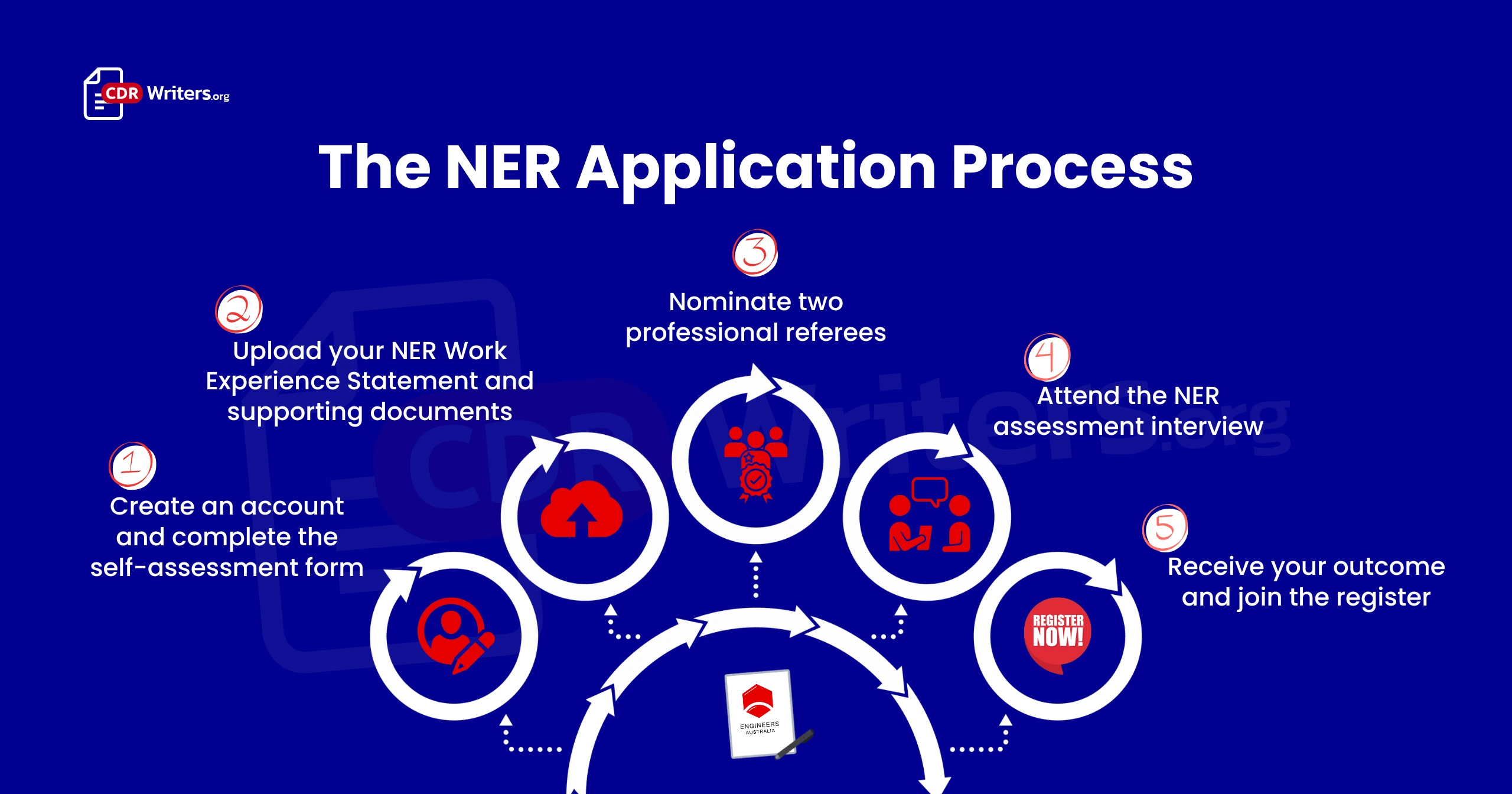
Log in or register to the Engineers Australia member portal. Fill in the online self-assessment form that indicates how well you meet each competency in the area of practice you selected. You are better off being honest — if you overclaim competency, there is a problem at the interview…
Submit the expanded CV (Work Experience Statement), CPD records (last 3 years), evidence of your qualification (Transcripts, Testamur or MSA outcome letter), PI Insurance confirmation and photo identification.
Be sure to include the names and contact information for two referees who adhere to EA’s guidelines. Engineers Australia will follow up on their own to confirm your experience prior to or during the assessment interview.
The statement will be assessed by a structured interview with a qualified Engineers Australia assessor, to confirm that the competencies and experience you are claiming are accurate. Be prepared for scenario-based, deeper questions regarding specific projects.
Upon success, you’ll be added to the NER and get a digital badge (on the Credly’s Acclaim platform) to post on LinkedIn and other professional social media networks. Registration is for a 1-year period and will need to be renewed on an annual basis.
All fees are GST inclusive and will be determined by Engineers Australia. Your NER listing must be renewed on an annual basis.
Applicant Type | Purpose | Fees (inclusive of AUD) GST) |
EA Member | Initial NER assessment + listing (for remainder of current year) | AU$335.50 |
Non-Member | Initial NER assessment + listing for rest of this financial year | AU$555.50 |
All Registrants | Annual renewal fee (after initial year) | AU$97.00 |
EA Member | Adding an additional area of engineering to existing NER | AU$395.00 |
There are about 27 distinct fields of practice that are recognised by Engineers Australia in the NER. Your Work Experience Statement should be focused on your nominated area(s). Common examples include:
Infrastructure, Roads, Bridges, Drainage, Geotechnical, Water supply.
Structural design, structures, structural analysis of loads, and foundation design.
Power systems, control systems, instrumentation, and HV/LV networks.
Mechanical, Rotating Equipment, Manufacturing Systems, HVAC.
Contamination, Waste Management, Environmental Impact Assessment.
Planning, executing, and managing engineering projects, programmes and procurement.
If you have more than one area of interest in your experience, you can apply for more than one area. Additional areas to an existing NER registration will cost AU$395 each.
NER registration is NOT a permanent one. To be on the register, you have to:
Engineers Australia carries out practice reviews and CPD audits. It is possible for engineers to be removed from the register if they do not meet the requirements for CPD and/or their ethical behaviour is not satisfactory.
NER registration is NOT a permanent one. To be on the register, you have to:
Your statement should be concise, well-organised, and competency-based in order to satisfy the expectations of Engineers Australia. The main components will be listed below:
Begin by telling a little about your work history, such as:
This provides a background to the assessor.
Definitely state your position in the company. Concentrate on the engineering-related duties instead of the administrative duties.
Examples include:
Describe the major projects that you were working on. For each project, explain:
It is in this section that you show your practical work in engineering.
Describe your use of engineering principles, standards, and methodologies in the course of your work. Engineers Australia does not want generic descriptions but evidence of critical thinking and of professional judgment.
The ethical decision-making, standard adherence, collaboration, and outcome accountability should be reflected in your statement.
CPD in a rolling 3-year period (around 50 hours per year).
Engineers Australia carries out practice reviews and CPD audits. It is possible for engineers to be removed from the register if they do not meet the requirements for CPD and/or their ethical behaviour is not satisfactory.


CDR reports, resumes, VETASSESS, and RPL applications can be challenging to prepare. Our team of professionals has effectively helped clients obtain approval with professional services that address all of these needs.
If writing a work experience statement is challenging for you, no need to worry. We offer NER writing services in Australia, and our experienced professionals have five years of expertise in crafting NER work experience statements (WES).
Our NER writing team has successfully written numerous statements that have received 100% approval. Don’t hesitate – contact our team now to receive professional assistance in creating your experience statement and ensure your registration on NER.
The following are the points that must be addressed when composing the NER statement.
The person registered with NER has demonstrated their technical skills in the specific areas mentioned in the “Evidence” section of this badge. They either have a recognized 4-year Bachelor’s Degree in Engineering or have been assessed by Engineers Australia to have qualifications of a similar standard.
Furthermore, they have a minimum of 5 years of relevant work experience at the Professional Engineer level (with exceptions for those with higher credentials). NER registrants are also required to meet Professional Development criteria, involving a minimum of 150 hours of relevant professional development activities over the last 3 years. This should highlight key achievements in their career.
They have also been rated as competent to the acknowledged standard of an independent practitioner, in terms of five competencies:
Furthermore, they are expected to follow Engineers Australia’s Code of Ethics and have their registration updated on a yearly basis to keep it valid. Once these prerequisites are met, NER registrants will be entitled to use the postnominal NER after their names. You can contact us and receive a free consultation on this.
The processing time for a points-tested visa can range from several months to over a year. Important factors that influence this duration include:
Due to the importance of planning in this process, consider collaborating with a registered migration agent who can guide you through the nuances of the PR application.
Professional written statements are time-saving, less stressful, and have a high chance of approval.
Get a free consultation today. Our engineers will assess your profile and tell you exactly what you need — at no cost, no commitment.

Expert CDR, ACS, and VETASSESS assessment writing service. 5,600+ documents written. 99% approval rate. Serving professionals from 65+ countries migrating to Australia. Free consultation available.
Disclaimer:
CDR Writers is an independent document preparation service. Not affiliated with EA, ACS, VETASSESS, IML, or any official authority.
Sun-Fri · 24 Hours a Day
Copyright © 2020 – 2026 CDR Writers
99% Success | Trusted in 65+ Countries | 4.9/5 Rated | 100% Secure Payments
