
Online

If you are an engineer looking to come to Australia via an engineering skills assessment, it is important to have a good competency application. The Summary Statement Guide is one of the most crucial yet overlooked parts of the application. It serves as the link between your career episodes and the competency elements that the assessing authority is looking for.
Numerous applicants spend weeks developing their career episodes but rush through the summary statement as if it is just an index or checklist. A poorly written summary statement, in reality, may lead to delays, requests for further information or even a failure to achieve a successful assessment result.
A Summary Statement is a document in which the competency elements needed by the assessment authority are aligned to examples and evidence in your career episodes.
The summary statement gives assessors a brief guide to where they can find evidence of each competency element in the career episodes they’re reviewing.
Consider the roadmap for assessors to follow through your application.
When you submit this question, you will include:
The structured method assists the evaluators in doing their evaluation more efficiently and accurately.
Applicants often overlook the importance of the summary statement because it is not as involved as the career episodes. But there is a tendency to look at the summary statement first before looking through the project description.
A good Summary Statement helps:
A poor summary statement, however, can lead to confusion and confusion for the assessor about where to find supporting details.
It is important to familiarize yourself with the competency elements that apply to your occupational category prior to writing your summary statement.
While the requirements for different engineering occupations may vary, competency elements typically encompass:
This section assesses your technical knowledge and engineering knowledge.
Examples include:
The competency area is about your use of the knowledge of Engineering in real-world contexts.
Examples include:
Your professional conduct and working skills are also judged during the assessments.
Examples include:
When it comes to mapping your experiences, it helps to have an understanding of these categories.
One of the common pitfalls is beginning the summary statement before completing the career episodes.
The suggested procedure is:
This sequence eliminates inconsistencies and omissions of references.
The first part of this Summary Statement Guide is to examine the competency standards in detail.
Many candidates are merely copying of competency wording without knowing what the assessors are looking for.
If the competency requires evidence of problem-solving skills, assessors would expect to see:
It is important to know what is intended by each competency.
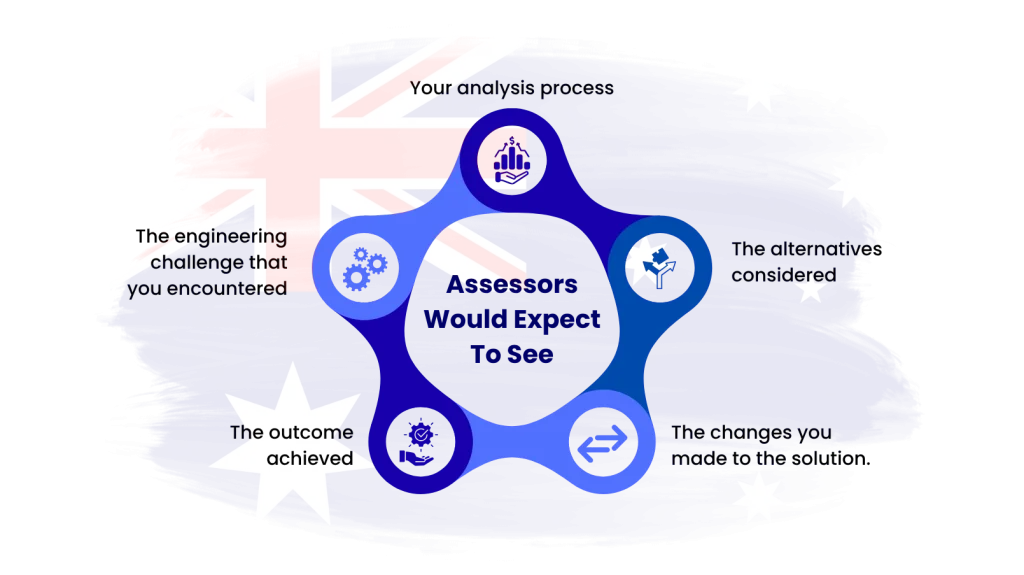
It is important to know what is intended by each competency.
One of the most essential requirements is that the paragraphs have to be numbered.
A typical numbering system could be:
For the second episode of his career:
And for the third:
These references enable an assessor to easily find evidence for each competency claim.
If you don’t number your summary statement, then you don’t have one.
For each competency requirement, ask:
Competencies could appear in more than one Career Episode.
For example:
Communication skills could be included in:
It’s best to have several references for reinforcement.
The largest errors that applicants make are their lengthy descriptions.
The summary statement is not a new career experience.
Instead of writing:
I have engaged in many engineering projects and worked with various stakeholders and provided technical information.
Write:
Coordinated with multidisciplinary teams and presented technical information to project stakeholders.
Be precise and succinct with explanations.
Accuracy is essential.
Your summary statement may include CE2.8, but the evidence in your portfolio may be found in CE2.9. This could make for a confusing experience with the assessor.
Always verify:
The careless use of numerals can undermine a highly good application.
The writing of the Competency Descriptions in their entirety.The exact wording of the Competency Descriptions.
This is a very little understanding of the requirement.
Rather, tell about how YOU showed the competency.
Do not use language that is ambiguous, for example:
There is no evidence to support these statements.
Instead write:
Specific examples are always better.
The assessment authorities are assessing the individual’s competency not the organisation’s.
Avoid:
Our team was responsible for the design of the control system.
Use:
“Designed control logic and set up control algorithms for system operation.
The use of first person language increases the sense of ownership of achievements.
A lack of one competency can impact the overall assessment result.
Make a checklist and ensure that there is evidence for all the competency elements.
The wrong references create a negative impression towards assessors and poor application.
Always review before submission.
Don’t just say what activities happen; discuss outcomes and results.
For example:
Results give evidence of competency that is measurable.
Using strong verbs is a great way to make your writing more readable and professional-sounding.
Examples include:
You are definitely showing your involvement in these words.
Ensure consistency across:
Variance could lead to uncertainties during evaluation.
Having a lot of technical detail is important, but too much can diminish in clarity.
Your summary statement should be short and straightforward.
Keep in mind that it is meant for navigation and not technical information.
Where possible, use more than one project as a reference.
This demonstrates to evaluators that you possess the skills necessary to go beyond a single project or job.
For example:
This will provide a more even application.
Competency Requirement:
The use of an engineering approach to solve complex problems.
Weak Mapping:
Worked to solve engineering problems.
Strong Mapping:
Conducted investigative equipment failure investigations, used root cause analysis, and correctly maintained the equipment that minimized repeat failures.
The second example definitely shows competency and impact.

Typically, the summary statement is written as a guideline for your career episodes to be reviewed by assessors.
They follow a general procedure that involves:
A good summary statement will make this easier and give a favourable impression.
Career episodes should complement the summary statements and not stand alone.
Career Episodes answer:
“What did you do?”
Summary Statements answer:
What supports does each competency have?
The summary statement does not work without good career episodes.
Great career episodes may not be given the credit they deserve if they don’t come across a strong statement.


CDR reports, resumes, VETASSESS, and RPL applications can be challenging to prepare. Our team of professionals has effectively helped clients obtain approval with professional services that address all of these needs.
Before applying, check the following:
The final review is an excellent way to enhance quality overall.
A summary statement is much more than an administrative requirement. It’s one of the most important sections of your engineering competency application, and a key element to the evaluators’ understanding of your experience.
A good summary statement shows professionalism, attention to detail, and knowledge of competency requirements. If you clearly and accurately identify which parts of your experience meet the criteria for the scholarship, provide specific details, and emphasize your own contributions, you can make a significant impact on the quality of your application.
This Summary Statement Guide serves as the baseline for a clear, accurate, and convincing document to assist in your engineering career objectives in Australia. Drafting a well-crafted summary statement can be the key to a great application and a great assessment result.
Get a free consultation today. Our engineers will assess your profile and tell you exactly what you need — at no cost, no commitment.
Expert CDR, ACS, and VETASSESS assessment writing service. 5,600+ documents written. 99% approval rate. Serving professionals from 65+ countries migrating to Australia. Free consultation available.
Disclaimer:
CDR Writers is an independent document preparation service. Not affiliated with EA, ACS, VETASSESS, IML, or any official authority.
Sun-Fri · 24 Hours a Day
Copyright © 2020 – 2026 CDR Writers
99% Success | Trusted in 65+ Countries | 4.9/5 Rated | 100% Secure Payments
