
Online

The Stage 1 Competency Assessment is a crucial part of the migration process for internationally qualified engineers who wish to migrate to Australia. This assessment is administered by Engineers Australia and provides an assessment of an applicant’s knowledge, skills and competencies to determine if they have the attributes required of a graduate engineer, engineering technologist, engineering associate or engineering manager in Australia.
When applying for a migration, many engineers’ applications are delayed, require further information, or are outright rejected because of avoidable mistakes in the assessment process, despite the thousands of applications received each year. It is important to know these errors before they happen and help you make the most of your chances of coming up with a good result.
The Stage 1 Competency Assessment aims to determine if an engineer has the competency required by Engineers Australia. The evaluation for the applicants is done in terms of their educational qualifications, technical knowledge, problem-solving potential, professional ethics, communication skills and engineering practice.
Assessment pathway is different for each applicant based on educational background and country of education. Some candidates are qualified by an accredited qualification; others may be required to prepare a Competency Demonstration Report (CDR) or other supporting documents.
In either case, there is attention to detail that must be observed during the application process.
Even the best engineers can find themselves in trouble when the application documentation is seriously lacking or not well done. The following may be the consequences of small errors:
If applicants are aware of the mistakes that are made during the stage 1 competency assessment, they can avoid making them and have a higher chance of success.
A common error is the wrong occupational type and engineering field.
There are a number of categories available with Engineers Australia, such as:
Sometimes, candidates choose a category not in terms of a qualification, but on the job title.
The candidate with an engineering technology degree, for instance, might apply as a PE, but may lack competence on the assessment process, for example.
How to Avoid This Mistake
One of the top reasons for assessments to be delayed is incomplete documentation.
Some missing documents are:
Just a single document missing can lead to requests for further information, which can add a lot of time to the processing.
How to Avoid This Mistake
Have a detailed list of documents to submit and ensure that all necessary paperwork is submitted in the proper format.
Some of the most significant Stage 1 Competency Assessment Mistakes for applicants pursuing the CDR pathway include weak Career Episodes or Summary Statements.
Common issues include:
Assessors are interested in what you and your engineering decisions have accomplished, not in your company’s or project team’s accomplishments.
How to Avoid This Mistake.
Focus on:
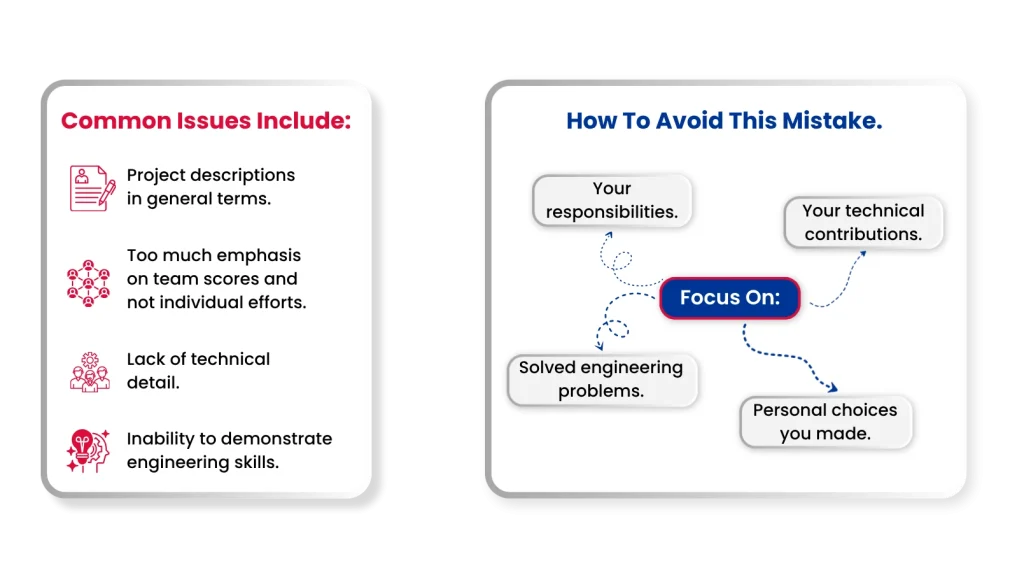
Avoid using second or third person verbs like “he/she designed,” “they analyzed,” “it implemented.
Plagiarism is one of the worst mistakes an applicant can make.
There is always a temptation to add content to their essays that has been copied from:
Engineers Australia employs cutting-edge plagiarism detection software to detect plagiarised material.
A plagiarised report may lead to rejection of the report and impact future applications.
How to Avoid This Mistake
The Summary Statement serves as a connection between Career Episodes and competency elements.
Many candidates just copy parts of their reports without mapping competencies to evidence.
This makes it difficult for evaluators to understand and diminishes the overall application.
How to Avoid This Mistake
Make sure all of the competency elements are clearly supported by the appropriate paragraphs in your Career Episodes.
The mapping should be precise, coherent and verifiable by the assessors.
Engineers Australia regularly reviews assessment requirements, templates and expectations of documents on an annual basis.
The information on the applications may be obsolete and the applications may not meet current requirements.
Examples include:
How to Avoid This Mistake
When you are applying for a migration visa, be sure to read the most up-to-date Migration Skills Assessment guidelines.
Documenting employment is important to competency claims.
Common problems include:
Work experience may be discounted if it is not properly documented.
How to Avoid This Mistake
Completing an employment reference should include:
Many applicants neglect to include documentation of English proficiency.
Late test results or sub-optimal minimums could be a delay to the assessment process.
Common English exams consist of:
How to Avoid This Mistake
Another large problem is a high level description of a project with too little engineering detail.
Technical competency is assessed, not project summaries.
For example, writing:
I did an electrical installation project.
provides very little evidence of engineering capability.
Rather, applicants are required to describe:
How to Avoid This Mistake
Use measurable outcomes and technical evidence of engineering competence.
The art of engineering is problem-solving.
Many applicants put too much emphasis on mundane activities and don’t demonstrate analytical skills.
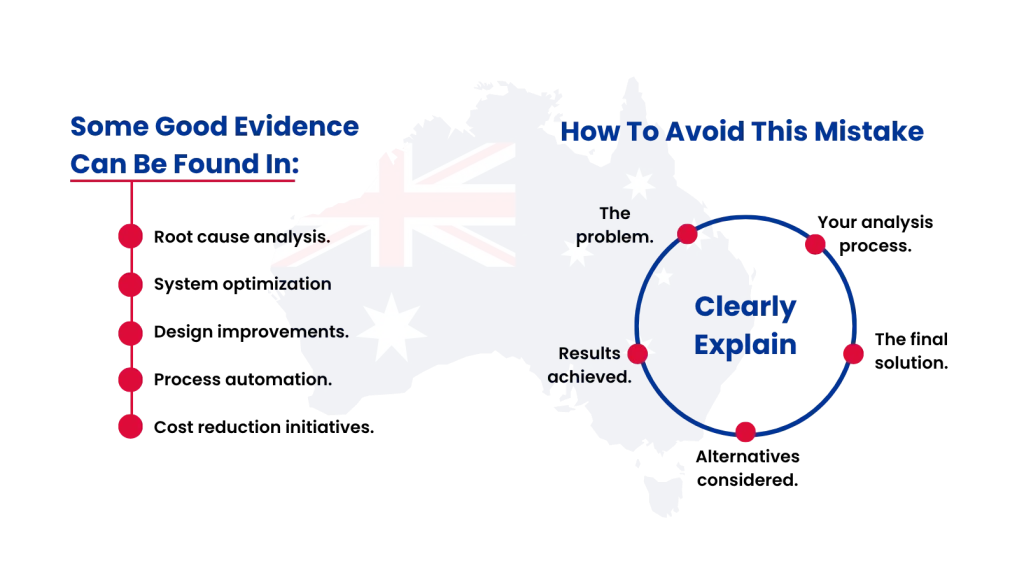
Some good evidence can be found in:
How to Avoid This Mistake
Clearly explain:
Assessment can be problematic if there is inconsistency.
Common inconsistencies include:
There may be requests for clarification made if there are minor discrepancies.
How to Avoid This Mistake
Double-check all documents for accuracy before submitting.
When creating a timeline, follow this one up to make sure it is consistent.
Professional presentation matters.
Formatting problems in applications may make them look hurried and unprofessional.
Examples include:
Follow a uniform structure for the application and label all files.
The time required to prepare an application for Stage 1 Competency Assessment will vary.
Many engineers underestimate the effort of:
You can’t rush a job.
How to Avoid This Mistake
Begin preparations months in advance of the intended migration period.
By making preparations early, revisions and quality checks can be made.
There are some applications when complicated situations arise, like:
Handling a complex case without an expert can lead to more mistakes.
How to Avoid This Mistake
If your case needs specialist support, please seek advice from specialists in migration or CDR.
Professional advice can save time, ease stress, and enhance the quality of submissions.
To maximize your chances of success:
Before starting the process, please read all the official guidelines.
It must be authentic and detailed.
Make sure that all the information is consistent across all documents.
Perform several reviews to ensure that errors and omissions are discovered.
Keep employment papers, project documentation, and certificates organized.


CDR reports, resumes, VETASSESS, and RPL applications can be challenging to prepare. Our team of professionals has effectively helped clients obtain approval with professional services that address all of these needs.
For engineers seeking to enter professional career paths and migration in Australia, Stage 1 Competency Assessment is a key milestone. Although the process may seem difficult, most failures are attributed to preventable errors, not to technical shortcomings.
Recognizing and avoiding these common Stage 1 Competency Assessment Mistakes can help applicants present stronger applications, minimize application processing time, and enhance the likelihood of a positive application assessment result.
Assessment applications encompass accurate documentation, original technical content, competency mapping, and strict adherence to assessment guidelines. With a little preparation time and knowledge of the common pitfalls mentioned in this guide, engineers can take a step forward towards their Australian migration goals with confidence.
If you are getting ready to fill out your application, it will be worth it to be proactive now to avoid a lot of time, money, and hassle down the road.
Get a free consultation today. Our engineers will assess your profile and tell you exactly what you need — at no cost, no commitment.
Expert CDR, ACS, and VETASSESS assessment writing service. 5,600+ documents written. 99% approval rate. Serving professionals from 65+ countries migrating to Australia. Free consultation available.
Disclaimer:
CDR Writers is an independent document preparation service. Not affiliated with EA, ACS, VETASSESS, IML, or any official authority.
Sun-Fri · 24 Hours a Day
Copyright © 2020 – 2026 CDR Writers
99% Success | Trusted in 65+ Countries | 4.9/5 Rated | 100% Secure Payments
