
Online

An ACS RPL (Recognition of Prior Learning) report is a Skills assessment document that ICT professionals submit to the Australian Computer Society to demonstrate the skills and work experience are aligned with an ANZSCO occupation code. To write one, you must have a Key Areas of Knowledge document, a project-based Summary Statement that references your ANZSCO unit group, employer references, and 100% original content that does not include plagiarism detection by ACS.

When an applicant does not have a specific degree closely related to the nominated occupation in ICT, the Australian Computer Society (ACS), which is the authority for assessing ICT skilled migration to Australia, will use the ACS RPL report. RPL is designed to recognise that your work experience and/or self-directed learning is equivalent to an accredited qualification in ICT, rather than relying solely on formal qualifications.
It is most often requested when applying for:
If your degree is not ICT-based, or is only “closely related”, then ACS may request a RPL report as proof of the additional experience-based competency.
There are four key components to a complete RPL submission. The most common cause of application rejection and resubmission for additional information is missing or weak sections.
The following is a list of ICT knowledge areas relevant to your nominated ANZSCO occupation, such as Software Engineer, Developer Programmer, ICT Business Analyst. The following tasks are required: you must be able to recognize approximately 6 knowledge areas from ACS’s syllabus and briefly explain the process of acquiring each of these areas (work, training or self-study).
This is the meat of the RPL report. This is a table in which each row corresponds to one of the ICT skills or knowledge points, and there’s a short paragraph that describes the way that skill was used in the project. ACS is looking for specifics and that first-person account — not job descriptions.
Use a mini STAR format for each entry:
Employer’s (or statutory) declaration of your job title, role, working hours, dates of work, etc (formal letters). These should support the projects you outlined in your .Summary Statement
An official degree certificate, transcript and any necessary certification (from the school, notary public or the Justice of the Peace)
All of the information in your report should relate to the skill criteria for your selected ANZSCO unit group (such as 261313 Software Engineer). Before writing, download the official ACS skills list for that code.
Select knowledge areas that actually relate to the work you do and don’t make up anything that you can’t explain in the Summary Statement.
Identify and select 3-6 actual projects over your career that demonstrate all the listed knowledge areas. Recent technically more substantial projects are more important than old or superficial projects.
Most applicants fail here. Every report is run by ACS through plagiarism-detection software (Turnitin-like). Commonly looked-for templates from migration agents or online forums are automatically rejected.
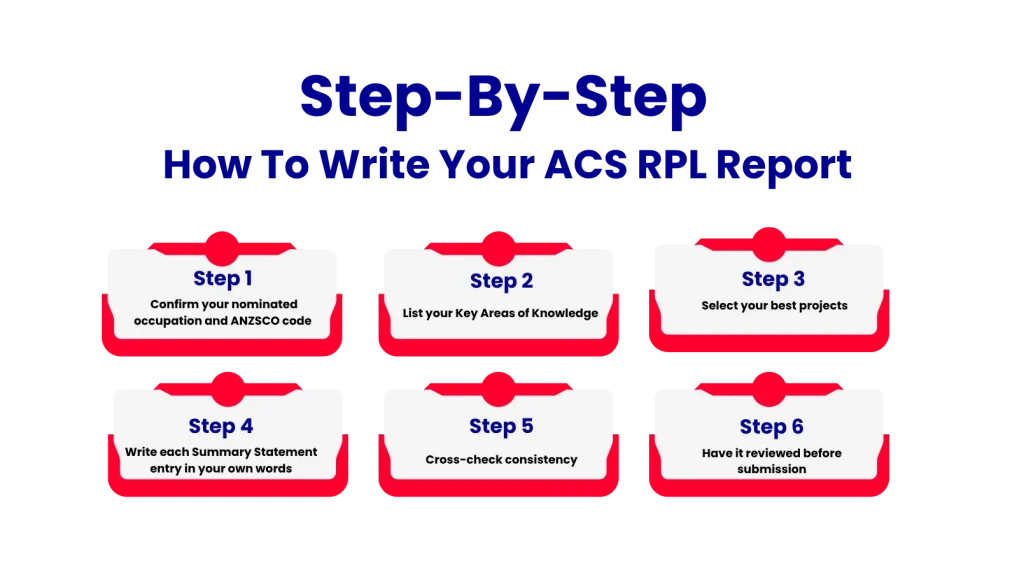
Use first-person voice; be specific about your personal contribution (not the team did); include real technical detail (tools, frameworks, architecture decisions, problem-solving steps).
The dates, job titles and responsibilities in your Summary Statement, CV and references from your employer should all be the same. One of the most frequent reasons for ACS to ask for more evidence is when there are inconsistencies.
A second pair of eyes ( preferably someone who is familiar with what ACS is assessing in their knowledge areas) can see gaps between your claimed knowledge area and your actual project descriptions.


CDR reports, resumes, VETASSESS, and RPL applications can be challenging to prepare. Our team of professionals has effectively helped clients obtain approval with professional services that address all of these needs.
Each project entry should be approximately 300 – 500 words in length and the entire Summary Statement should be 3,000 – 5,000 words for all knowledge areas of all projects.
Yes. ACS utilizes plagiarism-detection software to check for plagiarism in submitted reports against other submitted reports and the Internet. Content that is re-used or templated is a top reason for rejection.
Yes, but if the project really shows the knowledge area(s) and is specific and detailed for each.
ACS may request further information, request resubmission or provide a negative assessment. A negative evaluation is usually subject to appeal or re-evaluation on the basis of increased evidence.
Get a free consultation today. Our engineers will assess your profile and tell you exactly what you need — at no cost, no commitment.
Expert CDR, ACS, and VETASSESS assessment writing service. 5,600+ documents written. 99% approval rate. Serving professionals from 65+ countries migrating to Australia. Free consultation available.
Disclaimer:
CDR Writers is an independent document preparation service. Not affiliated with EA, ACS, VETASSESS, IML, or any official authority.
Sun-Fri · 24 Hours a Day
Copyright © 2020 – 2026 CDR Writers
99% Success | Trusted in 65+ Countries | 4.9/5 Rated | 100% Secure Payments
